ASPHER Competency Framework Explained for Public Health Students
Understand the ASPHER Competency Framework in simple terms. Learn the 6 public health domains with practical PHC examples tailored for Miva Public Health students.

If you are a Public Health student at Miva Open University, you’ve probably seen the term ASPHER Competency Framework in your practicum manual.
But what does it actually mean?
And more importantly, how does it apply to your daily activities at a Primary Health Care (PHC) centre?
This guide explains the six ASPHER competency domains in simple language, with practical examples you are likely to experience during your practicum.
PHC Practicum Logbook Made Easy
If you want to save hours and avoid formatting mistakes, you can use the AI-powered MIVA Logbook (PHC) tool by MonoEd.
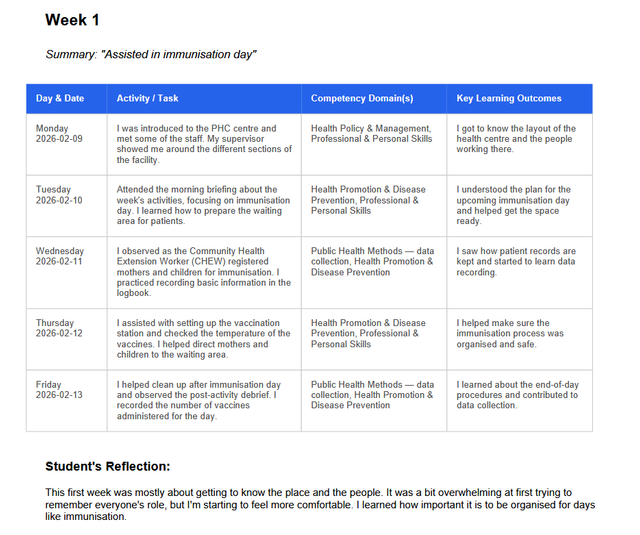
Just describe your week (for example: “Assisted with immunisation and updated ANC records”) and it automatically generates:
- Structured Monday–Friday entries
- Correct ASPHER competency tagging
- Professional learning outcomes
- Weekly reflections
- A clean PDF ready for submission
You can start here:
👉 https://phc-logbook.monoed.africa/
Prefer doing it manually? Let’s break it down step-by-step.
What Is the ASPHER Competency Framework?
The ASPHER framework was developed by Association of Schools of Public Health in the European Region to define the core skills every public health professional should have.
Your practicum is structured around these competencies to ensure that you are not just observing, but developing professional public health skills.
There are six key domains:
- Public Health Methods
- Population Health & Determinants
- Health Policy & Management
- Health Promotion & Disease Prevention
- Ethics, Values & Human Rights
- Professional & Personal Skills
Let’s break them down one by one.
1. Public Health Methods
This domain focuses on data and evidence.
In simple terms, it means learning how public health decisions are based on proper data collection and record keeping.
What It Looks Like at a PHC Centre
- Filling outpatient registers
- Recording antenatal care visits
- Updating immunisation registers
- Assisting with weekly or monthly data reports
- Learning how statistics are compiled
Why It Matters
Without accurate data:
- Disease trends cannot be tracked
- Vaccination coverage cannot be measured
- Health planning becomes unreliable
If you can correctly complete registers and understand basic reporting, you are demonstrating competence in Public Health Methods.
2. Population Health & Determinants
This domain looks beyond the hospital.
It focuses on how social, economic, environmental, and cultural factors influence health.
What It Looks Like in Practice
- Observing poor sanitation in a community
- Noticing lack of clean water supply
- Seeing how poverty affects access to care
- Identifying overcrowded living conditions
For example:
If many children present with diarrhoea, you might link it to unsafe water sources.
That connection shows you understand population health determinants.
3. Health Policy & Management
This domain focuses on how the health system is organized and managed.
At PHC level, this includes understanding:
- National immunisation programmes
- Antenatal care guidelines
- Malaria control programs
- How the PHC is structured under local government
What You Might Observe
- How vaccines are supplied and stored
- How clinic days are scheduled
- How reports are sent to the Local Government Health Department
- How ward health committee meetings are conducted
Understanding how policies are implemented at ground level shows competence in this domain.
4. Health Promotion & Disease Prevention
This domain is about preventing illness before it starts.
Examples at PHC
- Delivering a health talk on hand washing
- Educating mothers on exclusive breastfeeding
- Explaining the importance of immunisation
- Supporting malaria prevention campaigns
If you conduct even one structured health talk during your practicum, you are actively demonstrating this competency.
5. Ethics, Values & Human Rights
This domain focuses on professionalism and respect.
What It Means Practically
- Keeping patient information confidential
- Treating all patients equally
- Respecting cultural differences
- Showing empathy during antenatal visits
- Maintaining professional boundaries
For example:
You should never share patient details outside clinical discussions.
Ethical behaviour is not optional. It is a core public health competency.
6. Professional & Personal Skills
This domain focuses on how you function as a professional.
It includes:
- Teamwork
- Communication
- Time management
- Initiative
- Reflective practice
Examples During Practicum
- Participating in staff meetings
- Communicating clearly with patients
- Arriving on time consistently
- Taking initiative during outreach
Your preceptor observes these skills daily.
Why Understanding ASPHER Matters for Your Practicum
Your logbook entries, reflections, and final report must link activities to these domains.
Instead of writing:
“I assisted in immunisation today.”
You should write:
“Assisted in immunisation session, ensuring accurate vaccine documentation (Public Health Methods) and delivering health education on vaccine benefits (Health Promotion & Disease Prevention).”
That shows structured thinking aligned with the competency framework.
💡 Read on: How to Fill Miva Open University Public Health Practicum Logbook (Without Stress)
How to Use ASPHER Domains in Your Logbook
When writing weekly entries:
- Identify what you did
- Ask which competency it relates to
- Mention it clearly
- Reflect on what you learned
This makes your documentation stronger and improves your practicum score.
PHC Logbook Made Easy?
Let’s be honest.
Writing 8 to 12 weeks of structured entries manually is time consuming.
Instead of:
- Guessing competency domains
- Rewriting similar activities
- Formatting tables repeatedly
You can summarize your week in a few sentences and let an AI tool structure everything correctly.
The PHC Logbook Generator at
👉 https://phc-logbook.monoed.africa/
Generates:
- Daily entries
- ASPHER domain tagging
- Learning outcomes
- Weekly reflection
- Downloadable PDF
It is designed specifically for Miva Public Health students, so the format aligns with your practicum requirements at Miva Open University.
If your goal is to maximize that 20% logbook score without last minute stress, this can save you hours and possibly your grade.
Conclusion
The ASPHER Competency Framework is not just theory. It is a guide to becoming a competent public health professional.
At Miva Open University, your practicum is structured to ensure that you gain exposure across multiple domains.
If you understand these six areas clearly:
- Your logbook becomes easier to structure
- Your reflections become more analytical
- Your final report becomes stronger
- Your overall practicum score improves
Master the framework, and you master your practicum.
FAQs
Is it compulsory to cover all six ASPHER domains?
Students are expected to gain exposure in at least four domains during placement.
Can one activity fall under multiple domains?
Yes. For example, immunisation work can relate to Public Health Methods, Health Promotion, and Health Policy.
Do I need to mention the domains in my logbook?
Yes. Proper tagging shows you understand the competency framework.
Why is ASPHER important for future careers?
The competencies reflect international public health standards and prepare you for professional practice and postgraduate study.
About the Author
Mohammad-Jamiu B. Balogun, GMNSE
AI Security Researcher · Founder, MonoEd Africa
Mohammad-Jamiu is a First-Class Telecommunications Engineer and Best Graduating Student (BUK), and an AI security researcher. He founded MonoEd Africa to give Nigerian students AI-powered academic tools — from SIWES logbooks to final year projects. His work has reached over 10,000 students across Nigeria.