Best AI Tools for Writing Research Papers in 2026 (Compared by What They Actually Do)
Looking for the best AI tools for writing research papers? Compare the top AI research assistants for literature review, drafting, citations, editing, and complete manuscript writing in 2026.

Quick Summary
The best AI tool for writing a research paper depends on your stage of the research process. Elicit, Consensus, and SciSpace are excellent for discovering and understanding academic literature. Grammarly and Paperpal help improve writing quality. PaperDraft is designed for researchers who already have their topic, data, or references, and want to turn them into a properly structured manuscript with real citations.
The most effective approach is not choosing the AI with the most features, but choosing the one that solves your biggest bottleneck.
Best AI Tools for Writing Research Papers in 2026
AI has changed academic writing dramatically. Researchers can now search millions of papers, summarize complex studies, improve their writing, and generate early drafts in minutes.
However, there is no single AI tool that does everything perfectly.
Some tools are great at finding papers. Others help you understand PDFs. Some improve grammar and academic tone. Others assist with turning your research materials into a complete manuscript.
The challenge is choosing the right tool for the right part of the workflow.
In this guide, we compare the best AI tools for writing research papers in 2026, including their strengths, limitations, and who they are best suited for.
How We Evaluated These AI Research Tools
We compared each tool based on the tasks researchers actually perform:
- Finding relevant academic papers
- Understanding and summarizing literature
- Organizing references
- Creating outlines
- Writing manuscript sections
- Managing citations
- Improving language and clarity
- Supporting academic workflows
No tool is best in every category. The right choice depends on whether you are starting a literature review, drafting a journal paper, or preparing a final submission.
1. PaperDraft
Best for: Turning your references and research data into a complete manuscript
Many AI writing tools start with an empty chat box and ask you what you want to write.
The problem is that research papers require a structured process. You need relevant sources, discipline-specific sections, your own methods and results, and accurate citations.
PaperDraft takes a workflow approach.
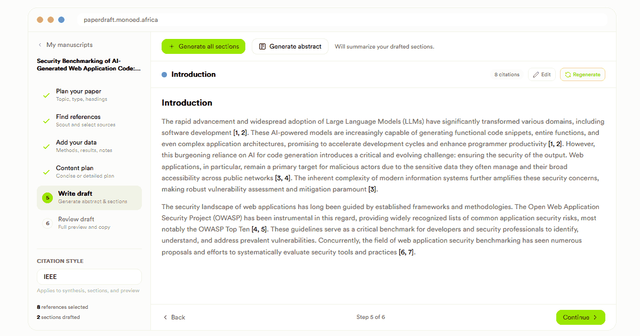
Instead of asking AI to invent a paper from scratch, you:
- Choose your research topic and paper type
- Search and select real academic references
- Add your own methods, results, and notes
- Generate a structured content plan
- Write sections with citations connected to your selected papers
- Switch between APA, IEEE, Harvard, Chicago, MLA, and Vancouver styles
- Export to Word, Markdown, LaTeX, or BibTeX
Pros
- Uses references selected by the researcher
- Helps reduce fake citation problems
- Supports different research structures depending on discipline
- Keeps citations, manuscript sections, and research data together
- Allows switching citation styles instantly
Cons
- Not designed as a broad-purpose AI chatbot
- Requires researchers to provide their own data and research direction
Best for:
- Scholarship applications
- Thesis to journal article conversion
- Journal manuscript drafting
- Researchers who need structured writing workflows
2. Elicit
Best for: Literature reviews and finding evidence
Elicit is one of the strongest AI tools for academic literature discovery.
Researchers can ask research questions and receive relevant papers, summaries, and structured information such as methods and findings.
Pros
- Excellent for discovering research papers
- Extracts information from multiple studies
- Helpful for literature review preparation
Cons
- Not focused on writing complete manuscripts
- Requires another workflow for turning research into a finished paper
3. Consensus
Best for: Getting evidence-backed answers from research papers
Consensus works like an academic search engine powered by AI.
It helps researchers understand what published evidence says about a specific question.
Pros
- Fast evidence discovery
- Simple research question search
- Shows scientific consensus on many topics
Cons
- Not a complete writing tool
- Limited support for creating a full manuscript
4. SciSpace
Best for: Reading and understanding research papers
SciSpace helps researchers interact with PDFs, ask questions about papers, and understand difficult concepts.
Pros
- PDF chat capabilities
- Helps explain complex papers
- Useful for literature exploration
Cons
- Manuscript writing is not its main strength
- Researchers may still need separate writing tools
5. Jenni AI
Best for: AI-assisted academic drafting
Jenni AI focuses on helping users overcome writer's block and draft academic content.
It can assist with creating paragraphs and developing ideas while maintaining an academic writing style.
Pros
- Easy drafting experience
- Helpful for brainstorming
- Designed specifically for academic writing
Cons
- Researchers still need to carefully verify generated content
- Less focused on a complete research workflow
6. Paperpal
Best for: Academic editing and language improvement
Paperpal focuses on improving grammar, clarity, style, and journal readiness.
It is especially useful after you already have a draft.
Pros
- Strong academic language suggestions
- Helps improve readability
- Useful during the final editing stage
Cons
- Not built primarily for research planning or complete manuscript generation
7. Scite.ai
Best for: Checking research evidence and citations
Scite helps researchers understand how papers have been cited by other scholars.
It can show whether a study has been supported, contrasted, or simply mentioned by later research.
Pros
- Helps evaluate scientific evidence
- Improves confidence in citations
- Useful for literature evaluation
Cons
- Not designed for writing research papers from start to finish
8. Grammarly
Best for: Grammar and clarity improvements
Grammarly remains one of the most widely used writing assistants.
It is useful for fixing grammar, improving sentence clarity, and refining the final manuscript.
Pros
- Easy to use
- Good grammar correction
- Helps improve readability
Cons
- Does not perform academic research
- Cannot create a complete research workflow
Comparison Table
| Tool | Best For | Main Limitation |
|---|---|---|
| PaperDraft | Complete research drafting workflow | Not a general AI chatbot |
| Elicit | Literature reviews | Not built for full manuscript writing |
| Consensus | Research discovery | Limited writing features |
| SciSpace | Understanding papers | Not a complete writing workflow |
| Jenni AI | Drafting assistance | Requires careful review |
| Paperpal | Academic editing | Comes after the draft stage |
| Scite.ai | Citation evaluation | Not a writing assistant |
| Grammarly | Grammar improvement | Not a research tool |
Which AI Tool Should You Choose?
Choose Elicit, Consensus, or SciSpace if your biggest challenge is finding and understanding research papers.
Choose Grammarly or Paperpal if you already have a draft and need to improve its quality.
Choose Jenni AI if you mainly need help overcoming writer's block and creating early drafts.
Choose PaperDraft if your challenge is moving from a research idea, selected references, and your own data into a structured manuscript with proper citations and formatting.
Many researchers may even use several tools together. For example, you might discover literature with Elicit, evaluate evidence with Scite, and draft your final manuscript using PaperDraft.
Is There One AI Tool That Can Write an Entire Research Paper?
The honest answer is no.
High-quality academic writing still requires your expertise, your research questions, your methodology, your results, and your interpretation.
The best AI tools do not replace researchers. They remove repetitive work such as searching, organizing, formatting, and drafting so researchers can spend more time thinking critically about their work.
Conclusion
The best AI research tool depends on where you struggle in the writing process.
If you need to find papers, use a literature discovery tool. If you need better grammar, use an editing assistant.
But if your biggest challenge is turning your topic, research data, and maybe references into a properly structured manuscript with real citations, a research-focused workflow tool like PaperDraft may save you the most time.
You can try PaperDraft for free, select your references, generate your first sections, and see how a guided research writing workflow compares to a general AI chat interface.
FAQs
What is the best AI tool for writing research papers?
There is no single best tool for everyone. Elicit and Consensus are excellent for literature discovery, Paperpal is strong for editing, and PaperDraft focuses on transforming selected references and research data into a structured manuscript.
Is ChatGPT good for writing research papers?
ChatGPT can help with brainstorming, explaining concepts, improving writing, and creating outlines. However, researchers should carefully verify citations and factual claims because general AI chat tools may produce inaccurate references.
Which AI tool gives real citations?
Tools that connect writing to academic databases or allow researchers to select their own references are generally more reliable for citations. Researchers should still verify all references before submission.
Can AI write a publishable journal article?
AI can assist with outlining, drafting, editing, and improving language, but a publishable paper still requires original ideas, accurate data, appropriate methodology, and human review.
Should students use AI for academic writing?
AI can be a useful research assistant when used responsibly. Students should follow their institution's policies, verify information, and ensure that their final work reflects their own understanding and research.
About the Author
Mohammad-Jamiu B. Balogun, GMNSE
AI Security Researcher · Founder, MonoEd Africa
Mohammad-Jamiu is a First-Class Telecommunications Engineer and Best Graduating Student (BUK), and an AI security researcher. He founded MonoEd Africa to give Nigerian students AI-powered academic tools — from SIWES logbooks to final year projects. His work has reached over 10,000 students across Nigeria.