How to Avoid Plagiarism in Your Final Year Project in Nigeria A Simple Guide for Students
Learn how to avoid plagiarism in your Nigerian final year project with clear steps on citing sources, paraphrasing, quoting, note taking, and using plagiarism checkers. Includes examples, tips, and common mistakes to avoid.
Plagiarism is one of the quickest ways to get your project flagged, rejected, or scored down. Nigerian universities take academic honesty seriously, so understanding how to write a clean, original project is non negotiable.
The truth is simple. You cannot write a full final year project from scratch without referencing other authors. Every good student builds ideas from existing studies but credits them properly. What gets you in trouble is failing to acknowledge those sources.
This guide breaks everything down in a simple way so you can avoid plagiarism completely and write a strong, credible undergraduate project.
📙 Final Year Project Tools 🔥
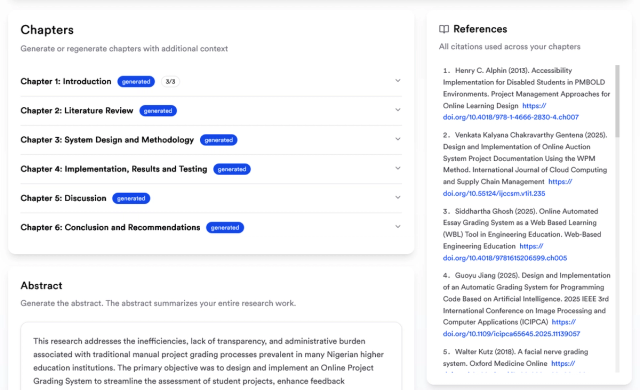
FYP Report Generator — Generate full project chapters and citations.
https://fyp.monoed.africa
Project Topic Generator — Get supervisor-ready project topics instantly.
https://topics.monoed.africa
What Counts as Plagiarism in a Nigerian Final Year Project
Many students think plagiarism only means copying word for word. It is more than that. These actions are also considered plagiarism:
• Copying text directly without quotation marks
• Paraphrasing too closely to the original wording
• Borrowing another student's work
• Submitting a project you bought or downloaded
• Reusing your old assignment without citation
• Using ideas from a source without credit
To stay safe, always assume that if the thought did not come from your mind, you must cite it.
Why Students Plagiarize Without Knowing
Some do not want to cheat. They just do not understand the rules. Common mistakes include:
• Forgetting where notes came from
• Mixing personal thoughts with copied text
• Thinking paraphrasing means changing a few words
• Rushing the project at the last minute
• Writing without tracking sources
The good news is that these problems disappear once you learn a few simple habits.
How to Avoid Plagiarism When Writing Your Final Year Project in Nigeria
Here is the full blueprint.
1. Understand What Needs to Be Cited
You must cite:
• Ideas or theories from any author
• Definitions, explanations, or facts not considered common knowledge
• Direct quotes
• Data, figures, tables, or diagrams
• Words or ideas from interviews
• Any material from books, journals, websites, videos, or articles
You do not need to cite:
• Your observations
• Your data from experiments or surveys
• Common facts for example Nigeria got independence in 1960
• Your personal conclusions and recommendations
2. Take Proper Notes While Researching
This is where many students accidentally plagiarize.
Use a three column note style:
• Column 1: Direct quotes
• Column 2: Paraphrased ideas
• Column 3: Your own comments or thoughts
Always separate the three. Never mix them. This makes writing easier later.
3. Paraphrase Correctly Not by Swapping Synonyms
Bad paraphrasing is one of the most common reasons for plagiarism.
Bad example:
The researcher discovered that plastic waste affects marine life in many ways.
Good paraphrasing example:
Studies reveal that plastic waste harms sea animals by interfering with feeding patterns and causing internal injuries.
Notice how the sentence structure changed.
Even with a correct paraphrase, still include a citation.
4. Use Direct Quotations When Necessary
When you copy an author word for word, you must:
• Put the text inside quotation marks
• Add an in text citation
• Keep quotes short and meaningful
Do not fill your project with too many quotes. Use them only when the original wording is important.
5. Keep Track of All Your Sources While Writing
Create a simple reference log for everything you check:
• Author name
• Year
• Title
• Publisher or link
You can use tools like:
• Zotero
• Mendeley
• EndNote
• Google Docs citation manager
This saves you stress when creating the reference list.
6. Add Your Own Analysis and Voice
Your project must show what YOU think.
Examiners want to see:
• Interpretation of findings
• Your arguments
• Your evaluation of theories
• Your reasoning
If your work is just a collection of other people's words, it will fail originality tests even with citations.
7. Use Plagiarism Checkers Before Submitting
Always check your work with:
• iThenticate
• Turnitin if your school has access
• Grammarly
• SmallSEOTools
• Quetext
These tools help you locate accidental overlaps and fix them easily.
Keep your similarity index within your department's allowed benchmark. Many Nigerian schools allow between 15 percent and 30 percent excluding references.
Use writing support tools to refine your sentences
Beyond plagiarism checkers, tools like WordWise by MonoEd Africa help students rewrite unclear sentences, reduce bulky paragraphs, and improve clarity without altering meaning. WordWise gives real time word and character counts, helps reduce content to fit limits, provides paraphrasing assistance, and tracks every version you edit.
It is useful when turning research notes into clean original writing, reducing repetition, and eliminating sentences that sound too close to your source.
8. Use AI Tools Responsibly
If you use AI for brainstorming or rewriting, make sure:
• You edit the text yourself
• You verify facts
• You avoid copying AI outputs word for word
• You do not use AI to paraphrase full articles and claim them as yours
Some universities now check for AI generated content too.
Common Plagiarism Mistakes Nigerian Students Make
• Copying definitions directly from blogs
• Using long blocks of text from PDF materials
• Rewriting only two or three words from a paragraph
• Forgetting to cite statistics
• Leaving out citations for conceptual frameworks
• Reusing previous assignments
Avoid these and you are safe.
Conclusion
Avoiding plagiarism is simple once you follow the right steps. Track your sources, paraphrase properly, quote when needed, use citation tools, and run your work through plagiarism checkers before submission. With these habits, your project will be original, credible, and safe from penalties.
FAQs
1. What plagiarism percentage is acceptable in Nigeria
Most schools accept between 15 percent and 30 percent excluding references.
2. Can I copy my senior's project
No. This is one of the most serious forms of plagiarism and can get you penalized.
3. Can I reuse my old assignment
Only if you cite yourself and get permission. Otherwise, it is self plagiarism.
4. Is paraphrasing without citation allowed
No. Paraphrased ideas still belong to someone else.
5. Does Turnitin detect AI
Some schools enable AI detection features. Always write and revise manually.
About the Author
Mohammad-Jamiu B. Balogun, GMNSE
AI Security Researcher · Founder, MonoEd Africa
Mohammad-Jamiu is a First-Class Telecommunications Engineer and Best Graduating Student (BUK), and an AI security researcher. He founded MonoEd Africa to give Nigerian students AI-powered academic tools — from SIWES logbooks to final year projects. His work has reached over 10,000 students across Nigeria.