How to Calculate Sample Size for a Final Year Project in Nigeria (2026)
Learn how to calculate sample size for a final year project in Nigeria using Taro Yamane or Cochran’s formula, with clear examples and Chapter Three templates.

Quick Summary
Sample size is the number of people selected from a study population to take part in research. The right sample size depends on the total population, research design, sampling method, expected response rate and your department’s approved formula. Taro Yamane’s formula is commonly used for known populations in many undergraduate projects.
How to Calculate Sample Size for a Final Year Project in Nigeria
One of the common questions in Chapter Three is:
How many respondents should I use for my final year project?
The answer is your sample size.
Many students make the mistake of choosing a random number because it looks reasonable. For example, they write 100, 200 or 300 respondents without explaining where the number came from.
Your supervisor may ask:
- What is your total population?
- Why did you select this number of respondents?
- Which formula did you use?
- What sampling technique will you use?
This guide explains sample size in simple terms, when to use common formulas and how to write the section in a proposal or completed project.
There is no single sample size that fits every study. Use the formula and method your supervisor or department approves.
What Is Sample Size?
Sample size is the number of people selected from a larger group for a study.
The larger group is called the population.
For example:
- If your study covers 1,200 final year students in a faculty, the population is 1,200.
- If you select 300 of them to complete your questionnaire, your sample size is 300.
You use a sample when it is difficult, costly or unnecessary to collect data from every person in the population.
Population vs Sample Size
| Term | Meaning | Example |
|---|---|---|
| Population | The complete group your study focuses on | All 1,200 final year students in a faculty |
| Sample | A smaller group selected from the population | 300 students selected for the study |
| Sample size | The number of people in the sample | 300 respondents |
| Sampling technique | How the sample is selected | Simple random, stratified or purposive sampling |
Do not confuse sample size with the number of questionnaires you print. You may distribute more questionnaires than your required sample size if you expect some people not to respond.
Do All Final Year Projects Need Sample Size Calculation?
Not always.
You may need a sample size calculation when:
- Your study uses a questionnaire or survey
- Your population is large
- You cannot reach every member of the population
- Your supervisor requires a formula
You may not need one when:
- Your population is very small and you will study everyone
- Your project uses interviews with selected key participants
- Your work is a system design project
- Your study is based mainly on documents, experiments or literature
- Your supervisor directs you to use a census of the full population
For example, if your study population is 15 staff members in an organisation, your supervisor may ask you to study all 15 instead of calculating a smaller sample.
What You Need Before Calculating Sample Size
Before choosing a formula, know these details:
1. Your target population
Who exactly are you studying?
Examples:
- 300-level Computer Science students of [Institution Name]
- Registered small business owners in Kano metropolis
- Academic staff of a selected polytechnic
- Customers of a particular bank branch
Avoid vague populations such as “all students in Nigeria” unless your research design can truly cover them.
2. The population size
You need the actual number in your study population.
You may get it from:
- Departmental records
- Faculty office
- Student affairs office
- Class register
- Organisation records
- Official reports
- A verified database
Do not invent a population figure. If you cannot access the exact number, explain the limitation to your supervisor before selecting a formula.
3. Your research design
A questionnaire-based survey, experiment, interview study and system project may use different approaches.
4. Your supervisor’s preferred method
Some departments commonly use Taro Yamane’s formula. Others prefer Cochran’s formula or another accepted method. Your supervisor’s instruction comes first.
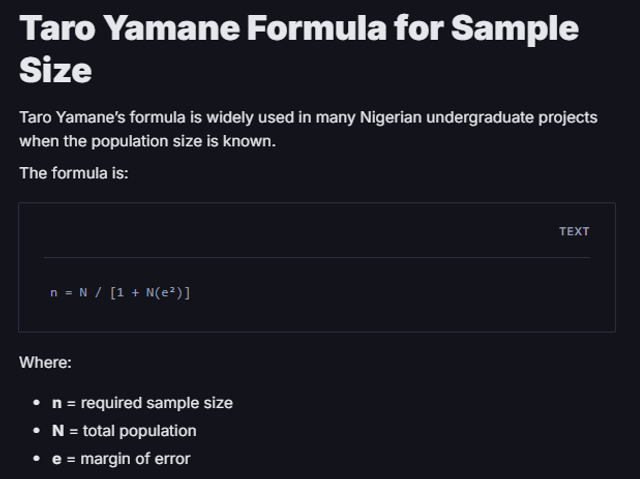
Taro Yamane Formula for Sample Size
Taro Yamane’s formula is widely used in many Nigerian undergraduate projects when the population size is known.
The formula is:
1n = N / [1 + N(e²)]Where:
- n = required sample size
- N = total population
- e = margin of error
A margin of error of 0.05, or 5 percent, is commonly used in undergraduate survey projects when approved by the supervisor.
Taro Yamane Formula Example
Study topic: Effect of Social Media Use on Academic Performance of Undergraduate Students
Population: 1,200 students
Margin of error: 0.05
1n = N / [1 + N(e²)]
2
3n = 1,200 / [1 + 1,200(0.05²)]
4
5n = 1,200 / [1 + 1,200(0.0025)]
6
7n = 1,200 / [1 + 3]
8
9n = 1,200 / 4
10
11n = 300
The required sample size is 300 respondents.
This does not mean you should automatically use the formula for every project. It only shows how the formula works when it is suitable for your study.
Cochran’s Formula for Sample Size
Cochran’s formula is often used when the population is very large, unknown or when a study requires a more statistical approach.
For a large population, the formula is commonly written as:
1n₀ = Z²p(1 − p) / e²Where:
- n₀ = initial sample size
- Z = confidence level value
- p = estimated proportion of the population with the characteristic being studied
- e = margin of error
If the population is finite and known, the initial result may need further adjustment.
Cochran’s formula has assumptions and requires careful selection of values. Do not use it because it looks more advanced. Use it only when it matches your research design and your supervisor approves it.
When a Census May Be Better Than a Sample
A census means studying every member of the population.
It may be more suitable when:
- The population is small
- Every person is relevant to the study
- The researcher can realistically reach all participants
- Your supervisor requires complete coverage
For example, if a study focuses on the 28 staff members of a department, using all 28 staff members may be more practical than calculating a smaller sample.
Sample Size Is Different From Sampling Technique
After calculating the number of respondents, you still need to explain how they will be selected.
Common sampling techniques include:
| Sampling technique | Meaning | Example |
|---|---|---|
| Simple random sampling | Every member has an equal chance of selection | Selecting students randomly from a class list |
| Stratified sampling | Population is divided into groups before selection | Selecting students from each level or department |
| Systematic sampling | Selecting people at a regular interval | Choosing every fifth name on a list |
| Purposive sampling | Selecting people with relevant knowledge or experience | Interviewing only lecturers who use e-learning platforms |
| Convenience sampling | Selecting available participants | Surveying students who are easily accessible |
Your sampling technique should fit your population and research design.
For example, if your study covers 200-level, 300-level and 400-level students, stratified sampling may help you include students from each level fairly.
How to Account for Non-Response
Not every questionnaire you distribute will be returned or completed correctly.
If your calculated sample size is 300, your supervisor may allow you to distribute more than 300 questionnaires to account for non-response.
For example, if you expect a 90 percent response rate:
1Number to distribute = Required sample size / Expected response rate
2
3Number to distribute = 300 / 0.90
4
5Number to distribute = 333.33
You may round up and distribute 334 questionnaires, subject to your supervisor’s approval.
Do not use this calculation to inflate your study without explanation. State clearly why you distributed more questionnaires and report the actual number returned in Chapter Four.
How to Write Sample Size in a Project Proposal
A proposal explains what you plan to do, so use future tense.
Taro Yamane Sample Write-Up
The population of this study will comprise 1,200 undergraduate students of [Faculty or Institution Name]. The sample size will be determined using Taro Yamane’s formula at a 5 percent margin of error:
n = N / [1 + N(e²)]
Where n represents the sample size, N represents the population size and e represents the margin of error.
Based on the formula, a sample size of 300 respondents will be selected for the study. The respondents will be selected using [insert approved sampling technique].
Replace all figures and methods with the real details of your own study.
How to Write Sample Size in a Completed Final Year Project
A completed report explains what you actually did, so use past tense.
Sample Write-Up
The population of the study comprised 1,200 undergraduate students of [Faculty or Institution Name]. The sample size was determined using Taro Yamane’s formula at a 5 percent margin of error. The calculation produced a sample size of 300 respondents. A total of [insert actual number] questionnaires were distributed using [insert actual sampling technique], while [insert actual number] completed questionnaires were retrieved and used for analysis.
Only report figures that are real. Do not claim that you distributed or retrieved questionnaires that do not exist.
Common Mistakes to Avoid
Choosing a random number of respondents
Do not use 100 or 200 respondents simply because it seems manageable. Explain the basis for your sample size.
Using the wrong population
Your population must match your title and scope. If your study focuses on 300-level students, do not use the population of the entire university.
Applying a formula without understanding it
Know what each symbol means and be able to explain why the formula is suitable for your study.
Using a sample size larger than your population
If your population is 80 people, you cannot have a sample size of 100 from that same population.
Forgetting the sampling technique
Calculating a sample size is only one step. You must also explain how participants will be selected.
Inventing population figures or returned questionnaires
Use real departmental records, actual questionnaires and genuine results. Fabricated data can create problems during project defence.
Ignoring your supervisor’s instruction
Your department may specify a formula, margin of error or sampling technique. Follow it even if another method appears in an online guide.
Quick Checklist
Before finalising your sample size section, check that:
- Your population is clearly defined.
- Your population figure is real and verifiable.
- Your formula suits your research design.
- Your supervisor approves the formula and margin of error.
- You can explain every part of your calculation.
- Your sampling technique matches the population.
- You have separated proposal plans from completed-report results.
- You have not invented figures, respondents or questionnaire returns.
Build a Methodology You Can Explain
A strong Chapter Three is not about using the biggest formula or the most complex words. It is about explaining a method that fits your approved topic and that you can defend.
If you have an approved topic, MonoEd Final Year Project Generator can help you organise your project into a structured draft. Review the methodology carefully, confirm every population figure and source, personalise the work and follow your supervisor’s corrections before submission.
Frequently Asked Questions
What is the best sample size for a final year project?
There is no universal number. The right sample size depends on your population, research design, sampling method, formula and supervisor’s instruction.
Can I use Taro Yamane’s formula for every project?
No. It is commonly used for known populations in survey-based studies, but it may not suit every research design or departmental requirement.
What margin of error should I use?
A 5 percent margin of error is common in many undergraduate projects, but you should use the value your supervisor or department approves.
Can I study the whole population instead of calculating sample size?
Yes, especially when the population is small or when your supervisor requires a census. This means every eligible member of the population is included.
What happens if not all respondents return their questionnaire?
Report the actual number returned and used for analysis. You may distribute extra copies in advance to account for non-response, but explain the reason and follow your supervisor’s direction.
Should I include the formula in Chapter Three?
Usually, yes, when you used a formula to determine the sample size. Show the formula, define the symbols, substitute the real population figure and present the final result clearly.
About the Author
Mohammad-Jamiu B. Balogun, GMNSE
AI Security Researcher · Founder, MonoEd Africa
Mohammad-Jamiu is a First-Class Telecommunications Engineer and Best Graduating Student (BUK), and an AI security researcher. He founded MonoEd Africa to give Nigerian students AI-powered academic tools — from SIWES logbooks to final year projects. His work has reached over 10,000 students across Nigeria.