How to Find Papers for Your Literature Review (Complete Guide for Students in 2026)
Learn how to find research papers for your literature review using Google Scholar, academic databases, AI research tools, and proven search strategies. A complete guide for students and researchers in 2026.

One of the biggest mistakes students make is writing a literature review before finding enough quality research papers.
If your sources are weak, outdated, or unrelated to your topic, your literature review will also be weak.
Whether you're writing a final year project, undergraduate thesis, postgraduate dissertation, or journal article, your first goal should be finding reliable academic papers that directly answer your research question.
Fortunately, you do not have to spend days searching manually.
With the right strategy and tools, you can build a solid collection of relevant papers in a few hours.
Step 1: Clearly define your research topic
Before searching for papers, write your topic as clearly as possible.
For example, instead of searching:
AI
Search something more specific like:
Artificial Intelligence in Healthcare Diagnosis
or
Impact of Artificial Intelligence on Software Development
The more specific your topic, the better your search results.
Step 2: Break your topic into keywords
Every research topic contains important keywords.
For example:
Topic:
Artificial Intelligence in Healthcare Diagnosis
Main keywords:
- Artificial Intelligence
- Machine Learning
- Healthcare
- Medical Diagnosis
- Clinical Decision Support
Also think about synonyms.
Artificial Intelligence
- AI
- Machine Learning
- Deep Learning
Healthcare
- Medicine
- Medical
- Clinical
Using different combinations helps you discover papers that use different terminology.
Step 3: Use Boolean search operators
Academic databases understand Boolean operators.
These include:
AND
Find papers containing both terms.
Example
Artificial Intelligence AND Healthcare
OR
Find papers using either keyword.
Example
Artificial Intelligence OR Machine Learning
NOT
Exclude unwanted topics.
Example
Artificial Intelligence NOT Robotics
You can also combine them.
("Artificial Intelligence" OR "Machine Learning")
AND
Healthcare
This usually produces much better search results than typing ordinary sentences.
Step 4: Search trusted academic databases
Avoid relying only on Google.
Instead, search databases designed for academic research.
Some of the best include:
| Database | Best For |
|---|---|
| Google Scholar | General academic research |
| Crossref | Journal articles and DOI records |
| OpenAlex | Research discovery |
| arXiv | Computer Science, AI, Mathematics, Physics |
| PubMed | Medicine and Health Sciences |
| IEEE Xplore | Engineering and Computer Science |
| ScienceDirect | Science and Technology |
| SpringerLink | Multidisciplinary research |
| Wiley Online Library | International journals |
| JSTOR | Humanities and Social Sciences |
Each database has different coverage, so searching multiple sources usually produces better results.
Find research papers faster with Research Paper Finder
Searching each academic database individually can be time consuming.
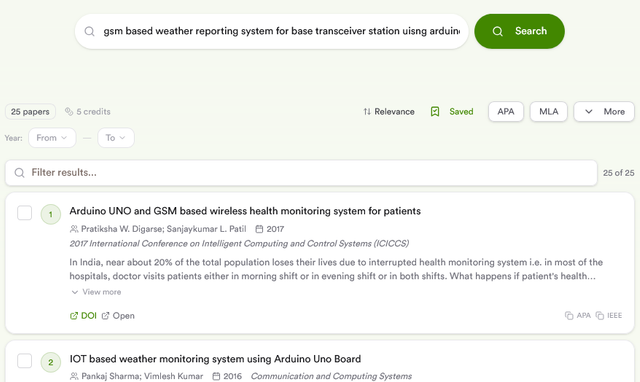
Research Paper Finder by MonoEd simplifies this process by searching multiple scholarly databases at the same time.
Instead of searching Crossref, OpenAlex, and arXiv separately, the tool searches them together, removes duplicate results, and ranks papers based on relevance.
Some of its features include:
- Multi database academic search
- AI powered query expansion
- Citation export in APA, IEEE, BibTeX and RIS
- Publication year filters
- Relevance and citation sorting
- Paper bookmarking
It is especially useful for undergraduate students, postgraduate researchers, and anyone beginning a literature review.
Step 5: Read review papers first
If you're new to a topic, don't begin with highly technical research papers.
Instead, search for:
- Literature Review
- Systematic Review
- Meta Analysis
These papers summarize years of research and help you understand:
- major theories
- important authors
- commonly used methods
- research gaps
After reading a few review papers, you'll know exactly which primary studies to read next.
Step 6: Use citation chaining
One excellent paper can lead you to hundreds more.
Check:
References
These are papers the author cited.
Also check:
Cited By
These are newer papers that cited the original study.
This process, known as citation chaining, helps you discover foundational studies and the latest research in your field.
Step 7: Filter by publication year
Many fields change rapidly.
For technology, AI, medicine, and computer science, prioritize papers published within the last five years unless you're citing classic foundational work.
For historical or theoretical topics, older studies may still be relevant.
Step 8: Organize your papers
After finding papers, organize them immediately.
Record:
- Authors
- Year
- Journal
- Research objective
- Methodology
- Key findings
- Limitations
- Important quotations
Many students also create a literature review matrix to compare studies side by side.
This makes writing Chapter Two much easier later.
Step 9: Turn your papers into a literature review
Finding papers is only half the work.
The next challenge is organizing your references and writing a properly structured literature review.
PaperDraft by MonoEd helps students generate properly cited research paper sections using the papers they selected.
Instead of working from a blank document, you can build your literature review, introduction, methodology, and other sections with verified references and multiple citation styles including APA, IEEE, Harvard, Chicago, MLA, and Vancouver.
Step 10: Verify every reference before submission
Incorrect references are one of the easiest ways to lose marks or receive reviewer comments.
Before submitting your work, verify:
- author names
- publication year
- journal title
- volume and issue
- DOI
Using a reference verification tool can save hours of manual checking.
💡 Reference Verifier — Quickly verify citations by checking authors, year, and DOI before submission.
Common mistakes students make
Avoid these common errors:
- Using only Google instead of academic databases
- Reading only abstracts without reviewing full papers
- Depending on outdated sources
- Ignoring highly cited foundational papers
- Downloading papers without organizing them
- Using references without verifying citation details
Best tools for finding research papers
| Tool | Best For |
|---|---|
| Research Paper Finder | Multi database academic search with AI |
| Google Scholar | General academic search |
| Crossref | DOI and citation records |
| OpenAlex | Research discovery |
| arXiv | Computer Science and AI |
| PubMed | Medicine |
| IEEE Xplore | Engineering |
| Zotero | Reference management |
| Mendeley | Reference management |
Conclusion
Finding papers for a literature review becomes much easier when you follow a structured process.
Start with a clear research topic, build effective keyword combinations, search trusted academic databases, read review papers, and organize your references as you go.
Using dedicated research tools can also save significant time. Research Paper Finder helps you discover relevant studies across multiple scholarly databases, PaperDraft assists with writing properly cited research sections, and RefVerify helps ensure your references are accurate before submission.
A strong literature review always begins with strong sources.
FAQs
Where can I find papers for my literature review?
You can search trusted academic databases such as Google Scholar, Crossref, OpenAlex, PubMed, IEEE Xplore, ScienceDirect, SpringerLink, JSTOR, and arXiv. Using multiple databases usually gives better coverage than relying on a single source.
Is Google Scholar enough for a literature review?
Google Scholar is an excellent starting point, but it should not be your only source. Searching additional academic databases helps you find more relevant and higher quality studies.
How many papers should I use for a literature review?
It depends on your level of study and your institution's requirements. Undergraduate projects often use between 20 and 50 references, while postgraduate theses and journal articles may require significantly more.
How do I know if a paper is credible?
Check whether it was published in a reputable journal, has been peer reviewed, includes clear methodology, and has been cited by other researchers.
Can AI help me find research papers?
Yes. AI research tools can improve search queries, search multiple databases at once, rank relevant papers, and export citations, making the literature search process much faster.
What should I do after finding my papers?
Read the papers carefully, take notes, organize your references, identify common themes, compare findings across studies, and then begin writing your literature review. Before submission, verify your references to ensure they are accurate and complete.
About the Author
Mohammad-Jamiu B. Balogun, GMNSE
AI Security Researcher · Founder, MonoEd Africa
Mohammad-Jamiu is a First-Class Telecommunications Engineer and Best Graduating Student (BUK), and an AI security researcher. He founded MonoEd Africa to give Nigerian students AI-powered academic tools — from SIWES logbooks to final year projects. His work has reached over 10,000 students across Nigeria.