NOUN CGPA Calculator 2026: GPA, Grading System & Guide
Calculate your NOUN GPA and CGPA using the 5-point grading system. See grade points, TMA and exam weighting, formulas, examples and degree classification.

If you are a student of the National Open University of Nigeria (NOUN), you do not have to wait until the end of your programme before knowing how well you are performing.
You can calculate your GPA for a semester, estimate your current CGPA, understand your grade points, and see how each course affects your overall result.
This guide explains the NOUN grading system and shows you how to calculate GPA and CGPA step by step.
Quick Summary
NOUN uses a 5-point grading system:
| Score | Grade | Grade Point |
|---|---|---|
| 70 and above | A | 5 |
| 60 - 69 | B | 4 |
| 50 - 59 | C | 3 |
| 45 - 49 | D | 2 |
| 40 - 44 | E | 1 |
| 39 and below | F | 0 |
The basic GPA formula is:
GPA = Total Grade Points Earned ÷ Total Credit Units
For CGPA:
CGPA = Total Grade Points Earned across all semesters ÷ Total Credit Units carried across all semesters
NOUN handbooks describe GPA as being calculated by multiplying the grade point earned in each course by the course credit unit, adding the results, and dividing by the total credit units carried.
NOUN CGPA Calculator
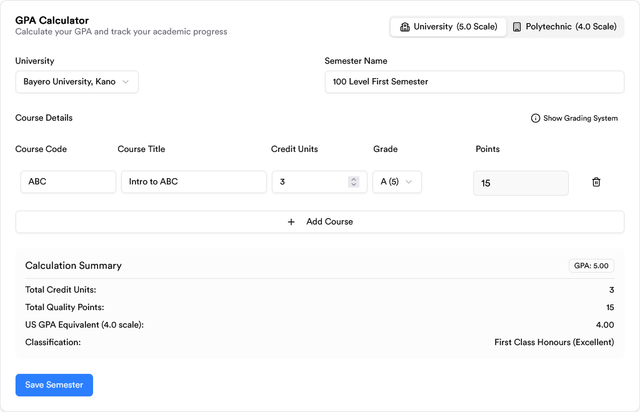
You can use the calculator below instead of calculating everything manually.
Add each course, select the credit unit and enter your grade or score. The calculator will automatically show your:
- Total credit units
- Total grade points
- Semester GPA
- Estimated CGPA
- Current degree classification
If you already have results from previous semesters, you can also enter your previous total credit units and grade points to calculate your updated CGPA.
The rest of this guide explains exactly how the calculation works.
NOUN Grading System
NOUN uses letter grades from A to F, with each grade carrying a different grade point.
An A gives you 5 grade points, while an F gives you 0.
The grading scale published in NOUN student handbooks is:
| Score | Grade | Grade Point |
|---|---|---|
| 70 - 100 | A | 5 |
| 60 - 69 | B | 4 |
| 50 - 59 | C | 3 |
| 45 - 49 | D | 2 |
| 40 - 44 | E | 1 |
| 0 - 39 | F | 0 |
This 5-point grading scale is also shown in official NOUN faculty handbooks.
For example, if you score 74 in a course, you receive an A and a grade point of 5.
If you score 63, you receive a B and a grade point of 4.
However, the grade point alone is not enough to calculate your GPA. The credit unit of the course also matters.
What Is GPA in NOUN?
GPA means Grade Point Average.
It measures your academic performance for a particular semester.
Suppose you register five courses in a semester. Each course has a credit unit and, after your result is released, a grade point.
Your GPA takes all those courses into account.
A 3-unit course has more effect on your GPA than a 1-unit course because its grade point is multiplied by a larger credit unit.
NOUN GPA Formula
The formula is:
GPA = Total Grade Points Earned ÷ Total Credit Units
For each course:
Grade Point Earned = Course Credit Unit × Grade Point
You then add the grade points earned for all your courses before dividing by the total number of credit units.
How to Calculate GPA in NOUN
Let us use a simple example.
Suppose your semester result looks like this:
| Course | Credit Unit | Grade | Grade Point | Grade Point Earned |
|---|---|---|---|---|
| GST101 | 2 | B | 4 | 8 |
| MTH102 | 3 | A | 5 | 15 |
| CIT103 | 3 | C | 3 | 9 |
| GST104 | 2 | A | 5 | 10 |
Step 1: Convert Each Grade to Its Grade Point
Using the NOUN grading system:
- A = 5
- B = 4
- C = 3
- D = 2
- E = 1
- F = 0
Step 2: Multiply the Grade Point by the Credit Unit
For GST101:
2 × 4 = 8
For MTH102:
3 × 5 = 15
For CIT103:
3 × 3 = 9
For GST104:
2 × 5 = 10
Step 3: Add the Grade Points Earned
8 + 15 + 9 + 10 = 42
Step 4: Add the Credit Units
2 + 3 + 3 + 2 = 10 credit units
Step 5: Calculate the GPA
GPA = 42 ÷ 10
GPA = 4.20
Your GPA for the semester would therefore be 4.20 out of 5.00.
What Is CGPA in NOUN?
CGPA means Cumulative Grade Point Average.
While GPA measures your performance in one semester, CGPA combines your academic performance across multiple semesters.
For example:
- First semester: GPA
- Second semester: GPA
- First and second semesters combined: CGPA
- All semesters completed so far: Current CGPA
Your CGPA continues to change as new results are added.
NOUN also explains that a student's CGPA may increase, decrease or remain the same after new academic results are released.
How to Calculate CGPA in NOUN
One mistake students sometimes make is simply adding their semester GPAs and dividing by the number of semesters.
That can give the wrong answer when the semesters have different numbers of credit units.
Instead, calculate CGPA using your total grade points and total credit units.
CGPA Formula
CGPA = Total Grade Points Earned ÷ Total Credit Units Carried
For example:
Semester One
Total credit units = 20
Total grade points = 80
GPA:
80 ÷ 20 = 4.00
Semester Two
Total credit units = 24
Total grade points = 84
GPA:
84 ÷ 24 = 3.50
To calculate your CGPA:
Total grade points:
80 + 84 = 164
Total credit units:
20 + 24 = 44
Therefore:
CGPA = 164 ÷ 44
CGPA = 3.73
Your cumulative GPA after the two semesters is 3.73.
How to Check Your CGPA in NOUN
You do not have to calculate your official CGPA manually.
NOUN provides students with access to their comprehensive results through its student support platform.
According to NOUN's official guidance, students can access their Result Statement, which contains their CGPA and outstanding courses.
To check your CGPA:
- Go to the NOUN student support website.
- Log in using your matriculation number or NOUN student email.
- Complete the password setup if you are logging in for the first time.
- Open Result Statement.
- Your comprehensive results and CGPA should be displayed.
You can still use the calculator on this page to estimate your GPA before results are officially updated or to understand how individual courses affect your CGPA.
How NOUN Calculates Your Final Course Score
Before a grade is converted into a grade point, your performance in the course must first be calculated.
For most courses, this combines your Tutor-Marked Assessments and your examination.
NOUN's current student guidance states that:
- TMA contributes 30%
- Examination contributes 70%
The two are combined to determine the final course score.
For example:
TMA score = 26
Examination score = 38
Final course score:
26 + 38 = 64
A score of 64 falls within the 60 to 69 range.
Your grade would therefore be:
B
Grade point:
4
NOUN also states that undergraduate students generally require at least 40% to attain a passing grade, although some programmes have different requirements. For example, the university states that Nursing and postgraduate programmes generally require at least 50%.
Always check the specific academic requirements for your programme where applicable.
NOUN Degree Classification
Your final CGPA is used in determining your degree classification.
NOUN handbooks consistently place the upper classifications at:
| CGPA | Degree Classification |
|---|---|
| 4.50 - 5.00 | First Class |
| 3.50 - 4.49 | Second Class Upper |
Published NOUN faculty handbooks are not completely uniform in how some of the lower CGPA bands are presented. For example, official handbooks from different faculties or editions show slightly different boundaries for Second Class Lower, Third Class and Pass classifications.
For that reason, if your CGPA is close to one of the lower classification boundaries, check the current handbook for your faculty or your official NOUN Result Statement rather than relying only on a general online table.
Does a Failed Course Affect Your NOUN CGPA?
Yes.
An F carries a grade point of 0.
For example, if you fail a 3-unit course:
3 × 0 = 0 grade points
However, those credit units are still part of the courses you carried, so the result can reduce your GPA.
NOUN also states that a course previously failed can remain visible on your statement of results even if you later pass the course.
Why Course Units Matter When Calculating GPA
Not every course affects your GPA equally.
Consider these two results:
Course A
3 units
Grade A
5 × 3 = 15 grade points
Course B
1 unit
Grade A
5 × 1 = 5 grade points
Although you received the same grade in both courses, the 3-unit course contributes three times as many grade points.
This is why you should always include course units when calculating GPA or CGPA.
Can Your CGPA Improve in Later Semesters?
Yes.
Your CGPA changes as more courses and grade points are added to your academic record.
If your GPA in future semesters is higher than your current CGPA, your CGPA can gradually increase.
For example, a student with a CGPA of 3.20 who consistently earns semester GPAs above 4.00 can improve the cumulative average over time.
The amount of improvement will depend on:
- Your current CGPA
- Credit units already completed
- Credit units remaining
- Grades obtained in future courses
The further you progress in your programme, the more difficult it may become to move your CGPA significantly because more completed credit units are already included in the calculation.
How to Improve Your GPA in NOUN
There is no shortcut to improving your GPA, but understanding the calculation helps you know where to focus.
Pay Attention to Higher Credit Courses
A poor grade in a 3-unit course affects your GPA more than the same grade in a 1-unit course.
This does not mean ignoring smaller courses, but higher credit courses deserve appropriate attention.
Take Your TMAs Seriously
TMAs contribute to your final course score, so losing avoidable marks there can make achieving a higher final grade more difficult.
Track Your Results Every Semester
Do not wait until your final year before calculating your CGPA.
Knowing your current position makes it easier to set realistic academic targets.
Avoid Failed Courses Where Possible
Since an F carries zero grade points, failed courses can have a significant effect on your GPA.
Common NOUN GPA and CGPA Calculation Mistakes
1. Ignoring Credit Units
You cannot calculate GPA correctly using grades alone.
Each grade point must be multiplied by the credit unit of the course.
2. Averaging Semester GPAs Directly
If two semesters have different total credit units, simply averaging their GPAs may produce an incorrect CGPA.
Use total grade points and total credit units instead.
3. Using the Wrong Grade Point
Remember:
A = 5
B = 4
C = 3
D = 2
E = 1
F = 0
4. Confusing GPA With CGPA
GPA generally refers to performance for a particular semester.
CGPA refers to your cumulative performance across multiple semesters.
5. Forgetting That Course Units Affect the Result
A 3-unit A contributes more grade points than a 1-unit A.
Always include the course unit.
Final Year Project Tools for NOUN Students
If you are already approaching your final year, calculating your CGPA is only one part of preparing for graduation.
MonoEd also provides tools that can help you with your research project, including:
You can use these tools alongside your department's project guidelines and your supervisor's instructions.
FAQs
How is GPA calculated in NOUN?
Multiply the grade point for each course by its credit unit. Add the grade points earned for all courses and divide the result by the total credit units.
GPA = Total Grade Points Earned ÷ Total Credit Units
How do I calculate my CGPA in NOUN?
Add the grade points earned across all semesters and divide by the total credit units carried across those semesters.
Do not simply average your semester GPAs unless the credit units are exactly the same.
Does NOUN use a 5-point grading system?
Yes. NOUN uses grade points from 0 to 5, with an A carrying 5 points and an F carrying 0 points.
What score is an A in NOUN?
A score of 70 and above is graded A and carries 5 grade points.
What score is a B in NOUN?
A score from 60 to 69 is graded B and carries 4 grade points.
What score is a C in NOUN?
A score from 50 to 59 is graded C and carries 3 grade points.
What is the NOUN pass mark?
NOUN states that undergraduate students generally require a final score of at least 40% to pass, although some programmes have different requirements. Nursing and postgraduate programmes generally require at least 50%.
How much does TMA contribute to my NOUN result?
TMA contributes 30% of the final score, while the examination contributes 70%.
How can I check my CGPA in NOUN?
Log in to the NOUN student support platform and open your Result Statement. NOUN states that the Result Statement displays your comprehensive results, including your CGPA and outstanding courses.
Can my NOUN CGPA increase?
Yes. Your CGPA can increase when you perform better in subsequent semesters. It can also decrease or remain unchanged depending on your new results.
Is GPA the same as CGPA?
No.
GPA usually measures your performance for one semester, while CGPA combines your performance across all completed semesters.
Conclusion
Calculating your NOUN GPA or CGPA is straightforward once you understand the relationship between your grade, grade point and course credit unit.
For each course:
Grade Point Earned = Grade Point × Credit Unit
Then:
GPA = Total Grade Points Earned ÷ Total Credit Units
You can calculate everything manually using the steps above or use the NOUN CGPA calculator at the top of this page to get the result automatically.
Tracking your GPA throughout your programme can help you understand your academic progress and identify where improvement is needed before you reach your final year.
About the Author
Mohammad-Jamiu B. Balogun, GMNSE
AI Security Researcher · Founder, MonoEd Africa
Mohammad-Jamiu is a First-Class Telecommunications Engineer and Best Graduating Student (BUK), and an AI security researcher. He founded MonoEd Africa to give Nigerian students AI-powered academic tools — from SIWES logbooks to final year projects. His work has reached over 10,000 students across Nigeria.