What Is OpenAI Prism? Complete Guide for Students and Researchers (2026)
Learn what OpenAI Prism is, how it works, its features, benefits, pricing, and how students, researchers, and academics can use it for writing papers, managing citations, collaborating, and conducting research in 2026.

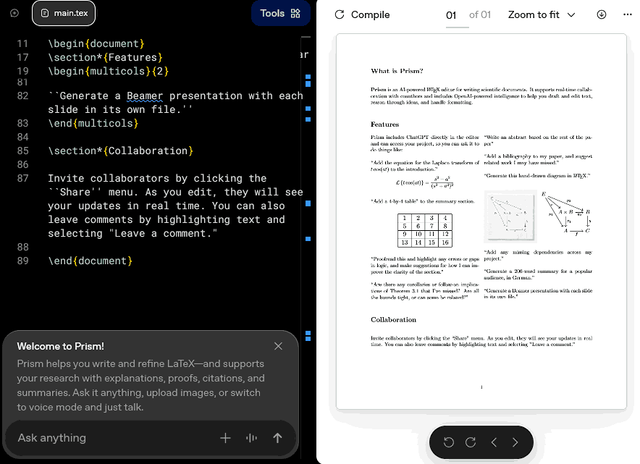
Scientific writing can be challenging, especially when researchers have to switch between multiple tools for writing, citations, collaboration, literature searches, and document formatting. To address this problem, OpenAI introduced Prism, a new AI-powered workspace designed specifically for scientific writing and research.
Prism combines the capabilities of advanced AI with a cloud based LaTeX editor, allowing researchers, lecturers, postgraduate students, and undergraduate students to work on papers and projects in one place.
If you have heard about OpenAI Prism and are wondering what it is, how it works, and whether it is worth using, this guide explains everything you need to know.
Quick Summary: What Is OpenAI Prism?
OpenAI Prism is a free AI-native scientific writing and collaboration platform powered by GPT-5.2. It provides a cloud based LaTeX workspace where users can write research papers, manage citations, collaborate with co-authors, search academic literature, and use AI assistance directly within their documents.
Unlike traditional AI chatbots that work separately from your writing environment, Prism understands the context of your entire document, including text, equations, references, and structure. This allows it to provide more relevant suggestions and assistance during the research and writing process.
What Is OpenAI Prism?
OpenAI Prism is an AI-powered workspace created to simplify scientific research and academic writing. It was introduced in January 2026 as a free platform for anyone with a ChatGPT account. The goal is to reduce the friction researchers experience when moving between multiple applications during the research process.
Traditionally, researchers may use:
- A LaTeX editor for writing
- A citation manager for references
- PDF readers for academic papers
- Collaboration tools for co-authors
- AI assistants for brainstorming and editing
Prism brings these functions together into a single environment, helping researchers focus more on their work and less on managing tools.
Why Did OpenAI Create Prism?
Research workflows have become increasingly complex.
A researcher writing a paper often spends time:
- Searching for literature
- Managing references
- Formatting citations
- Writing equations
- Revising drafts
- Collaborating with multiple authors
OpenAI identified that these tasks are often spread across disconnected applications. Prism was created to provide a unified workspace where AI can understand the full context of a research project rather than just responding to isolated prompts.
Key Features of OpenAI Prism
1. AI-Powered Scientific Writing
Prism integrates GPT-5.2 directly into the writing environment.
Instead of copying text into ChatGPT and then pasting responses back into a document, researchers can interact with AI inside the project itself.
The AI can help with:
- Drafting sections of a paper
- Improving clarity
- Rewriting paragraphs
- Explaining complex concepts
- Suggesting improvements to arguments
- Reviewing document structure
Because the AI understands the surrounding context, its suggestions are often more relevant than those generated through standalone chat sessions.
2. LaTeX Native Workspace
Prism is built around LaTeX, the document preparation system widely used in academia, especially in mathematics, engineering, computer science, and physics.
Researchers can:
- Create LaTeX documents
- Compile documents online
- Preview outputs instantly
- Manage equations efficiently
- Prepare manuscripts for publication
Since everything runs in the browser, there is no need to install or maintain a local LaTeX environment.
3. Full Document Awareness
One of Prism's most significant advantages is its ability to understand an entire document.
The AI can access:
- Paper structure
- Citations
- Equations
- Figures
- References
- Previous sections
This allows it to identify inconsistencies, suggest improvements, and provide context aware assistance across large documents.
4. Literature Search Integration
Prism can help researchers discover relevant academic literature without leaving the workspace.
Instead of manually switching between databases and writing tools, researchers can search for related papers and integrate findings directly into their projects.
This feature can save considerable time during literature reviews and background research.
5. Real Time Collaboration
Research is often a team effort.
Prism supports collaborative writing with multiple contributors working on the same document.
Benefits include:
- Shared projects
- Simultaneous editing
- Easier version management
- Reduced file conflicts
- Improved communication among collaborators
OpenAI states that Prism supports unlimited projects and collaborators for eligible users.
6. Equation and Diagram Support
Scientific papers frequently contain equations, mathematical expressions, and diagrams.
Prism helps researchers by:
- Assisting with equation creation
- Converting handwritten equations into LaTeX
- Supporting scientific notation
- Simplifying complex formatting tasks
This can be especially useful for STEM students and researchers.
Who Should Use OpenAI Prism?
Prism is designed primarily for academic and scientific work.
It may be useful for:
Undergraduate Students
Students writing assignments, seminar papers, dissertations, and final year projects can use Prism to improve productivity and organization.
Postgraduate Students
Master's and PhD students often work with large documents, extensive citations, and technical content. Prism can simplify many of these tasks.
Researchers
Researchers conducting studies and preparing manuscripts can benefit from integrated writing, literature search, and collaboration features.
Lecturers and Academics
Academic staff involved in publishing journal articles and supervising student projects may find Prism useful for drafting and reviewing content.
Scientific Teams
Research groups working across institutions can collaborate within a single cloud based workspace.
How Is OpenAI Prism Different From ChatGPT?
Many people assume Prism is simply another version of ChatGPT.
While both use OpenAI's AI models, their purposes are different.
| Feature | ChatGPT | OpenAI Prism |
|---|---|---|
| General conversations | Yes | Limited |
| Scientific writing focus | Limited | Yes |
| Full document awareness | No | Yes |
| LaTeX editing | No | Yes |
| Academic collaboration | Limited | Yes |
| Research workflow integration | Limited | Yes |
| Citation management | No | Yes |
Prism is designed specifically for research and academic writing, while ChatGPT serves a broader range of general purposes.
OpenAI Prism vs Overleaf
Many researchers compare Prism to Overleaf because both are cloud based LaTeX platforms.
Some differences include:
OpenAI Prism
- Integrated GPT-5.2 assistance
- Context aware AI support
- Literature search tools
- AI powered revisions
- Unified research workflow
Overleaf
- Established LaTeX platform
- Large academic user base
- Strong collaboration features
- Extensive template library
- Less AI integration
For researchers seeking AI-assisted writing and document analysis, Prism offers capabilities that go beyond traditional LaTeX editing. However, Overleaf remains a popular choice due to its maturity and long standing presence in academia.
Is OpenAI Prism Free?
Yes.
OpenAI launched Prism as a free platform available to users with personal ChatGPT accounts. OpenAI has indicated that more advanced AI features may become available through paid plans in the future.
For students and researchers with limited budgets, the free access model makes Prism particularly attractive.
Benefits of OpenAI Prism
Some of the major benefits include:
Reduced Context Switching
Researchers no longer need to move constantly between writing tools, citation managers, AI assistants, and collaboration platforms.
Faster Writing Process
AI assistance can help generate drafts, improve wording, and suggest revisions more efficiently.
Better Collaboration
Teams can work together within a single environment rather than exchanging multiple versions of documents.
Easier LaTeX Usage
Researchers who are less familiar with LaTeX may find it easier to create professional academic documents.
Increased Productivity
By automating repetitive tasks, researchers can spend more time on critical thinking and analysis.
Potential Limitations of OpenAI Prism
Like any AI tool, Prism has limitations.
AI Can Make Mistakes
Researchers should always verify facts, references, and interpretations rather than accepting AI generated content without review.
Learning Curve
Users unfamiliar with LaTeX may still need some time to understand the platform.
Not a Replacement for Research Skills
Prism can assist researchers, but it cannot replace critical thinking, methodological rigor, or subject expertise.
Dependence on AI Suggestions
Overreliance on AI generated text may reduce originality if users do not actively engage with the writing process.
How Students Can Use OpenAI Prism
Students can use Prism for:
- Final year projects
- Literature reviews
- Seminar papers
- Research proposals
- Undergraduate dissertations
- Thesis writing
- Academic reports
- Scientific assignments
It can also help students learn proper academic writing structures while improving document organization.
The Future of AI in Academic Research
OpenAI believes that AI will play an increasingly important role in accelerating scientific discovery. Prism represents one of the first attempts to integrate advanced AI directly into the daily workflow of researchers rather than offering AI as a separate tool.
As AI technology continues to evolve, we may see research environments become even more intelligent, collaborative, and efficient.
Conclusion
OpenAI Prism is more than just another AI writing assistant. It is a dedicated scientific workspace designed to bring writing, collaboration, citations, research, and AI support into a single platform.
For students, researchers, lecturers, and academic professionals, Prism offers a modern approach to managing complex research projects without constantly switching between multiple tools.
While it is not a replacement for expertise, critical thinking, or rigorous academic standards, it has the potential to make the research and writing process faster, more organized, and more productive.
As AI continues to transform education and scientific research, OpenAI Prism is likely to become an important tool for many researchers worldwide.
FAQs
What is OpenAI Prism?
OpenAI Prism is a free AI-powered scientific writing and collaboration platform that combines a cloud based LaTeX editor with GPT-5.2 to help researchers write, edit, collaborate, and manage research projects.
Is OpenAI Prism free?
Yes. OpenAI launched Prism as a free platform for users with personal ChatGPT accounts, although some advanced features may be offered through paid plans in the future.
Can students use OpenAI Prism?
Yes. Undergraduate, postgraduate, and doctoral students can use Prism for assignments, dissertations, literature reviews, research proposals, and final year projects.
Is OpenAI Prism better than ChatGPT?
Prism and ChatGPT serve different purposes. ChatGPT is a general AI assistant, while Prism is designed specifically for scientific writing and academic research.
Does OpenAI Prism support LaTeX?
Yes. Prism is a LaTeX-native platform that allows users to create, edit, and compile scientific documents directly within the browser.
Can OpenAI Prism help with citations?
Yes. Prism includes tools that assist with citations, references, and literature discovery, helping researchers manage academic sources more efficiently.
Is OpenAI Prism suitable for final year projects?
Yes. Students working on final year projects can use Prism for literature reviews, drafting chapters, managing references, and improving academic writing quality.
About the Author
Mohammad-Jamiu B. Balogun, GMNSE
AI Security Researcher · Founder, MonoEd Africa
Mohammad-Jamiu is a First-Class Telecommunications Engineer and Best Graduating Student (BUK), and an AI security researcher. He founded MonoEd Africa to give Nigerian students AI-powered academic tools — from SIWES logbooks to final year projects. His work has reached over 10,000 students across Nigeria.