Sample Public Health Practicum Logbook Entries (Week 1–12)
Download structured sample Public Health practicum logbook entries (Week 1–12) for Miva Open University students. Includes ASPHER domains, learning outcomes, and reflections.

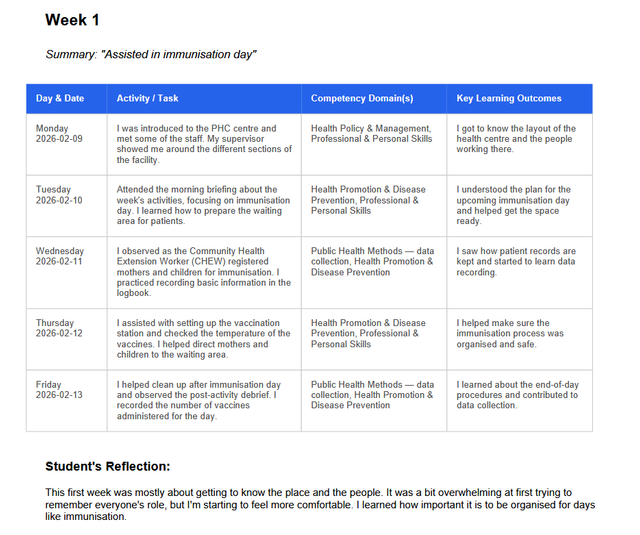
If you’re a Public Health student at Miva Open University, one of the most challenging parts of your practicum is not the fieldwork — it’s documenting it correctly.
Students often ask:
- What should I write for Week 1?
- How do I structure daily entries?
- How do I tag ASPHER competency domains properly?
- How detailed should learning outcomes be?
Before we go into detailed examples, here’s something important.
If you want your entire Week 1–12 logbook structured automatically — with correct ASPHER tagging, learning outcomes, reflections, and a ready-to-download PDF — you can use the AI-powered MIVA Logbook (PHC) tool.
You simply describe your week (e.g., “Assisted with immunisation and updated ANC register”), and it generates properly formatted entries instantly.
Now, if you prefer doing it manually or want to understand the structure first, the samples below will guide you.
To keep this practical and readable, we’ll show 3 fully written sample weeks (Week 1, Week 5, and Week 9). You can then adapt the format for Weeks 2–4, 6–8, and 10–12.
💡 Read on: How to Fill Miva Open University Public Health Practicum Logbook (Without Stress)
📘 Week 1 – Orientation & Introduction to PHC
Summary: Orientation to PHC structure and immunisation unit operations.
| Day & Date | Activity / Task | Competency Domain(s) | Key Learning Outcomes |
|---|---|---|---|
| Monday | Attended morning briefing and was introduced to PHC staff. Tour of facility conducted by supervisor. | Health Policy & Management; Professional & Personal Skills | Understood PHC structure, staff roles, and workflow processes. |
| Tuesday | Observed immunisation room setup and cold chain equipment. Reviewed temperature logbook. | Public Health Methods; Health Promotion & Disease Prevention | Learned importance of maintaining cold chain to preserve vaccine potency. |
| Wednesday | Observed CHEW delivering health talk on hygiene practices to mothers. | Health Promotion & Disease Prevention; Professional & Personal Skills | Gained insight into effective community health communication. |
| Thursday | Assisted in preparing immunisation cards and recording patient biodata. | Public Health Methods | Practiced accurate documentation of patient records. |
| Friday | Observed vaccine administration and infection prevention techniques. | Health Promotion & Disease Prevention; Public Health Methods | Learned safe vaccine handling and administration procedures. |
Student Reflection
This week focused on orientation and understanding PHC operations. Initially, adapting to the workflow was challenging, but observing immunisation processes improved my confidence. I gained foundational knowledge of cold chain management and documentation systems.
📘 Week 5 – Antenatal Clinic & Maternal Health Services
Summary: Participation in ANC activities and maternal record management.
| Day & Date | Activity / Task | Competency Domain(s) | Key Learning Outcomes |
|---|---|---|---|
| Monday | Observed antenatal booking procedures and patient history documentation. | Public Health Methods | Learned structured maternal health record documentation. |
| Tuesday | Assisted in measuring blood pressure and weight under supervision. | Public Health Methods; Professional & Personal Skills | Developed basic clinical observation skills. |
| Wednesday | Observed counselling session on nutrition during pregnancy. | Health Promotion & Disease Prevention | Understood importance of maternal nutrition education. |
| Thursday | Assisted in updating ANC register and tallying attendance data. | Public Health Methods | Gained experience in compiling routine clinic statistics. |
| Friday | Attended ward health committee meeting discussing maternal outreach. | Health Policy & Management; Professional & Personal Skills | Learned how policies are implemented at PHC level. |
Student Reflection
Week 5 enhanced my understanding of maternal healthcare services. I improved in documentation and learned how antenatal counselling supports positive pregnancy outcomes. Observing community engagement strategies broadened my understanding of PHC management.
📘 Week 9 – Community Outreach & Environmental Health
Summary: Participation in outreach and sanitation assessment.
| Day & Date | Activity / Task | Competency Domain(s) | Key Learning Outcomes |
|---|---|---|---|
| Monday | Participated in community sanitation inspection. | Population Health & Determinants | Understood link between poor sanitation and diarrhoeal diseases. |
| Tuesday | Assisted in malaria prevention awareness campaign. | Health Promotion & Disease Prevention | Learned strategies for community-based malaria control. |
| Wednesday | Collected data during outreach immunisation visit. | Public Health Methods | Gained experience in field data collection. |
| Thursday | Observed waste disposal practices at local market. | Population Health & Determinants | Identified environmental risk factors affecting public health. |
| Friday | Participated in debriefing session with PHC staff. | Professional & Personal Skills | Developed teamwork and reporting skills. |
Student Reflection
This week deepened my understanding of how environmental and social factors influence community health. Participating in outreach strengthened my communication skills and reinforced the importance of preventive health services.
How to Structure Weeks 2–4, 6–8, 10–12
For the remaining weeks, rotate focus areas such as:
- Immunisation follow-ups
- ANC documentation
- Child welfare clinics
- Malaria testing support
- Data compilation & monthly reporting
- Health talks
- Ward health meetings
- Community-based surveillance
Each week should:
- Describe specific daily tasks
- Tag relevant ASPHER domains
- Include meaningful learning outcomes
- End with a professional reflection
If you follow the pattern in the examples above, you can confidently structure all 12 weeks.
💡 Read on: Common Mistakes Miva Public Health Students Make in Their Logbook (And How to Avoid Them)
Want Your Entire Logbook Structured Like This Automatically?
Writing 8–12 weeks manually can become repetitive and time-consuming.
If you want your entire logbook formatted exactly like the structured samples above — including:
- Proper Monday–Friday entries
- Correct ASPHER competency tagging
- Professional learning outcomes
- Weekly reflections
- Clean PDF formatting ready for submission
You can use the AI-powered MIVA Logbook (PHC) tool.
Just describe your week in simple sentences like:
“Assisted with immunisation and updated ANC register.”
The system structures everything automatically.
It saves hours, reduces formatting errors, and ensures competency alignment.
Conclusion
Use these examples as a structural guide — not content to copy directly.
Your logbook should reflect:
- Your real field experiences
- Your competency development
- Your professional growth
Whether you complete it manually or use a structured generator, ensure your entries are detailed, competency-based, and professionally presented.
About the Author
Mohammad-Jamiu B. Balogun, GMNSE
AI Security Researcher · Founder, MonoEd Africa
Mohammad-Jamiu is a First-Class Telecommunications Engineer and Best Graduating Student (BUK), and an AI security researcher. He founded MonoEd Africa to give Nigerian students AI-powered academic tools — from SIWES logbooks to final year projects. His work has reached over 10,000 students across Nigeria.