What Is ORCID iD and Why Do Students and Researchers Need It? Complete Beginner Guide
Learn what ORCID iD is, why students and researchers need it, how to create one for free, and how to use it for journal submissions, CVs, scholarships, and research visibility.

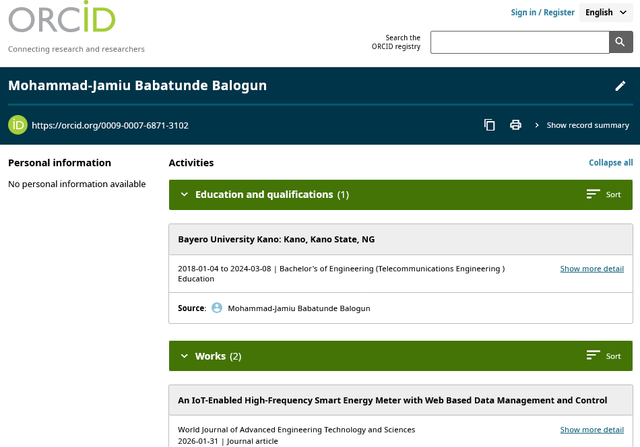
If you have ever submitted a journal paper, applied for a scholarship, created a research profile, or searched for academic opportunities online, you may have seen something called an ORCID iD.
Many students ignore it at first because it looks like just another long number:
0000-0000-0000-0000
But in reality, ORCID has become one of the most important academic tools for students, graduates, lecturers, and researchers around the world.
Today, many journals, publishers, universities, funding organizations, and research databases ask for an ORCID iD during registration or manuscript submission.
The good news is that ORCID is completely free and only takes a few minutes to set up.
This guide explains what ORCID is, why it matters, how to create one, and how students and graduates can use it professionally.
Quick Summary
ORCID stands for Open Researcher and Contributor ID.
It is a free persistent digital identifier that permanently connects researchers to their academic work, publications, projects, affiliations, and professional activities.
Your ORCID iD stays with you throughout your career even if:
- you change schools
- you move to another country
- you change your name
- you switch jobs
- you publish in different journals
Many publishers and academic platforms now use ORCID to correctly identify authors and automatically connect publications to their profiles.
What Is ORCID?
ORCID is a non profit organization that provides researchers with a unique academic identity.
Your ORCID iD is a personal 16 digit identifier such as:
0009-0007-6871-3102
Think of it as a digital academic passport.
Instead of relying only on your name, ORCID creates a permanent identity linked specifically to your research activities.
This helps avoid confusion between researchers who may have similar names.
For example:
- Mohammed Balogun
- M. Balogun
- Mohammad J. Balogun
could all refer to different people.
With ORCID, your work remains connected specifically to you.
Is ORCID Free?
Yes. ORCID is completely free for students, graduates, lecturers, and researchers.
You do not need to pay to:
- create an ORCID iD
- add publications
- update your profile
- connect journals
- link your research activities
Once you register, your ORCID iD belongs to you permanently.
Why ORCID Is Important for Students and Researchers
Many people think ORCID is only for professors or PhD holders.
That is no longer true.
Even undergraduate students and fresh graduates now benefit from having an ORCID iD.
1. It Prevents Name Confusion
One of the biggest problems in academic publishing is author confusion.
Two researchers may have similar names, initials, or spellings.
ORCID solves this problem by assigning every researcher a unique identifier.
This ensures your papers, conference presentations, and research activities are correctly linked to you.
2. It Makes Journal Submission Easier
Many journals now request ORCID during paper submission.
Instead of repeatedly typing:
- your name
- affiliation
- publication details
your ORCID profile can automatically provide that information.
This saves time and reduces mistakes during submission.
3. It Helps Build Your Academic Reputation
Your ORCID profile acts like an online academic portfolio.
People can view:
- your publications
- research projects
- affiliations
- education history
- conference papers
- professional activities
This becomes useful for:
- scholarship applications
- postgraduate admissions
- grant opportunities
- research collaborations
- job applications
4. It Stays With You for Life
Unlike university portals or institutional emails, your ORCID iD remains the same throughout your career.
If you graduate from one university and later move elsewhere, your research history stays connected to the same ORCID profile.
5. It Improves Research Visibility
Platforms like:
- Crossref
- Scopus
- Web of Science
- journal publishers
can connect your research outputs directly to your ORCID profile.
This helps other researchers discover your work more easily.
Who Should Create an ORCID iD?
ORCID is useful for:
- final year students
- postgraduate students
- lecturers
- researchers
- journal authors
- conference presenters
- scholarship applicants
- independent researchers
Even if you have not published a paper yet, creating your ORCID early is still a good idea.
How to Create an ORCID iD
Creating an ORCID account takes only a few minutes.
Step 1: Visit the Official Website
Go to:
Step 2: Register
Click “Register” and enter:
- your name
- email address
- password
Step 3: Verify Your Email
ORCID will send a verification email to confirm your account.
Step 4: Complete Your Profile
You can then add:
- education
- employment
- publications
- keywords
- websites
- biography
- research activities
How to Add Publications to ORCID
There are two common methods.
Add Using DOI
If your paper already has a DOI, ORCID can automatically import the publication details.
Simply:
- go to Works
- click Add
- select Add DOI
- paste the DOI
ORCID retrieves the paper information automatically.
Add Manually
If your paper is unpublished or still under review, you can manually add it as:
- working paper
- report
- conference paper
- preprint
You can update it later after publication.
Example of How ORCID Works
Imagine a student publishes a paper titled:
“An IoT-Enabled High-Frequency Smart Energy Meter with Web Based Data Management and Control”
After publication, the student adds the paper DOI to ORCID.
Later, the same student begins another research project on AI generated web application security.
Even if the student changes institutions or emails in the future, both projects remain permanently connected to the same ORCID iD.
This creates a reliable academic history over time.
Should You Add ORCID to Your CV?
Yes.
Adding your ORCID iD to your CV looks professional and helps people verify your academic work easily.
You can place it near your contact details.
Example:
Mohammad-Jamiu Babatunde Balogun
Email: example@gmail.com
ORCID: https://orcid.org/0000-0000-0000-0000
If your CV is a PDF, make the ORCID link clickable.
ORCID vs Google Scholar
Many students confuse ORCID with Google Scholar.
They are different.
ORCID
- creates your permanent researcher identity
- connects publications to you
- used during journal submissions
- controlled by you
Google Scholar
- tracks citations
- indexes academic papers
- measures visibility and citations
Most researchers use both together.
ORCID vs ResearchGate
ResearchGate is a research networking platform.
ORCID is an official researcher identification system.
ResearchGate focuses more on:
- networking
- paper sharing
- discussions
ORCID focuses on:
- identity verification
- publication tracking
- institutional integration
Common ORCID Mistakes to Avoid
Creating Multiple Accounts
Try to maintain one ORCID iD throughout your career.
Multiple accounts can split your publication history.
Leaving Your Profile Empty
After registration, update your:
- education
- affiliations
- publications
- keywords
An empty profile provides little value.
Forgetting to Verify Email
Always verify your email so you do not lose access later.
Incorrect Employment Information
If you were only a student at a university, list it under Education rather than Employment unless you officially worked there.
Why ORCID Matters More in 2026
Academic publishing is becoming more digital and automated.
Many systems now use ORCID for:
- manuscript tracking
- author verification
- grant applications
- citation indexing
- institutional reporting
Some journals even update ORCID profiles automatically after publication.
Having an ORCID iD today is becoming as important as having a professional email or LinkedIn profile.
Conclusion
ORCID may look like a simple number, but it plays a major role in modern academic and research identity.
For students and graduates, creating an ORCID iD early helps establish a professional academic presence before opportunities start appearing.
Whether you plan to:
- publish research papers
- apply for scholarships
- pursue postgraduate studies
- build an academic career
- join research collaborations
an ORCID iD helps ensure your work remains connected to you permanently.
The best part is that setting it up is completely free and only takes a few minutes.
FAQs
What does ORCID stand for?
ORCID stands for Open Researcher and Contributor ID.
Is ORCID free?
Yes. ORCID is completely free for individuals.
Can undergraduate students create ORCID?
Yes. Undergraduate and final year students can create ORCID accounts even before publishing papers.
Does ORCID replace a CV?
No. ORCID supports your CV by providing a verified online academic profile.
Can I add unpublished work to ORCID?
Yes. You can manually add working papers, reports, and ongoing research projects.
Can I edit my ORCID profile later?
Yes. You can update your profile anytime.
Should I add ORCID to my CV?
Yes. Adding ORCID to your CV looks professional and helps people verify your research work.
Can I have two ORCID accounts?
It is recommended to maintain only one ORCID iD throughout your career.
Is ORCID useful outside academia?
Yes. ORCID can also support research related jobs, innovation projects, consulting work, and professional portfolios.
How long does ORCID last?
Your ORCID iD is permanent and stays with you throughout your career.
About the Author
Mohammad-Jamiu B. Balogun, GMNSE
AI Security Researcher · Founder, MonoEd Africa
Mohammad-Jamiu is a First-Class Telecommunications Engineer and Best Graduating Student (BUK), and an AI security researcher. He founded MonoEd Africa to give Nigerian students AI-powered academic tools — from SIWES logbooks to final year projects. His work has reached over 10,000 students across Nigeria.