Final Year Project Format in Nigeria (2026): Approved Structure, Chapters & Formatting Guide
Learn the approved final year project format in Nigeria for universities and polytechnics. Covers preliminary pages, chapter structure, font, spacing, page numbering, and FAQs.

Writing a final year project (FYP) is a compulsory academic requirement for students in Nigerian universities and polytechnics. While many students struggle with how to write, an even bigger issue is not following the correct project format, which can lead to unnecessary mark deductions.
This guide explains the official and widely accepted final year project format in Nigeria, including:
- Approved preliminary pages
- Standard chapter structure
- Formatting rules (font, spacing, margins)
- Page numbering system
- Differences across institutions
- Common formatting mistakes to avoid
This format applies to most Nigerian universities, polytechnics, colleges of education, and NOUN, unless your department states otherwise.
1. Standard Final Year Project Structure in Nigeria
A Nigerian final year project is divided into three major parts:
- Preliminary Pages
- Main Chapters (Chapter 1–5 or 6)
- References and Appendices
The order matters and should be followed strictly.
2. Preliminary Pages (Front Matter)
These pages come before Chapter One and are usually numbered using Roman numerals (i, ii, iii).
Approved Order of Preliminary Pages
- Title Page
- Declaration
- Certification
- Dedication
- Acknowledgements
- Abstract
- Table of Contents
- List of Tables
- List of Figures
- List of Abbreviations (optional)
2.1 Title Page Format
The title page must contain:
- Project title (maximum of 20–23 words recommended)
- Student full name
- Matriculation or registration number
- Department and Faculty
- Institution name
- Degree being awarded
- Month and year of submission
Example:
A PROJECT ON THE IMPACT OF DIGITAL BANKING ON CUSTOMER SATISFACTION
By
Mohammad Jamiu Babatunde Balogun
Matric No: CSC/2019/1042
A Project Submitted to the Department of Computer Science
Faculty of Science
University of Lagos
In Partial Fulfillment of the Requirements for the Award of
Bachelor of Science (B.Sc)
March, 2026
2.2 Declaration Page
A simple originality statement.
Sample:
I hereby declare that this project was carried out by me and has not been submitted elsewhere for the award of any degree.
2.3 Certification Page
Must be signed by:
- Project supervisor
- Head of Department
- External examiner (if required)
2.4 Dedication
Optional. Keep it short.
2.5 Acknowledgements
One page maximum. Appreciate:
- Supervisor
- Lecturers
- Family and friends
- Organizations or respondents
2.6 Abstract (Very Important)
The abstract is a summary of the entire project (150–300 words).
It should include:
- Background
- Methodology
- Key findings
- Conclusion or recommendations
Write the abstract last.
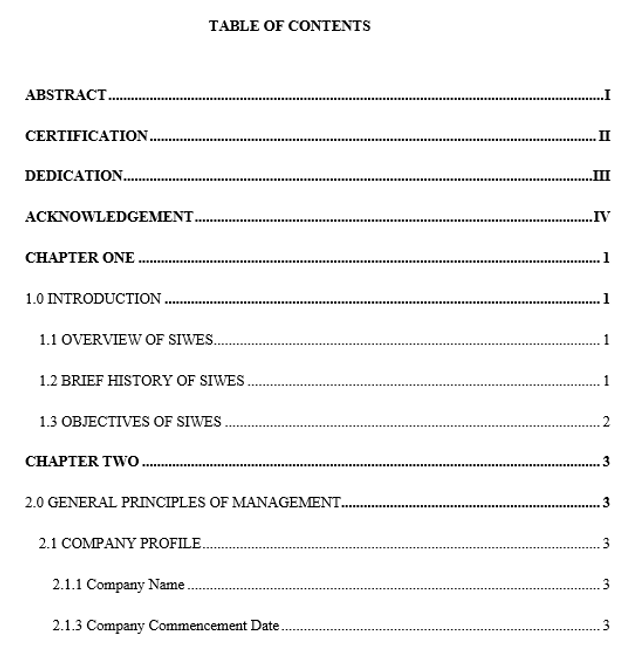
2.7 Table of Contents
- Must match final page numbers
- Auto-generate in Word if possible
3. Main Chapters (Approved Nigerian Format)
Most Nigerian institutions use five chapters, though some engineering and IT departments use six chapters.
Chapter One: Introduction
Standard Subheadings:
- Background of the Study
- Statement of the Problem
- Aim and Objectives
- Research Questions / Hypotheses
- Significance of the Study
- Scope and Limitations
- Definition of Terms
Chapter Two: Literature Review
Standard Subheadings:
- Conceptual Framework
- Theoretical Framework
- Review of Related Studies
- Summary and Research Gap
Chapter Three: Research Methodology
Standard Subheadings:
- Research Design
- Population of the Study
- Sample and Sampling Technique
- Instrument for Data Collection
- Validity and Reliability
- Procedure for Data Collection
- Method of Data Analysis
Chapter Four: Results / Data Analysis
Includes:
- Presentation of data
- Tables and figures
- Statistical analysis
- Interpretation of findings
Chapter Five: Summary, Conclusion and Recommendations
Standard Subheadings:
- Summary of Findings
- Conclusion
- Recommendations
- Suggestions for Further Research
Optional Chapter Six (Engineering / Computer Science)
Some departments use:
- Chapter Four: System Design & Implementation
- Chapter Five: Testing, Results & Discussion
- Chapter Six: Conclusion & Recommendations
Always confirm with your supervisor.
4. Final Year Project Formatting Rules in Nigeria
These rules are widely accepted nationwide.
| Item | Requirement |
|---|---|
| Paper size | A4 |
| Font | Times New Roman |
| Font size | 12 |
| Line spacing | 1.5 or Double |
| Text alignment | Justified |
| Margin | 1 inch (all sides) |
| Chapter titles | Bold, CAPITAL LETTERS |
| Subheadings | Bold, Title Case |
5. Page Numbering Format
- Preliminary pages: Roman numerals (i, ii, iii)
- Chapter One onward: Arabic numerals (1, 2, 3)
Page numbers are usually placed at the bottom center or top right, depending on school guidelines.
6. Referencing Style
Most Nigerian institutions accept:
- APA (most common)
- Harvard
- MLA
- IEEE (Engineering)
Be consistent throughout the project.
7. Appendices Section
Placed after References.
May include:
- Questionnaires
- Raw data
- Interview transcripts
- Letters of introduction
- System screenshots
- Code snippets
8. Common Formatting Mistakes That Cost Students Marks
Avoid these:
- Wrong chapter order
- Missing abstract
- Incorrect font or spacing
- No page numbers
- Inconsistent headings
- Copying old project formats blindly
- Ignoring departmental guidelines
9. Important Note for Nigerian Students
While this format is standard nationwide, your department’s handbook overrides everything.
Always confirm:
- Number of chapters
- Line spacing
- Referencing style
If you want a step-by-step explanation of how to write each chapter with examples, see:
👉 How to Write Your Final Year Project in Nigeria: Complete Step-by-Step Guide
(This article focuses strictly on format.)
Conclusion
Understanding the correct final year project format in Nigeria can save you from losing easy marks. Supervisors may forgive weak writing, but they rarely forgive wrong structure or formatting.
Follow the approved structure, format neatly, and confirm department-specific rules early.
A well-formatted project already puts you ahead of 70% of students.
FAQs for Final Year Project Format in Nigeria
Q1: How many chapters should a final year project have in Nigeria?
Most projects have five chapters, but engineering and computer science projects may have six.
Q2: What font and size is approved for Nigerian final year projects?
Times New Roman, font size 12 is the standard.
Q3: Is 1.5 or double spacing required?
Most schools accept 1.5 line spacing, though some prefer double spacing.
Q4: Can the project format differ by school?
Yes. Always confirm with your department, but this guide reflects the nationally accepted structure.
Q5: Is APA referencing compulsory?
APA is the most commonly accepted, but some departments allow Harvard, MLA, or IEEE.
About the Author
Mohammad-Jamiu B. Balogun, GMNSE
AI Security Researcher · Founder, MonoEd Africa
Mohammad-Jamiu is a First-Class Telecommunications Engineer and Best Graduating Student (BUK), and an AI security researcher. He founded MonoEd Africa to give Nigerian students AI-powered academic tools — from SIWES logbooks to final year projects. His work has reached over 10,000 students across Nigeria.