How I Scored Band 7.0 in IELTS Academic in Nigeria After 3 Weeks of Preparation (My Honest Strategy)
I scored an overall IELTS Band 7.0 (C1 level) in Nigeria after about three weeks of preparation. Here is my honest experience, preparation strategy, mistakes, and the exact approach I used for Listening, Reading, Writing, and Speaking.

Many students believe getting an IELTS Band 7 requires several months of intensive preparation, expensive coaching classes, or having perfect English.
My experience was different.
I prepared for my IELTS Academic exam for around three weeks. During preparation, I constantly scored around 6.5 in official mock tests, especially on IELTS Ready Premium, and there were moments when I started questioning whether I could actually achieve my target score.
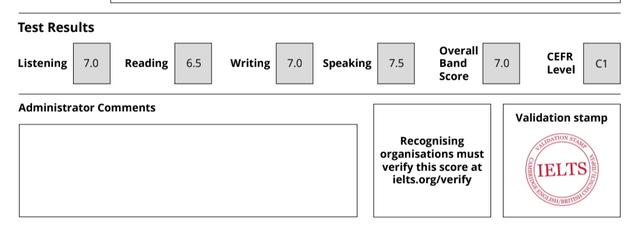
When my result came out less than 24 hours after my computer-based test, I achieved an overall Band 7.0, which corresponds to a C1 level of English proficiency.
My scores were:
- Listening: 7.0
- Reading: 6.5
- Writing: 7.0
- Speaking: 7.5
In this article, I will share exactly how I prepared, what I did right, what I struggled with, and the strategies that helped me achieve my score.
Quick Summary: How I Got IELTS Band 7
If you do not have time to read the full article, these are the biggest lessons from my IELTS journey:
- Practice using official materials so the exam format becomes familiar.
- Do not panic if your mock test scores are lower than your target score.
- IELTS Writing is more about structure and clarity than using difficult vocabulary.
- In Speaking, your goal is to communicate naturally. Your answers do not have to be stories that actually happened in your life.
- Learn to manage your time because each section has strict limits.
- Treat the mock tests as training. If your practice is harder than the real exam, the actual test will feel easier.
💡 You may like to read on: Why My IELTS Mock Scores Were Lower Than My Real Exam Score (From Band 6.5 Practice Tests to Band 7.0 IELTS)
Is Getting Band 7 in IELTS Easy?
The honest answer is yes and no.
If you walk into the exam without understanding the format, Band 7 can be difficult.
However, if you already have a reasonable level of English and spend time understanding what IELTS expects from you, Band 7 is very achievable.
One mistake many students make is treating IELTS like a normal school examination where you need to memorize facts.
IELTS is a language proficiency test. It wants to see whether you can understand information, organize your thoughts, explain ideas, and communicate clearly.
For example, in the Speaking test, you may be asked to describe a person you admire or an experience you had.
The examiner is not checking whether the story really happened. They are assessing your fluency, vocabulary, grammar, and ability to develop an answer.
That understanding changed the way I approached both Speaking and Writing.
My Preparation Strategy
I did not spend my preparation period trying to learn thousands of new words.
My biggest focus was becoming comfortable with the exam.
I used official practice materials and repeatedly exposed myself to the test format.
During my preparation, I often scored around 6.5 in the mock tests. At first, this was frustrating because my target was Band 7.
But I realized something important:
If you practice with difficult materials, the actual exam can feel easier.
If you avoid challenging practice, the real exam becomes your practice session.
How I Scored 7.0 in IELTS Listening
Listening was one section where familiarity mattered a lot.
The biggest thing I learned was that the answers usually come in order. You need to stay focused because the speakers may mention one answer and then correct themselves.
For example, a speaker may say one date or location and then immediately change it.
If you only listen for keywords, you can easily lose marks.
My advice is to practice actively, learn different accents, and train yourself to follow the conversation from beginning to end.
Why Reading Was My Lowest Score at 6.5
Reading was actually my most difficult section.
The challenge was not understanding English. The challenge was speed.
Sometimes, I knew the answer was somewhere in the passage but finding the exact sentence under time pressure was difficult.
The biggest skills you need are skimming, scanning, and recognizing paraphrased words.
The passage may not use the exact same words that appear in the question.
Because of this, I recommend practicing with a timer rather than simply reading articles casually.
How I Scored 7.0 in IELTS Writing
Writing was the section where having a structure helped me the most.
For Task 1, I followed a simple structure:
Introduction
Overview
Body paragraph 1
Body paragraph 2
There is no need for a conclusion.
For the overview, I focused on the main trends. For example, what increased, what decreased, or what remained stable.
For Task 2, my structure was:
Introduction
Body paragraph 1
Body paragraph 2
Conclusion
I made sure my opinion was clear whenever the question required it.
Another important lesson I learned was that IELTS is not testing whether your examples are historically accurate or based on your real personal experiences.
Your examples simply need to be relevant and allow you to demonstrate your ability to explain ideas clearly using good grammar and vocabulary.
How I Scored 7.5 in IELTS Speaking
Speaking ended up being my highest score.
My strategy was simple.
I treated the examiner like a person I was having a conversation with.
I did not try to memorize perfect answers because memorized responses often sound unnatural.
Instead, I focused on extending my answers.
If the examiner asked me a simple question, I did not just give a one-sentence response. I explained why, gave examples, and continued speaking naturally.
My IELTS Test Day Experience in Nigeria
One thing that surprised me was how organized the computer-based IELTS process was.
There were identity checks, fingerprint verification, photographs, and security procedures before entering the exam room.
Once I sat down, the computer system guided me through each section, including instructions on how to use the interface and adjust settings.
Because I had practiced on a computer beforehand, the actual environment felt familiar.
Does IELTS Band 7 Mean C1?
Yes.
An IELTS Band 7 generally corresponds to a C1 level on the Common European Framework of Reference for Languages.
A C1 level means you can use English effectively in academic and professional situations.
This score is accepted by many universities and organizations around the world.
Final Thoughts
Looking back, the biggest reason I achieved Band 7 was not because I knew every difficult English word.
It was because I understood the exam.
I learned the format, practiced consistently, identified my weak areas, and developed strategies for each section.
If you are currently getting 6.0 or 6.5 in your mock tests, do not panic.
Your practice score does not always determine your final result.
Use the mock tests to identify your mistakes, improve your approach, and build confidence.
With the right preparation, achieving an IELTS Band 7 is absolutely possible.
FAQs
Can I get IELTS Band 7 in 3 weeks?
Yes, it is possible, especially if you already have a good foundation in English. Your preparation should focus on understanding the exam format, practicing your weak sections, and improving your time management.
How many marks do I need to get Band 7 in IELTS?
For IELTS Academic, Band 7 generally requires around 30 to 32 correct answers out of 40 in Listening and around 30 out of 40 in Reading, depending on the scoring scale used for the specific test.
Is IELTS Band 7 considered good?
Yes. IELTS Band 7 is considered a good score and corresponds to a C1 level of English proficiency. It meets the English requirements of many universities and professional organizations.
What was my biggest IELTS mistake?
My biggest challenge was worrying too much about my practice scores. Looking back, the mock tests were training tools, not predictions of my final score.
Should I memorize answers for IELTS Speaking?
No. Memorizing complete answers can make your speech sound unnatural. It is better to understand common topics, develop your ideas naturally, and speak confidently.
About the Author
Mohammad-Jamiu B. Balogun, GMNSE
AI Security Researcher · Founder, MonoEd Africa
Mohammad-Jamiu is a First-Class Telecommunications Engineer and Best Graduating Student (BUK), and an AI security researcher. He founded MonoEd Africa to give Nigerian students AI-powered academic tools — from SIWES logbooks to final year projects. His work has reached over 10,000 students across Nigeria.