How to Choose a Final Year Project Topic in Nigeria (2026 Guide)
Learn how to choose a strong final year project topic in Nigeria. This step-by-step guide covers topic selection, feasibility, originality, supervisor approval, and real examples.

Choosing a final year project topic is one of the most important academic decisions you will make as a Nigerian university or polytechnic student. A good topic makes your research easier, earns supervisor approval faster, and significantly improves your final grade. A poor topic can delay graduation, force topic changes, or lead to weak defense performance.
This guide explains exactly how Nigerian students should choose a final year project topic, whether you are in a university or polytechnic, science or arts, ND, HND, or BSc.
📙 Final Year Project Tools 🔥
FYP Report Generator — Generate full project chapters and citations.
https://fyp.monoed.africa
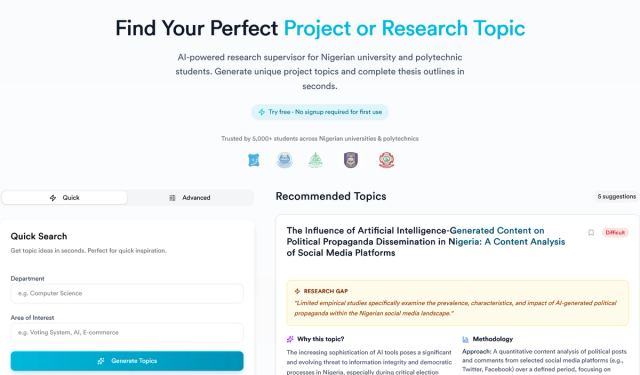
Project Topic Generator — Get supervisor-ready project topics instantly.
https://topics.monoed.africa
Why Your Final Year Project Topic Matters
Your project topic determines:
- How easy it will be to find research materials
- Whether data collection is possible in Nigeria
- How interested your supervisor will be
- How confident you will be during defense
- Your final project score
Many students struggle not because they are bad researchers, but because they choose unrealistic or poorly defined topics.
Step 1: Start With Self-Assessment and Interest
Before searching Google for topics, start with yourself.
Ask Yourself:
- Which courses did I enjoy most?
- Which topics do I understand better than others?
- What real problems do I notice in my field or environment?
Example:
- Computer Science student: fintech, e-commerce, AI, cybersecurity
- Accounting student: taxation, auditing, forensic accounting
- Education student: teaching methods, curriculum evaluation
- Engineering student: system optimization, materials testing
Choosing a topic you are genuinely interested in helps you stay motivated when research becomes difficult.
Step 2: Identify a Real Problem or Research Gap
Strong final year projects solve problems or improve understanding.
Where to Find Problems:
- Nigerian society and institutions
- Industry practices
- Government policies
- Technology adoption gaps
- Organizational inefficiencies
Example:
Instead of choosing
“The Impact of Social Media”r
Refine it to
“The Impact of Social Media Marketing on Consumer Purchase Decisions in Lagos State”
This shows clarity, scope, and relevance.
💡 If you are struggling to narrow your ideas into supervisor-approved topics, you can use the MonoEd Project Topic Generator for Nigerian students to generate department-specific project topics based on your interests, difficulty level, and available resources.
Step 3: Check If the Topic Is Researchable in Nigeria
A topic may sound intelligent but still be a bad choice if it is not researchable.
Confirm the Following:
- Are journals and previous studies available?
- Can you access data or respondents?
- Is the topic suitable for undergraduate level?
- Can it be completed within the academic calendar?
💡 You can easily get available papers for your project topic by inputting your topic and search on MonoEd Papers Finder.
Practical Test:
Type your proposed topic on Google Scholar or Google search.
If you cannot find related studies, journals, or theses, the topic may be risky.
Avoid topics that require:
- Expensive laboratory equipment you do not have
- Confidential company data
- National datasets you cannot access
Step 4: Ensure Availability of Recent Research Materials
Most Nigerian supervisors expect references that are not older than 10 to 11 years.
Before committing to a topic:
- Check journal publication dates
- Review reference lists of similar projects
- Ensure you can find recent Nigerian or international studies
Old references weaken your literature review and reduce marks.
Step 5: Narrow and Refine Your Topic
Broad topics cause confusion and poor grading.
Bad Topic:
“Poverty in Nigeria”
Better Topic:
“The Effect of Microfinance Banks on Poverty Reduction in Ibadan Metropolis”
A refined topic clearly states:
- Independent variable
- Dependent variable
- Location or scope
This structure makes your research objectives and methodology easier to define.
Step 6: Check Feasibility and Cost
Feasibility means whether you can realistically complete the project.
Consider:
- Cost of printing questionnaires
- Transportation for fieldwork
- Internet and data access
- Time left before submission
If a topic will overstretch your budget or timeline, drop it early.
Step 7: Discuss With Your Supervisor Early
Never finalize a topic without supervisor input.
Why Supervisor Approval Matters:
- Some supervisors already have preferred areas
- They guide you away from weak or rejected topics
- Early discussion saves time and prevents topic changes
Present 2 to 3 refined topic options, not just one.
Step 8: Use Smart Tools to Generate and Validate Topics
Many Nigerian students now use AI tools to refine ideas.
A project topic generator can help you:
- Generate department-specific topics
- Adjust difficulty level
- Factor in data access and resources
- Create supervisor-ready titles
This saves days of stress and increases approval chances.
Examples of Strong Final Year Project Topics
Management and Social Sciences
- The Effect of Employee Motivation on Organizational Productivity in Nigerian SMEs
- Customer Relationship Management and Business Growth in Lagos Retail Firms
Computer Science and IT
- Design and Implementation of an Online Voting System
- Machine Learning Approach to Credit Risk Prediction in Nigerian Banks
Education
- Impact of Teaching Methods on Academic Performance of Secondary School Students
Sciences
- Analysis of Water Quality and Public Health Implications in Urban Nigeria
Common Mistakes Nigerian Students Make
- Choosing topics copied directly from past projects
- Selecting topics with no Nigerian relevance
- Ignoring data availability
- Using outdated references
- Avoiding supervisor discussions
- Choosing topics that are too complex
Avoiding these mistakes alone can significantly improve your final grade.
How This Fits With Writing Your Final Year Project
Once your topic is approved, the next step is writing it correctly. Follow our complete step-by-step guide on how to write a final year project in Nigeria to structure your chapters, methodology, and references properly.
Your earlier guide on How to Write Your Final Year Project in Nigeria already explains:
- Chapter structure
- Methodology formats
- Referencing styles
- Use of AI tools for outlines and citations
This article focuses strictly on choosing the right topic, which is the foundation of that entire process.
Conclusion
Choosing the right final year project topic in Nigeria is not about sounding intelligent. It is about clarity, feasibility, relevance, and originality. When your topic is strong, the rest of the project becomes easier.
Start with your interest, confirm research availability, refine the scope, consult your supervisor early, and choose a topic you can confidently defend.
A good topic does not just help you graduate. It sets the tone for your academic and professional future.
FAQs
Can I reuse a topic from a previous student?
You can get inspiration, but your topic must be original or have a clearly defined new angle.
How many topics should I submit to my supervisor?
At least two or three refined options.
Is it okay to choose a topic suggested by my supervisor?
Yes, as long as you understand it and have interest in it.
Should I choose an easy topic or a complex one?
Choose a topic that balances simplicity, relevance, and originality. Complex topics are not automatically better.
Can AI help me choose a project topic?
Yes, AI can assist with idea generation and refinement, but you must still understand and defend the topic.
About the Author
Mohammad-Jamiu B. Balogun, GMNSE
AI Security Researcher · Founder, MonoEd Africa
Mohammad-Jamiu is a First-Class Telecommunications Engineer and Best Graduating Student (BUK), and an AI security researcher. He founded MonoEd Africa to give Nigerian students AI-powered academic tools — from SIWES logbooks to final year projects. His work has reached over 10,000 students across Nigeria.