How to Fill Your SIWES Logbook as a Microbiology Student (With Week 1 and Week 2 Examples)
Learn how to fill your SIWES logbook as a Microbiology student with clear daily and weekly examples. Includes practical lab tasks, sample entries, and free AI tools to simplify your logbook writing.

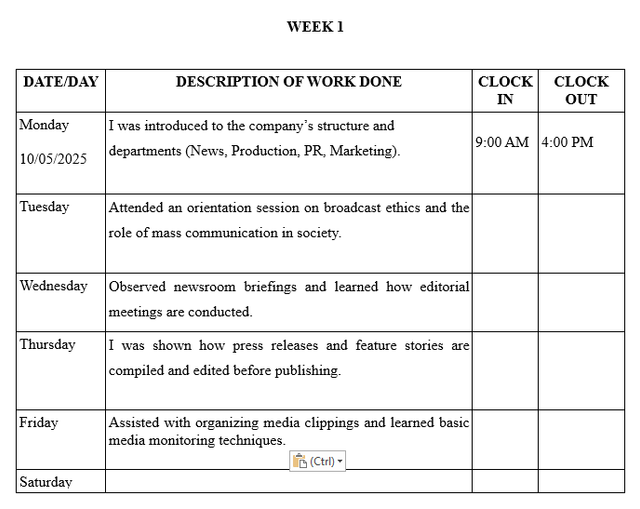
If you are a Microbiology student in SIWES and you are confused about what to write in your logbook, you are not alone. Your logbook is an official record that shows your school and industrial supervisor exactly what you learned, observed and practiced each day. A well written logbook boosts your final grade and reflects your professionalism.
This guide explains what to write, how to write it, and includes real examples for your first two weeks.
What to Fill in the Front Pages
If this is your first time opening your logbook, here is the information you need to fill in the early few pages.
Student Information
- Include your name, matric number, department, institution, level, and session.
Organization Information
- Include the lab or facility name, address, supervising microbiologist, phone number, and email.
Training Duration
- Record your start and end dates.
Supervisor Signatures
- Ensure your industry and school supervisors sign at the required times.
What Your Microbiology Logbook Should Contain
Every daily entry should cover the following:
- Day and date
- Tasks you observed or performed
- Equipment and materials used
- Reagents or chemicals involved
- Techniques applied
- What you learned
- Signature space for your supervisor at the end of the week
Avoid vague statements like "did lab work". Instead, be clear and specific, for example:
- “Prepared nutrient agar for bacterial culturing.”
- “Performed Gram staining and observed cocci under the microscope.”
- “Assisted in receiving blood samples and labeling collection bottles.”
⚡ SIWES Tools for Students 🔥
Use our free AI-powered tools to make SIWES easier.
SIWES Report Generator — Generate a formatted SIWES report instantly.
https://report.monoed.africa
SIWES Logbook Generator — Create weekly logbook entries in seconds.
https://logbook.monoed.africa
SIWES / IT Placement Finder — Find verified SIWES & IT placement opportunities.
https://siwesfinder.monoed.africa
📙 Final Year Project Tools 🔥
FYP Report Generator — Generate full project chapters and citations.
https://fyp.monoed.africa
Project Topic Generator — Get supervisor-ready project topics instantly.
https://topics.monoed.africa
Tips for Writing a Good SIWES Logbook
Here are practices that match school expectations across Nigeria:
1. Write in past tense
Examples:
- “I observed…”
- “I assisted in…”
- “I participated in…”
2. Be specific
Mention the test or procedure.
For example:
- PCV
- Gram staining
- Widal
- Urine MCS
- Blood grouping
- Culture and sensitivity
- Microscopy of stool or sputum
3. Mention equipment
Examples include:
- Microscope
- Autoclave
- Centrifuge
- Incubator
- Spectrophotometer
- Pipettes
- Petri dishes
4. Mention reagents where applicable
Examples:
- Crystal violet
- Safranin
- Normal saline
- Antisera
- Culture media like MacConkey agar or nutrient agar
5. Keep a jotter
Write rough notes daily, then transfer the clean version into the logbook neatly.
6. Get weekly signatures
Your supervisor should sign at the end of every week.
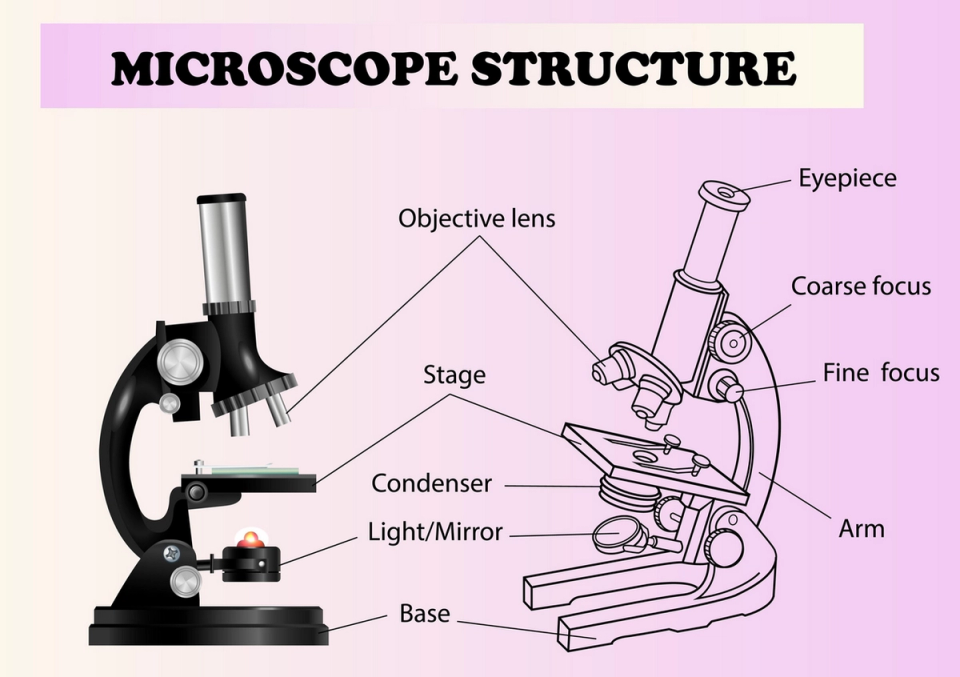
7. Add drawings when possible
Sketch items like a microscope, autoclave, Gram stain setup or culture plate layout.
Tips for diagrams:
- Use pencil, not pen or biro, so errors can be corrected.
- Label all parts clearly (e.g., bacterial colonies, culture plates, slides).
- Draw diagrams only when necessary – such as Gram staining results or microbial arrangements.
- Keep diagrams simple and readable – accuracy matters more than artistry.
- Include a brief caption describing the diagram, e.g., “Gram-positive cocci observed under 100x oil immersion.”
Sample SIWES Logbook Entries for Microbiology Students
These examples assume you were posted to a diagnostic or medical laboratory.
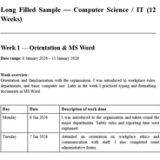
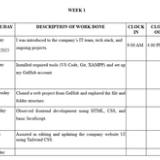
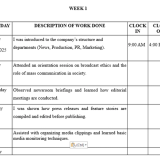
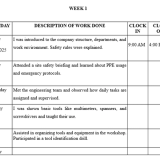
Week 1: Orientation and Introduction to Microbiology Laboratory
| Day | Activities |
|---|---|
| Monday | Reported to the diagnostic lab and received a general orientation. Introduced to staff and taken through the various departments. Observed basic laboratory rules, safety protocols and patient confidentiality guidelines. |
| Tuesday | I observed procedures for receiving clinical samples such as urine, stool and blood. Learned the correct method for labeling specimen containers and recording patient information. |
| Wednesday | Participated in basic hygiene practices in the lab. Learned the correct use of PPE including gloves, coats and face masks. Observed disinfection of benches and proper waste disposal methods. |
| Thursday | Observed the autoclave and learned its function in sterilizing glassware and media. Watched preparation of simple solutions such as normal saline. |
| Friday | Today, I assisted in cleaning laboratory surfaces and organizing shelves. Reviewed safety rules with a senior technologist to reinforce understanding. |
Week 2: Sample Handling, Media Preparation and Basic Techniques
| Day | Activities |
|---|---|
| Monday | I observed urinalysis using dipsticks and assisted in recording results. Learned the importance of proper timing and color interpretation. |
| Tuesday | Assisted in preparing culture media including nutrient agar and MacConkey agar. Measured components, dissolved powders and observed sterilization in the autoclave. |
| Wednesday | Learned and practiced sample handling techniques such as mixing anticoagulated blood samples. Observed PCV measurement and recording. |
| Thursday | I watched a full demonstration of the Gram staining procedure. Observed differences between Gram positive and Gram negative organisms under the microscope. |
| Friday | Assisted in performing blood group tests using anti A, anti B and anti D reagents. Cleaned used slides and prepared them for reuse. |
Common Microbiology Tests and Procedures You Can Mention
| Test or Technique | Description |
|---|---|
| Gram Staining | For identifying bacterial groups and morphology |
| Urine MCS | Microscopy, culture and sensitivity |
| Stool MCS | For parasite and bacterial detection |
| Widal Test | Typhoid diagnosis |
| PCV | Packed cell volume measurement |
| Blood Grouping | ABO and Rh classification |
| ESR | Inflammation test |
| Hormone tests | For labs that run ELISA kits |
| Spectrophotometry | For quantitative biochemical tests |
| Culture and Isolation | Using streak plate and other methods |
Quick Writing Formula for Each Day
Here is an easy structure you can follow:
1. Start with what you observed
2. State what you assisted in or performed
3. Mention materials or equipment used
4. State what you learned
Example:
“I observed the preparation of nutrient agar and assisted in pouring the media into sterile Petri dishes. I used a hot plate, conical flask, pipettes and the autoclave. I learned how to maintain aseptic conditions during media preparation.”
Want to Write Faster? Automate Your Daily Entries
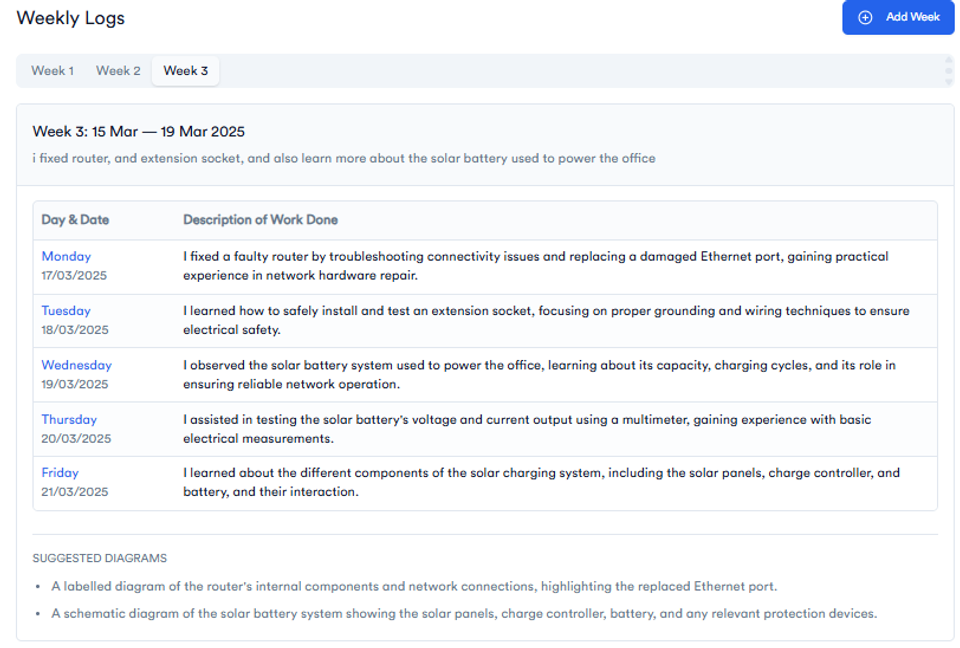
Instead of manually writing your daily entries for 24 or more weeks, you can use MonoEd SIWES logbook generator.
Just type a short weekly summary and get polished Monday to Friday entries instantly.
📘 SIWES Logbook Generator – Instantly create weekly logbook entries.
📑 SIWES Report Draft Generator – Generate a full SIWES report draft in minutes.
🎓 Trusted by 1,000+ Nigerian students.
👉 Try them now and save hours of work.
About the Author
Mohammad-Jamiu B. Balogun, GMNSE
AI Security Researcher · Founder, MonoEd Africa
Mohammad-Jamiu is a First-Class Telecommunications Engineer and Best Graduating Student (BUK), and an AI security researcher. He founded MonoEd Africa to give Nigerian students AI-powered academic tools — from SIWES logbooks to final year projects. His work has reached over 10,000 students across Nigeria.