SIWES Technical Report for Civil Engineering / Construction (Free Sample + PDF/Word Download) 2026
Free Civil Engineering SIWES report sample for Nigerian students. Download filled Word + PDF, see correct chapter format for site/road work, and finish your technical report fast.

Writing a Civil Engineering SIWES technical report can be challenging if you have never seen a properly completed example. Many students are unsure how to structure each chapter, describe their site activities, or present their industrial experience in a way that meets their department's requirements.
To make the process easier, this page provides a complete SIWES technical report sample for Civil Engineering students in Nigeria. Whether you need an editable Word document or a Civil Engineering SIWES report sample PDF, you can download both versions below and adapt them to reflect your own industrial training experience.
Quick Summary
- Complete Civil Engineering SIWES report sample
- Available in Word and PDF
- Includes preliminary pages and Chapters 1 to 4
- Suitable for most Nigerian universities and polytechnics
- Covers common site activities such as earthworks, concrete works, drainage, and road construction
- Edit it to match your own SIWES experience before submission
This sample is intended as a guide rather than a report to submit unchanged. It shows how each section should be organised, the level of detail expected, and the type of content lecturers typically look for. Simply replace the company information and rewrite the industrial experience section to reflect the work you actually carried out during your SIWES attachment.
Free Download — SIWES Technical Report Sample (Civil)
| File | Description | Download |
|---|---|---|
| Filled Sample (Word) | Full report with preliminary pages + Chapters 1–4 | Download Word |
| Filled Sample (PDF) | Same content but in PDF | Download PDF |
Download the editable Word version if you plan to customise the report, or choose the SIWES technical report for Civil Engineering PDF if you simply want a reference copy while writing your own report.
What Is Inside the Sample?
If you're looking for a Civil Engineering industrial training report sample, this report follows the standard chapter structure used by most Civil Engineering departments in Nigerian universities and polytechnics.
Preliminary Pages
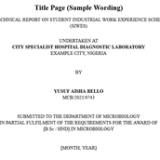
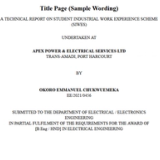
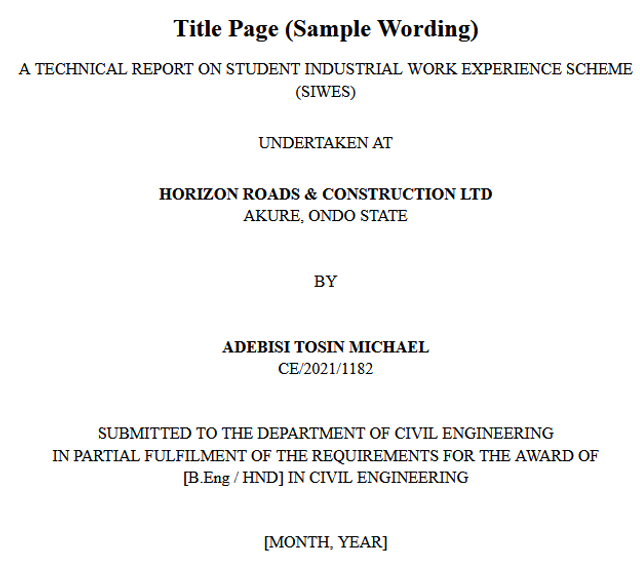
- Title / Cover Page
- Certification
- Dedication
- Acknowledgement
- Abstract
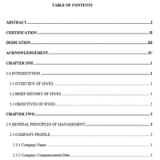
- Table of Contents
- List of Figures / Tables
Main Chapters
- Chapter One introduces SIWES, explains the objectives of the training, and outlines the scope of the report.
- Chapter Two describes the host organisation, including its history, structure, departments, and the type of construction projects undertaken.
- Chapter Three explains the practical work completed during the attachment, including site activities, equipment used, safety procedures, and technical skills acquired.
- Chapter Four summarises the overall experience, lessons learned, challenges encountered, and recommendations.
Back Matter
- References
- Appendices (site photos, organogram, road layer sketch, logbook extracts)
Preview: Chapter One — Introduction
1.0 Introduction
The Student Industrial Work Experience Scheme (SIWES) was established by the Industrial Training Fund (ITF) to expose students in engineering and technology courses to real industrial work environments before graduation. It is designed to bridge the gap between classroom theory and practical field experience.
1.1 Background of SIWES
SIWES was introduced in 1973 to ensure that students in higher institutions acquire technical skills and industrial experience relevant to their various disciplines. The scheme is funded by the Federal Government and coordinated by the ITF, with individual universities and polytechnics supervising their students.
1.2 Objectives of the Report
This report documents the industrial training undertaken at [Company Name], [City], from [Start Date] to [End Date]. It describes the host organisation, the nature of work carried out on the construction site, the equipment and tools used, and the technical and soft skills acquired during the attachment.
1.3 Scope of the Report
The report covers site orientation, safety procedures, setting-out, earthworks, compaction, drainage construction, concrete works, asphalt paving observation, and general site maintenance activities carried out under supervision.
Preview: Chapter Three — Industrial Experience (Excerpt)
3.1 Site Orientation and Safety
On resumption, I attended a site induction programme where I was briefed on company safety policies, traffic control on active construction zones, and the proper use of personal protective equipment (PPE). I was issued a safety helmet, reflective vest, steel-toed boots, and hand gloves. I was also shown the location of first-aid kits and the procedure for reporting site incidents.
3.2 Activities and Work Done
During the attachment period, I participated in the following activities under the supervision of site engineers and foremen:
- Setting-out assistance: I assisted in laying out building lines and road alignments using pegs, ranging rods, and measuring tapes. I observed the use of total stations and dumpy levels for accurate levelling and alignment.
- Earthworks and excavation: I assisted in clearing vegetation, stripping topsoil, and observing bulk excavation for road embankments and building foundations. I learned how to read cut-and-fill levels from survey drawings.
- Compaction and layer works: I observed the placement and compaction of laterite sub-base and stone base courses using vibratory rollers and plate compactors. I assisted in checking layer thicknesses and moisture content before compaction.
- Drainage construction: I assisted in excavating drainage trenches, laying precast concrete pipes, and backfilling with selected granular material. I learned the importance of gradient and flow direction in surface water control.
- Concrete works: I assisted in batching, mixing, and casting concrete for kerbs, slabs, and small drainage structures. I observed slump tests and the proper curing of concrete members.
- Asphalt paving observation: I observed the laying of asphalt wearing course, including temperature checks, rolling patterns, and joint construction. I assisted in checking surface levels and edge alignment.
- Site documentation: I assisted in recording daily progress, taking site photographs, and filing material delivery notes.
3.3 Tools and Equipment Used
| Tool / Equipment | Purpose |
|---|---|
| Measuring tape | Distance and dimension measurement |
| Ranging rods and pegs | Setting-out and alignment |
| Dumpy level / Total station | Levelling and surveying |
| Shovel and pickaxe | Excavation and material spreading |
| Vibratory roller / Plate compactor | Compaction of soil and base layers |
| Concrete mixer | Mixing concrete on site |
| Wheelbarrow | Transporting materials |
| PPE (helmet, vest, boots, gloves) | Personal safety on active site |
3.4 Skills Acquired
- Technical: construction sequence understanding, setting-out basics, earthwork measurement, compaction control, drainage layout, concrete handling, drawing interpretation.
- Soft skills: site discipline, teamwork with labourers and artisans, communication with site engineers, punctuality, and adherence to safety protocols.
How to Use This Sample
- Download the Word file using the button above.
- Replace bracketed placeholders — change
[Company Name],[City],[Start Date], and all specific details to match your real placement. - Rewrite Chapter Three — Keep the structure, but describe the actual work you did. If you worked on a building site instead of a road project, swap the tasks (formwork, reinforcement observation, blockwork, plastering, finishing, etc.).
- Add your diagrams — Insert your host company’s organogram, site photos, road layer sketches, or building plans your supervisor provided.
- Match your school’s format — Check your department’s SIWES handbook for font type, line spacing, and margin requirements. Apply them before printing.
- Get signed — Ensure your certification page is signed by your site supervisor and school coordinator.
This document serves as a practical Civil Engineering SIWES report example. Use the structure as a guide, but ensure every activity described reflects your own industrial training experience.
Common Mistakes to Avoid
- Copying another student’s company details — Lecturers recognise reused company names and project locations.
- Claiming plant operation you were not authorised to do — Do not write that you operated an excavator or roller if you only observed. Observation and assistance are valid.
- Skipping PPE and site safety — Civil Engineering reports must mention safety. Supervisors look for this.
- Thin Chapter Three — This is the most important chapter. Write detailed, specific paragraphs about your daily site work.
- No diagrams or photos — Most departments expect an organogram, site photos, or sketches in the appendix.
SIWES Report vs SIWES Logbook
| SIWES Technical Report | SIWES Logbook | |
|---|---|---|
| What it is | A formal document with chapters | A weekly diary of daily activities |
| Length | 25–50 pages (depending on school) | Usually one page per week |
| Submitted to | School department | Supervisor (weekly signatures) |
| Contains | Background, company profile, work done, conclusion | Day-to-day tasks, reflections, supervisor comments |
You need both to complete your SIWES requirement. If you still need to fill your logbook, you can generate entries instantly:
👉 Generate SIWES Logbook Entries
FAQs
What is the correct SIWES report format for Civil Engineering?
Preliminary pages (title, certification, abstract, table of contents) followed by four chapters: Introduction, Host Organisation, Industrial Experience, and Conclusion/Recommendations. End with references and appendices.
How many pages should a Civil Engineering SIWES report be?
Most departments expect roughly 25 to 50 pages, including diagrams and appendices. Check your SIWES handbook for the exact minimum.
Can I submit the filled sample exactly as it is?
No. You must customise it with your real company name, location, dates, and the actual work you performed. Submitting a generic sample is academic misconduct.
What if I only did LGA road maintenance or minor drainage work?
That is perfectly valid. Focus your Chapter Three on patching, drainage clearing, earthworks, compaction, and safety. You do not need to invent major highway construction experience.
Is there a PDF version available?
Yes. Both Word and PDF versions are available in the download table above.
How do I write the Abstract?
Keep it to one page. State where you did your IT, which unit or site you worked on, the duration, and a summary of the activities and skills covered in the report. See the sample file for the exact wording.
Can I use this sample for Building Technology or Quantity Surveying too?
Yes. The structure is identical. Simply replace the civil/site tasks with building-specific work such as formwork, reinforcement, block laying, plastering, or bill preparation.
How can I finish my report faster?
Download the filled sample, replace the placeholders with your own details, edit Chapter Three to reflect the work you actually carried out, add your diagrams, and format the report according to your department's requirements before submission.
If you prefer to create a personalised report instead of editing a sample, you can use the MonoEd SIWES Report Generator to generate a draft tailored to your placement.
About the Author
Mohammad-Jamiu B. Balogun, GMNSE
AI Security Researcher · Founder, MonoEd Africa
Mohammad-Jamiu is a First-Class Telecommunications Engineer and Best Graduating Student (BUK), and an AI security researcher. He founded MonoEd Africa to give Nigerian students AI-powered academic tools — from SIWES logbooks to final year projects. His work has reached over 10,000 students across Nigeria.