How to Write a Literature Review: A Step by Step Guide for Research Papers, Proposals, and Dissertations
Learn how to write a literature review step by step for a research paper, proposal, thesis, or dissertation. Discover the best structure, examples, common mistakes, and practical writing tips.

Quick Summary
A literature review is more than a summary of previous studies. It analyzes, compares, and connects existing research to show what is already known, where researchers disagree, and what gaps still exist. To write a strong literature review, define your research question, find relevant studies, organize them by themes or ideas, critically evaluate each source, and connect the findings to your own research rather than discussing each paper separately.
If you have ever stared at dozens of journal articles wondering how to turn them into a literature review, you are not alone.
Many students think a literature review is simply a collection of summaries. They read one paper, summarize it, move to the next paper, and continue until they have several pages of notes.
That approach rarely produces a good literature review.
A strong literature review tells a story. It explains how research on a topic has developed over time, what researchers agree on, where debates exist, and what questions remain unanswered. Most importantly, it shows why your own research is needed.
Whether you are writing a final year project, research proposal, thesis, dissertation, or journal article, this guide will walk you through the entire process.
What Is a Literature Review?
A literature review is a critical analysis of existing research related to your topic.
Instead of simply listing previous studies, you evaluate them, compare their findings, identify patterns, and explain how they relate to your own research.
Think of it as answering these questions:
- What do researchers already know?
- What methods have they used?
- Where do they agree?
- Where do they disagree?
- What problems remain unsolved?
- How will my research contribute?
Your literature review provides the foundation for your study.
Why Is a Literature Review Important?
A good literature review helps you:
- Understand existing knowledge on your topic
- Avoid repeating previous research
- Identify research gaps
- Support your research questions
- Build a theoretical foundation
- Demonstrate your understanding of the field
Without a literature review, readers cannot understand how your study fits into existing research.
When Do You Need a Literature Review?
You may need to write one for:
- Research papers
- Final year projects
- Undergraduate dissertations
- Master's theses
- PhD dissertations
- Research proposals
- Journal articles
- Scholarship applications
Although the length varies, the purpose remains the same: explain what previous research says about your topic.
Step 1: Define Your Research Question
Before searching for papers, be clear about what you are studying.
For example:
Too broad:
Social media and education
Better:
The impact of social media on academic performance among university students in Nigeria
A focused topic makes it much easier to find relevant literature.
Ask yourself:
- What problem am I studying?
- Which population am I focusing on?
- What time period matters?
- Which theories relate to my research?
Step 2: Search for Relevant Literature
Once your topic is clear, begin searching for academic sources.
Useful sources include:
- Google Scholar
- University library databases
- PubMed
- IEEE Xplore
- ScienceDirect
- SpringerLink
- JSTOR
- Scopus
Use combinations of keywords instead of a single phrase.
For example:
- social media AND academic performance
- undergraduate students AND learning outcomes
- AI AND academic writing
- cybersecurity AND machine learning
Searching multiple variations usually produces better results.
Step 3: Evaluate Your Sources
Not every article belongs in your literature review.
Ask these questions before including a source:
- Is it relevant to my research question?
- Was it published in a reputable journal?
- Is it recent enough?
- Does it provide useful evidence?
- Is the methodology reliable?
Choose quality over quantity.
Twenty highly relevant studies are usually better than fifty unrelated ones.
Step 4: Take Notes While Reading
Avoid reading papers without recording important information.
Create a simple table like this.
| Author | Year | Research Question | Method | Findings | Limitations |
|---|---|---|---|---|---|
| Smith | 2024 | AI in education | Survey | Improved learning | Small sample |
| Ahmed | 2025 | Student engagement | Interviews | Mixed results | Single university |
This makes writing much easier later.
Step 5: Group Studies by Themes
One of the biggest mistakes students make is discussing papers one after another.
Instead of this:
Smith (2023) found...
Johnson (2024) found...
Ahmed (2025) found...
Organize studies into themes.
For example:
Theme 1: Benefits of Artificial Intelligence in Education
Discuss multiple studies together.
Compare their findings.
Highlight similarities and differences.
Theme 2: Challenges of AI Adoption
Discuss studies reporting ethical concerns, bias, or privacy issues.
Theme 3: Future Research Directions
Explain what researchers still do not know.
Grouping by themes creates a much stronger literature review.
Step 6: Compare Rather Than Summarize
A literature review is about analysis.
Instead of writing:
Smith found that online learning improves performance.
Try this:
Several studies suggest that online learning improves academic performance. Smith (2024) reported higher student engagement, while Ahmed (2025) found improvements only among self motivated learners. Johnson (2023), however, observed no significant difference between online and traditional classrooms, suggesting that the effectiveness of online learning may depend on course design and student characteristics.
Notice how multiple studies are connected.
That is synthesis.
Step 7: Identify Research Gaps
One purpose of a literature review is showing why your research matters.
Research gaps may include:
- Limited studies in your country
- Small sample sizes
- Conflicting findings
- Outdated research
- Missing variables
- Weak methodologies
For example:
Although previous studies have examined AI adoption in higher education, very few have focused on universities in Nigeria. This study addresses that gap by examining...
That transition naturally leads into your own research.
Step 8: Write the Literature Review
A typical literature review contains three main sections.
Introduction
Introduce the topic.
Explain the scope of the review.
State how the literature is organized.
Example:
This literature review examines existing research on artificial intelligence in higher education. It focuses on learning outcomes, student engagement, ethical concerns, and current research gaps.
Main Body
This is the largest section.
Organize it using themes rather than individual papers.
Each section should:
- Introduce the theme
- Compare findings
- Discuss disagreements
- Evaluate strengths and weaknesses
- Connect studies together
Avoid writing isolated summaries.
Conclusion
Summarize the major findings.
Highlight important gaps.
Explain how your study builds on previous research.
Example Literature Review Structure
A review about AI in academic writing could look like this:
Introduction
AI Writing Tools
- Growth of AI assistants
- Adoption in universities
Benefits
- Faster drafting
- Improved grammar
- Research support
Challenges
- Fake citations
- Academic integrity
- Overreliance on AI
Research Gaps
- Few studies in African universities
- Limited evidence from undergraduate students
Conclusion
This structure is much easier to follow than discussing papers one by one.
Common Mistakes to Avoid
Many literature reviews become weak because students make avoidable mistakes.
Do not:
- Summarize every paper separately
- Include unrelated studies
- Ignore conflicting findings
- Use outdated references when newer research exists
- Forget to explain research gaps
- Add personal opinions without evidence
- Copy wording from published papers
- Cite sources you have not read
A literature review should demonstrate critical thinking, not just reading.
How AI Can Help You Write a Literature Review
AI can save time during the literature review process, but it should support your research rather than replace it.
General AI assistants can help you:
- Brainstorm keywords
- Explain difficult concepts
- Simplify technical language
- Improve sentence clarity
- Organize themes
However, researchers should always verify citations and read the original papers before including them in a literature review.
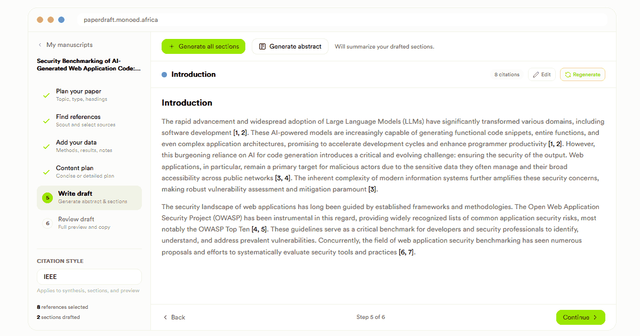
A research focused platform like PaperDraft takes a more structured approach. Instead of generating unsupported references, it allows you to search for relevant papers, select the studies you want to use, organize them into a manuscript structure, and generate literature review sections based on the references you chose. This helps keep your review connected to real sources while reducing repetitive writing tasks.
Tips for Writing a Better Literature Review
- Start reading early
- Keep detailed notes
- Use recent and credible sources
- Group papers into themes
- Compare studies instead of summarizing them
- Identify research gaps clearly
- Keep your writing objective
- Revise multiple times before submission
The best literature reviews are built gradually, not written in one sitting.
Conclusion
Writing a literature review can feel overwhelming at first, especially when you have dozens of papers to read. The key is to stop thinking of it as a long list of article summaries.
Instead, focus on telling the story of your research area. Show how ideas have developed, where researchers agree, where they disagree, and what questions remain unanswered.
By defining a clear research question, organizing studies into themes, comparing evidence, and identifying research gaps, you can produce a literature review that strengthens the rest of your research paper.
If you want to speed up the process, use tools that help you organize real references, plan your manuscript, and generate structured drafts from the sources you have selected. That approach is far more effective than starting from a blank page or relying on unverified AI generated citations.
💡 Continue reading:
- How to Write a Research Paper Fast (Without Sacrificing Quality)
- How to Write a Research Paper in One Day
- How to Publish Your Research for Free
- Why ChatGPT Invents Citations (And How to Avoid Fake References)
FAQs
How do you start writing a literature review?
Start by defining a clear research question. Then search for relevant academic sources, read and evaluate them, organize them into themes, and create an outline before writing.
What is the structure of a literature review?
Most literature reviews include an introduction, a main body organized by themes or topics, and a conclusion that summarizes key findings and identifies research gaps.
How many sources should a literature review have?
There is no fixed number. A small undergraduate project may use 15 to 30 sources, while a dissertation or doctoral thesis may include 100 or more. The focus should always be on relevance and quality rather than quantity.
Can I use AI to write a literature review?
AI can help you brainstorm ideas, organize themes, improve writing, and explain complex concepts. However, you should always read the original studies, verify every citation, and ensure the final review accurately reflects the published research.
What is the biggest mistake when writing a literature review?
The most common mistake is summarizing each paper individually instead of comparing studies, identifying patterns, discussing disagreements, and explaining research gaps.
How do I identify a research gap in a literature review?
Look for areas where previous studies disagree, use limited data, focus on different populations, rely on outdated evidence, or leave important questions unanswered. Your research should aim to address one of these gaps.
How long should a literature review be?
The length depends on your project. A literature review for a research paper may be a few pages, while one for a thesis or dissertation can span an entire chapter. Focus on covering the most relevant studies rather than trying to include every publication on the topic.
About the Author
Mohammad-Jamiu B. Balogun, GMNSE
AI Security Researcher · Founder, MonoEd Africa
Mohammad-Jamiu is a First-Class Telecommunications Engineer and Best Graduating Student (BUK), and an AI security researcher. He founded MonoEd Africa to give Nigerian students AI-powered academic tools — from SIWES logbooks to final year projects. His work has reached over 10,000 students across Nigeria.