How to Write a Research Paper Fast (Without Sacrificing Quality)
Learn how to write a research paper fast with a practical step-by-step process. Discover how to research, outline, draft, and format your paper efficiently while keeping citations accurate.

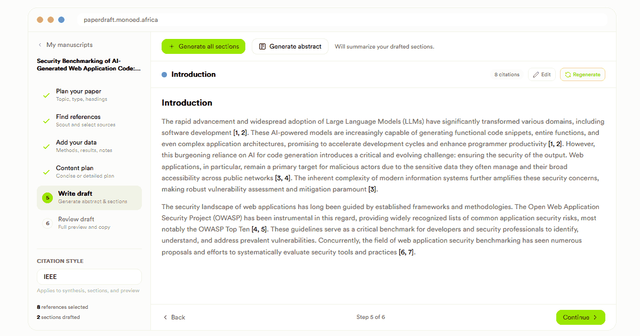
Writing a research paper often feels overwhelming. You open a blank document, spend hours searching for sources, rewrite the first paragraph repeatedly, and suddenly an entire day has passed with little progress.
The truth is that fast research writing is not about typing quickly or letting AI generate random paragraphs. Good researchers write faster because they follow a process. They know what they want to say, have their references ready, and focus on one stage of writing at a time.
Whether you are preparing a university assignment, a conference paper, a journal manuscript, or a scholarship application, these strategies can help you finish your paper faster without reducing its quality.
1. Understand the Goal of Your Paper Before You Start Writing
The fastest way to waste time is to begin writing without a clear direction.
Before opening your document, answer these questions:
- What research question am I answering?
- Who is my target audience?
- What type of paper am I writing?
- What citation style is required?
- What evidence or data will support my arguments?
A clear answer to these questions makes every other step easier. You will know what papers to search for, what sections you need, and what information belongs in your manuscript.
💡 You may like to read on: How to Write a Research Paper in One Day
2. Find Your References Before You Start Drafting
Many researchers make the mistake of writing a paragraph and then stopping every few minutes to search for a citation.
This breaks concentration and makes writing much slower.
Instead, spend dedicated time finding your most relevant papers first. Read their abstracts, save the ones that directly support your topic, and organize them according to the sections of your paper.
For example:
- Introduction: Background studies and research gaps
- Literature review: Previous methods and findings
- Discussion: Papers used for comparison
Having your references ready means you can focus completely on writing.
💡 You may like to read on: How to Turn Your Final Year Project Into a Research Paper
3. Create a Simple Outline Before Writing
A good outline can reduce your writing time significantly.
You do not need a perfect document. A simple structure with headings and bullet points is enough.
For example:
Introduction
- Explain the problem
- Explain why it matters
- Identify the research gap
- State your objective
Methods
- Describe your approach
- Explain materials, participants, or tools
- Describe your process
Results
- Present your findings
- Include important observations
Discussion
- Interpret your results
- Compare with previous studies
- Discuss limitations
Conclusion
- Summarize the main contribution
- Suggest future work
Once you have a roadmap, writing becomes a matter of expanding your points rather than creating ideas from nothing.
4. Write the Body Sections Before the Introduction
One of the biggest mistakes researchers make is spending hours trying to write a perfect opening paragraph.
The introduction is usually easier to write after you already know what your paper contains.
A faster writing order is:
- Methods
- Results
- Discussion
- Conclusion
- Introduction
- Abstract
By leaving the introduction and abstract until the end, you can accurately summarize your completed work.
💡 You may like to read on: How to Publish Your Research for Free
5. Separate Writing From Editing
Trying to write and edit at the same time slows everything down.
During your first draft:
- Do not worry about perfect grammar.
- Do not spend ten minutes changing a sentence.
- Leave placeholders for missing information.
- Keep moving forward.
Your goal is to create a complete draft.
After that, return for editing, where you improve clarity, fix grammar, check your logic, and verify your references.
6. Use AI Carefully to Speed Up Research Writing
AI tools can dramatically reduce the time needed to organize and draft a paper. However, using AI incorrectly can create serious problems.
A common issue with general AI chat tools is that they may generate references that do not exist or cite papers inaccurately. This means researchers must spend extra time verifying every source.
A better approach is to use AI as a writing assistant while keeping your actual sources, methods, and results under your control.
For example, a structured research writing tool like PaperDraft allows you to select real academic papers, add your own methods and results, generate a content plan, and write sections with citations linked to sources you chose. This helps you write faster without losing academic credibility.
7. Do Not Spend Hours Formatting Citations at the End
Many researchers underestimate how much time formatting takes.
Changing between APA, IEEE, Harvard, or other citation styles manually can take hours, especially for long manuscripts.
Using tools that manage references and update formatting automatically can save significant time and reduce mistakes.
8. Work Section by Section Instead of Trying to Finish Everything at Once
A research paper feels difficult when viewed as a single large task.
Break it into smaller goals:
Day 1:
- Define your topic
- Find references
- Create an outline
Day 2:
- Write methods and results
Day 3:
- Write discussion and conclusion
Day 4:
- Complete introduction and abstract
Day 5:
- Edit and format your paper
Even a complex manuscript becomes manageable when divided into smaller steps.
Common Mistakes That Make Research Papers Take Longer
Avoid these time-consuming habits:
- Searching for references while writing every paragraph
- Editing sentences before finishing the draft
- Using too many unrelated sources
- Writing without an outline
- Manually formatting citations at the last minute
- Relying on AI-generated information without checking sources
Write Research Papers Faster With PaperDraft
Writing quickly is not about replacing your thinking. It is about removing repetitive tasks that slow you down.
With PaperDraft, researchers can:
- Search and select real academic references
- Generate a research outline before drafting
- Add their own methods, results, and limitations
- Generate sections with citations from selected papers
- Switch between APA, IEEE, Harvard, Chicago, MLA, and Vancouver styles instantly
- Export manuscripts as Word, Markdown, LaTeX, or BibTeX
Instead of jumping between multiple tabs, citation tools, and documents, you can keep your entire research writing workflow in one place.
Start with the free plan and generate your first two sections before upgrading.
Conclusion
Writing a research paper fast does not mean taking shortcuts or producing low-quality work. The fastest researchers are usually the most organized.
They collect their references early, create a structure before writing, draft sections without constant editing, and use tools that reduce repetitive tasks.
If you want to speed up your workflow, tools like PaperDraft can help by keeping your selected references, your data, your manuscript structure, and your citations in one place so you spend more time thinking about your research and less time managing documents.
💡 Continue reading:
- How to Write a Research Paper in One Day
- How to Turn Your Final Year Project Into a Research Paper
- How to Publish Your Research for Free
- Why ChatGPT Invents Citations (And How to Avoid Fake References)
FAQs
Can I write a research paper in one day?
Yes, a short research paper can be completed in one day if you already have your topic, references, and necessary data. For longer academic papers, a few days or weeks is usually more realistic.
What is the fastest order to write a research paper?
A fast approach is to write the methods, results, discussion, conclusion, introduction, and abstract in that order. This allows your opening sections to reflect what you actually wrote.
Can AI write a research paper for me?
AI can help with outlining, improving clarity, summarizing information, and drafting sections. However, researchers should always verify citations, provide their own data, and review the final manuscript for accuracy.
How many references should a research paper have?
There is no fixed number. It depends on your discipline, the length of the paper, and publication requirements. The goal is to include relevant and credible sources rather than as many references as possible.
How can I avoid fake citations when using AI?
Use AI tools that allow you to work with real, verified sources that you select yourself. Always check authors, titles, journals, and publication details before submitting your paper.
About the Author
Mohammad-Jamiu B. Balogun, GMNSE
AI Security Researcher · Founder, MonoEd Africa
Mohammad-Jamiu is a First-Class Telecommunications Engineer and Best Graduating Student (BUK), and an AI security researcher. He founded MonoEd Africa to give Nigerian students AI-powered academic tools — from SIWES logbooks to final year projects. His work has reached over 10,000 students across Nigeria.