10 Common SIWES Logbook Mistakes Students Make (and How to Avoid Them
Avoid costly SIWES logbook errors with this guide. Learn the top 10 mistakes Nigerian students make and how to fix them easily using MonoEd’s free tool.

Filling your SIWES logbook may look simple, but one small mistake can cost you valuable marks — or even make your supervisor question your seriousness.
Whether you’re an Engineering, Computer Science, SLT, or Business student, these are the most common SIWES logbook mistakes Nigerian students make — and how you can avoid them easily.
⚡ SIWES Tools for Students 🔥
Stop struggling with your SIWES documents — use our free AI-powered generators:
📘 SIWES Logbook Generator – Instantly create weekly logbook entries.
📑 SIWES Report Draft Generator – Generate a full SIWES report draft in minutes.
🎓 Trusted by 1,000+ Nigerian students.
👉 Try them now and save hours of work!
❌ Mistake 1: Writing All Entries in One Day
Many students wait until the end of the month to fill their logbooks.
Supervisors can easily detect this — the handwriting looks rushed, and the dates are unrealistic.
✅ How to Avoid It:
Write your entries daily (or every 2–3 days).
If you’re too busy, use the SIWES Logbook Generator to quickly generate daily entries you can copy neatly into your logbook.
❌ Mistake 2: Copying from Friends or Online Samples
Each student’s experience is unique. Copying someone else’s logbook word-for-word can lead to identical entries across classmates — a clear red flag during assessment.
✅ How to Avoid It:
Use your real tasks as inspiration. Even if you did basic work, describe it clearly.
Example:
“Observed how the IT officer configured network routers”
is better than
“Worked on networking.”
❌ Mistake 3: Using Slang, Shortcuts, or Wrong Grammar
Your SIWES logbook is an official academic record.
Writing things like “2day I wrkd on comptr stf” or “fixed stuff in eng lab” can make it look unserious.
✅ How to Avoid It:
Write in clear, simple English and use technical terms where necessary.
- ✅ “Installed and tested a 5KVA inverter system.”
- ❌ “Did some wiring work.”
❌ Mistake 4: Leaving Out Dates and Time
Some students forget to include the “week ending” or their daily time in/out. This gives the impression the logbook was filled carelessly.
✅ How to Avoid It:
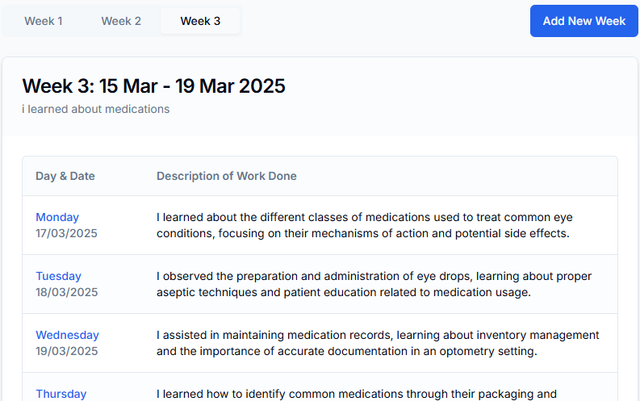
Every week, include:
- Week ending date (e.g., Friday, June 20, 2025)
- Time in and out (e.g., 9:00 AM – 4:00 PM)
- Tasks for each day (Monday–Friday)
❌ Mistake 5: Not Getting Supervisor’s Signature Weekly
Skipping weekly signatures or comments is one of the fastest ways to lose marks. ITF and school assessors check for these signatures before grading.
✅ How to Avoid It:
At the end of every week, politely ask your supervisor to:
- Review your entries
- Add comments
- Sign and stamp (if required)
❌ Mistake 6: Writing Vague or Repetitive Entries
Some students repeat the same sentence every day, like “I worked in the lab.”
This makes it look like you didn’t learn anything new.
✅ How to Avoid It:
Use action words and variety in your sentences:
“I assisted in preparing chemical reagents.”
“I tested the pH of solutions using a digital meter.”
“I recorded experiment results in Excel.”
Even small differences show progress and understanding.
❌ Mistake 7: Not Including Tools, Equipment, or Software Used
Your supervisor expects to see practical evidence of what you did — tools, machines, or software.
✅ How to Avoid It:
Always mention at least one tool or software per task.
Examples:
- Visual Studio Code, MySQL, or Postman (CS students)
- Multimeter, Torque wrench (Engineering students)
- Microscope, Centrifuge (SLT students)
❌ Mistake 8: No Diagrams or Sketches (for Technical Courses)
In Engineering or Science-based training, drawing diagrams is part of your mark. Many students skip it entirely.
✅ How to Avoid It:
Draw neatly with labels. Examples:
- Circuit diagrams
- Lab apparatus setups
- Machine components
Use pencil and ruler — messy sketches reduce marks.
❌ Mistake 9: Mixing Present and Past Tense
Writing “I am fixing the machine” today, and “I fix machine” tomorrow shows poor grammar consistency.
✅ How to Avoid It:
Always write in past tense:
“I assisted in fixing the machine.”
“I observed the installation process.”
❌ Mistake 10: Submitting an Untidy or Torn Logbook
A rough logbook (folded pages, stains, or torn corners) can make even good entries look bad.
✅ How to Avoid It:
- Keep your logbook in a clear file or plastic cover.
- Write with blue or black pen only.
- Avoid canceling — use correction fluid neatly.
Bonus Tip: Use the SIWES Logbook Generator to Avoid All These Mistakes
If you find it hard to write daily entries correctly, you can use the free SIWES Logbook Generator by MonoEd.
Just enter the summary of work done in that week — it creates detailed, professional weekly entries you can copy into your logbook.
✅ Tailored for Engineering, Computer Science, SLT, and Business students.
✅ Includes correct grammar, tools, and realistic tasks.
✅ Saves you hours of writing.
Wrap Up
Avoiding these common SIWES logbook mistakes can make a big difference in your final grade.
Remember — your logbook is not just paperwork. It’s proof that you’ve learned something meaningful during your industrial training.
Stay consistent, write clearly, and let your entries tell your story of growth and experience.
FAQs
What happens if I don’t fill my SIWES logbook correctly?
You may lose marks during grading or have your logbook rejected by your school or ITF supervisor.
Can I use AI or online tools to write my SIWES logbook?
Yes. Tools like the MonoEd SIWES Logbook Generator help you create structured entries that follow proper SIWES format.
Do I need to write every single day?
Yes — ideally Monday to Friday. You can summarize short days, but avoid skipping entire weeks.
Is handwriting required?
Yes. Even if you type with a generator, you’ll need to copy it neatly by hand into your official logbook.
Can I fill my logbook after SIWES ends?
Technically yes, but it’s risky. Supervisors can tell if it wasn’t written during the training. Fill it gradually each week instead.
About the Author
Mohammad-Jamiu B. Balogun, GMNSE
AI Security Researcher · Founder, MonoEd Africa
Mohammad-Jamiu is a First-Class Telecommunications Engineer and Best Graduating Student (BUK), and an AI security researcher. He founded MonoEd Africa to give Nigerian students AI-powered academic tools — from SIWES logbooks to final year projects. His work has reached over 10,000 students across Nigeria.