SIWES Report at Radio Station (FM): Full Guide, Equipment, Work Done and Sample
Learn how to write a complete SIWES report for a radio station (FM). This guide covers format, departments, equipment used, work done, samples, and FAQs for Mass Communication and related students.


For students of Mass Communication, Broadcast Journalism, Theatre Arts, and related courses, a radio station is one of the most common and relevant places for SIWES attachment. However, many students get confused when writing their SIWES report after training at an FM station.
This article provides a complete, well structured guide on how to write a high scoring SIWES report for a radio station. It explains the chapters, equipment used, departments, work done, sample write ups, and frequently asked questions.
You can adapt this guide to suit your school’s specific format.
What SIWES Means for Radio and Media Students
The Student Industrial Work Experience Scheme (SIWES) is a compulsory industrial training program introduced to expose students to practical experience in real work environments.
For radio and media students, SIWES at an FM station helps to:
- Apply classroom theories to real broadcasting practice
- Understand studio operations and media ethics
- Learn audio production and presentation skills
- Gain confidence in public communication
- Prepare for careers in broadcasting and journalism
Your SIWES report is used to assess how much you learned during this training.
Standard SIWES Report Structure (Nigeria)
Most universities and polytechnics in Nigeria use a similar structure:
- Preliminary pages
- Chapter One: Introduction
- Chapter Two: Description of the Organization
- Chapter Three: Work Done and Experience Gained
- Chapter Four: Challenges and Recommendations
- Chapter Five: Summary and Conclusion
Preliminary Pages (Brief Overview)
Your report may include the following pages before Chapter One:
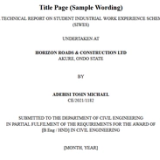
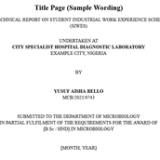
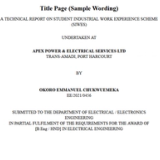
- Title page
- Declaration (if required)
- Certification page
- Dedication
- Acknowledgement
- Abstract
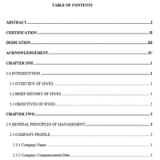
- Table of contents
These pages are usually written last.
💡 You can read more on: SIWES Report Abstract: How to Write a Clear, High Scoring Abstract (With Samples)
Chapter One: Introduction
1.1 Background of SIWES
The Student Industrial Work Experience Scheme was established to bridge the gap between theoretical knowledge acquired in schools and practical skills required in industries. It allows students to gain hands on experience in their chosen field of study.
1.2 Aim and Objectives of SIWES
The objectives of SIWES include:
- Exposing students to real industrial environments
- Developing technical and professional skills
- Preparing students for future employment
- Enhancing students’ understanding of workplace ethics
1.3 Scope of Training
This section explains that your SIWES was carried out at a radio station and briefly mentions the departments you were attached to during the training period.
💡 Read more on: How to Write SIWES Chapter One: Full Guide, Structure, Format and A Grade Example
Chapter Two: Description of the Radio Station
2.1 Name and Location of the Organization
State the official name and physical location of the radio station.
Example:
The industrial training was carried out at XYZ FM Radio Station located in [City], [State], Nigeria.
2.2 Brief History of the Radio Station
Explain when the station was established, its ownership (private or government owned), and its purpose.
2.3 Vision and Mission of the Station
Describe the station’s goals, such as information dissemination, public enlightenment, education, and entertainment.
2.4 Organizational Structure
A typical radio station consists of:
- Management department
- Program department
- News and current affairs department
- Engineering and transmission department
- Marketing and commercial department
You may include an organizational chart if required.
Chapter Three: Work Done and Experience Gained
This is the most important chapter of your SIWES report.
3.1 Departments Attached To
During SIWES, students are often rotated through different units such as:
- Program production unit
- News and current affairs unit
- Studio operations
- Engineering and transmission unit
3.2 Equipment Used at the Radio Station
Common radio station equipment you can describe include:
- Microphones for live and recorded programs
- Audio mixers used to balance sound
- Studio monitors and headphones
- Digital voice recorders
- Computers with audio editing software
- Transmitters used for signal transmission
- Cables and studio accessories
Explain the function of each equipment briefly.
3.3 Practical Activities Performed
Examples of work done include:
- Assisting presenters during live programs
- Editing recorded programs
- Writing radio program scripts
- Participating in news gathering and reporting
- Setting up studio equipment before broadcast
- Observing transmission processes
3.4 Skills and Knowledge Acquired
During the training, students usually acquire:
- Communication and presentation skills
- Audio editing skills
- Teamwork and cooperation
- Time management
- Professional conduct in media environments
Chapter Four: Challenges and Recommendations
4.1 Challenges Encountered
Common challenges experienced during SIWES at a radio station include:
- Power supply interruptions
- Limited modern broadcasting equipment
- Pressure during live programs
- Short duration of training
4.2 Recommendations
Suggestions may include:
- Provision of standby power systems
- Upgrading of broadcasting equipment
- Extending SIWES duration
- More supervision and mentorship for students
Chapter Five: Summary and Conclusion
This chapter summarizes your SIWES experience and explains how the training contributed to your academic and professional development. Conclude by stating how the experience prepared you for future roles in broadcasting and media practice.
Sample SIWES Report Write Ups (For Guidance Only)
Sample Introduction Paragraph
The Student Industrial Work Experience Scheme is a program designed to expose students to practical industrial experience. This report documents my SIWES training at XYZ FM Radio Station, where I gained practical knowledge in radio broadcasting and media operations.
Sample Equipment Description
The radio station makes use of microphones, audio mixers, studio monitors, digital recorders, and transmitters for effective broadcasting. These equipment ensure clear audio production and transmission to listeners.
Sample Experience Paragraph
During the training period, I assisted presenters during live programs, edited recorded audio content, participated in news reporting activities, and observed studio operations. These experiences improved my communication skills and understanding of radio broadcasting.
Conclusion
A good SIWES report at a radio station should be original, well structured, and clearly written. Focus on explaining what you learned, the equipment you used, and how the experience relates to your course of study.
Following this guide will help you produce a professional SIWES report that earns high marks and reflects your real training experience.
Related Articles
- How to Write Your Final SIWES Report (Format, Structure & A+ Tips)
- Challenges Students Face During SIWES and Solutions
- Top SIWES Companies in Nigeria 2025
- How to Write an Acknowledgment for SIWES Report (With 6 Examples)
- How to Fill Your SIWES Logbook (Step-by-Step)
- Ultimate Guide to APA 7th and MLA 9th Referencing for Nigerian Final Year Projects
FAQs
Can Mass Communication students do SIWES at a radio station?
Yes. Radio stations are highly suitable for Mass Communication and related courses.
What equipment should I include in a radio station SIWES report?
You should include microphones, audio mixers, studio monitors, transmitters, computers, and recording devices.
How long is SIWES training at a radio station?
SIWES usually lasts between 3 and 6 months, depending on your institution.
Can I do SIWES at any FM station?
Yes, provided the station is approved by your institution.
Do I need pictures in my SIWES report?
Some schools require pictures while others do not. Always follow your department’s guidelines.
Can I copy another student’s SIWES report?
No. Samples are only for guidance. Your report must be written in your own words.
About the Author
Mohammad-Jamiu B. Balogun, GMNSE
AI Security Researcher · Founder, MonoEd Africa
Mohammad-Jamiu is a First-Class Telecommunications Engineer and Best Graduating Student (BUK), and an AI security researcher. He founded MonoEd Africa to give Nigerian students AI-powered academic tools — from SIWES logbooks to final year projects. His work has reached over 10,000 students across Nigeria.