How to Turn a Thesis Into a Journal Article: A Step by Step Guide (2026)
Learn how to turn a thesis into a journal article with this practical step by step guide. Discover how to shorten your thesis, choose a journal, rewrite sections, and prepare a publishable manuscript.

Quick Summary
A thesis and a journal article serve different purposes. A thesis demonstrates your understanding of a research topic in detail, while a journal article communicates one focused contribution to a wider academic audience.
To convert your thesis into a journal article, identify your strongest finding, choose a suitable journal, restructure your work into a standard research paper, shorten unnecessary sections, rewrite rather than copy, and adapt your manuscript to the journal's guidelines.
If you already have your thesis and supporting references, turning it into a journal article is often much faster than writing a paper from scratch.
Can You Turn a Thesis Into a Journal Article?
Yes.
In fact, many published journal articles begin as undergraduate projects, master's theses, or PhD dissertations.
Your thesis already contains valuable research. The challenge is that journals expect a very different type of document.
A thesis is written for examiners who want to evaluate your understanding of a subject. It includes detailed background information, a comprehensive literature review, extensive methodology, appendices, and supporting materials.
A journal article has a different goal. It is written for researchers who want to understand your main contribution as quickly as possible.
Instead of proving everything you know, your article should focus on one important research question and explain your findings clearly and concisely.
Thesis vs Journal Article
| Thesis | Journal Article |
|---|---|
| Often 20,000 to 100,000+ words | Usually 3,000 to 8,000 words |
| Covers multiple objectives | Focuses on one main contribution |
| Written for examiners | Written for researchers |
| Detailed literature review | Brief, focused background |
| Extensive methodology | Concise methods section |
| Multiple chapters | Standard research paper structure |
Trying to submit your thesis without major revisions almost always leads to rejection.
Instead, think of your thesis as the raw material for a new paper.
Step 1: Choose the Strongest Part of Your Thesis
Many students believe they should convert their entire thesis into one article.
That is rarely the best approach.
Instead, ask yourself:
- Which finding is the most important?
- Which chapter contains the strongest results?
- Which research question would interest other researchers most?
Some theses can even produce two or three separate journal articles.
For example:
- One article focusing on your experimental results
- Another discussing your methodology
- Another exploring a case study or application
A focused manuscript is usually stronger than trying to include everything.
Step 2: Select the Right Journal Before You Start Writing
Do not wait until your paper is finished before choosing a journal.
Different journals have different expectations for:
- Word count
- Citation style
- Article structure
- Figure limits
- Formatting
- Scope
Reading several recent papers from your target journal helps you understand what editors expect.
If your manuscript closely matches the journal's style, you may spend less time making revisions later.
Step 3: Create a New Outline Instead of Copying Chapters
One of the biggest mistakes researchers make is copying thesis chapters directly into a Word document.
A better approach is to build a new outline around your main contribution.
A typical journal article includes:
Introduction
Briefly explain:
- the problem
- why it matters
- the research gap
- your objective
Literature Review
Unlike a thesis, this section should only include studies directly related to your research question.
You are not trying to summarize everything ever written on the topic.
Instead, show:
- what previous researchers discovered
- where the gap exists
- how your work contributes
Methodology
Keep this section focused.
Explain only the methods necessary for readers to understand and reproduce your work.
Standard procedures often require only a citation rather than several pages of explanation.
Results
Present only the findings that support your main research objective.
Large datasets, extra tables, and secondary analyses that appeared in your thesis may not belong in the journal article.
Choose the results that tell the clearest story.
Discussion
This is where you explain what your findings mean.
Compare your results with previous studies.
Discuss:
- similarities
- differences
- possible explanations
- practical implications
- limitations
Many manuscripts are accepted or rejected based largely on the quality of the discussion.
Conclusion
End with a concise summary of your contribution.
Avoid repeating the entire paper.
Instead, remind readers:
- what you discovered
- why it matters
- what future research could explore
Step 4: Rewrite Instead of Copying
Although your thesis belongs to you, copying large sections word for word is usually not recommended.
Many journals screen submissions using plagiarism detection software.
Even if the text comes from your own thesis, extensive copying may be flagged as self plagiarism depending on the journal's policies.
Rewrite each section with a fresh perspective.
Your journal article should read like a new manuscript rather than a shortened thesis.
Step 5: Reduce the Word Count
Most theses contain far more detail than a journal article requires.
You may need to remove:
- lengthy historical background
- repeated explanations
- extra tables
- appendices
- questionnaires
- raw datasets
- secondary analyses
Every paragraph should help support your main argument.
If it does not, consider removing it.
Step 6: Update Your References
Do not assume the references in your thesis are still current.
Before submitting:
- remove outdated studies where appropriate
- add recent research
- verify every citation
- ensure your reference style matches the journal
Using recent literature shows that your work reflects the current state of research.
Step 7: Adapt the Paper to the Journal's Guidelines
Every journal has its own requirements.
Check:
- maximum word count
- abstract length
- heading structure
- figure resolution
- citation style
- reference formatting
- supplementary materials
Many otherwise strong papers are returned simply because they ignore submission guidelines.
How AI Can Help Convert a Thesis Into a Journal Article
AI can save significant time during the rewriting process, but it should support your research rather than replace it.
General AI assistants can help:
- improve clarity
- shorten paragraphs
- rewrite sentences
- brainstorm titles
- summarize sections
However, researchers still need to verify citations and ensure the manuscript accurately reflects their own work.
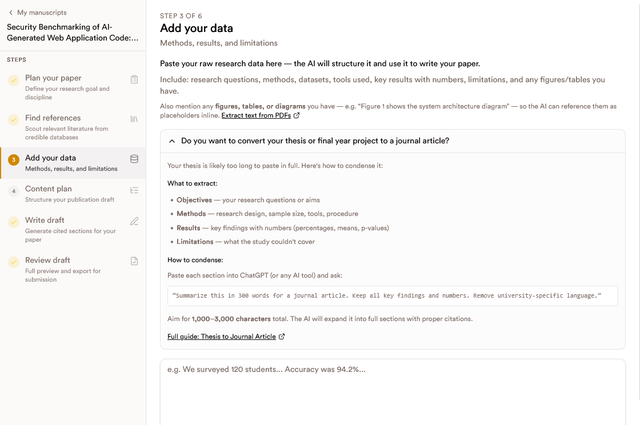
A research focused workflow such as PaperDraft takes a different approach. Instead of starting with a blank chat, you can work from your existing research, select real references, add your own methods and results, generate a structured content plan, and draft manuscript sections with citations linked to sources you selected.
This can make the transition from thesis to journal article much more organized while keeping your research at the center of the writing process.
Common Mistakes to Avoid
Many first time authors make these mistakes:
- Trying to publish the entire thesis as one paper
- Copying chapters without rewriting
- Including every table and figure
- Writing a literature review that is too long
- Ignoring journal formatting requirements
- Using outdated references
- Submitting before asking colleagues for feedback
A focused manuscript usually has a much better chance of publication.
How PaperDraft Can Help
Converting a thesis into a journal article involves much more than shortening chapters.
You need to:
- identify the main contribution
- organize supporting references
- restructure the manuscript
- adapt the paper to journal expectations
- maintain accurate citations
PaperDraft helps streamline this workflow by allowing you to select real references, organize your paper structure, add your own research data, generate properly cited sections, and export your manuscript in formats such as Word, Markdown, LaTeX, and BibTeX.
Instead of juggling multiple documents, citation managers, and AI chats, you can manage the entire drafting process in one workspace.
Conclusion
Turning a thesis into a journal article is not about cutting pages until the document becomes shorter.
It is about reshaping your research into a focused paper that highlights one meaningful contribution.
Choose your strongest findings, create a fresh structure, rewrite your content, update your references, and follow your target journal's guidelines carefully.
If you already have a completed thesis, you have done the hardest part. With the right workflow and careful editing, your research can become a publishable journal article that reaches a much wider academic audience.
💡 Continue reading:
- How to Write a Literature Review: A Step by Step Guide for Research Papers, Proposals, and Dissertations
- How to Write a Research Paper Fast (Without Sacrificing Quality)
- How to Write a Research Paper in One Day
- How to Publish Your Research for Free
- Why ChatGPT Invents Citations (And How to Avoid Fake References)
FAQs
Can I publish my thesis as a journal article?
Yes. Many journal articles are adapted from undergraduate projects, master's theses, and PhD dissertations. However, the thesis usually needs significant restructuring and rewriting before submission.
How long should a journal article be compared to a thesis?
A thesis may contain tens of thousands of words, while most journal articles range from about 3,000 to 8,000 words, depending on the journal and discipline.
Can one thesis become multiple journal articles?
Yes. A large thesis often contains enough original research to produce two or more journal articles, with each paper focusing on a specific research question or finding.
Can I copy text from my thesis into a journal article?
Most journals expect authors to rewrite and adapt thesis content rather than copying it directly. Rewriting also helps create a paper that better matches journal style and reduces concerns about self plagiarism.
Can AI help convert a thesis into a journal article?
AI can help improve writing, organize sections, and summarize content, but researchers should always review the output, verify citations, and ensure the manuscript accurately represents their own research. Research focused tools such as PaperDraft can further simplify the process by combining real references, manuscript planning, and structured drafting in a single workflow.
About the Author
Mohammad-Jamiu B. Balogun, GMNSE
AI Security Researcher · Founder, MonoEd Africa
Mohammad-Jamiu is a First-Class Telecommunications Engineer and Best Graduating Student (BUK), and an AI security researcher. He founded MonoEd Africa to give Nigerian students AI-powered academic tools — from SIWES logbooks to final year projects. His work has reached over 10,000 students across Nigeria.