How to Write SIWES Chapter One: Full Guide, Structure, Format and A Grade Example
Learn how to write SIWES Chapter One correctly. This step by step guide explains the full structure, history of SIWES, aims, objectives, scope, relevance to your field and a complete sample you can copy and edit.

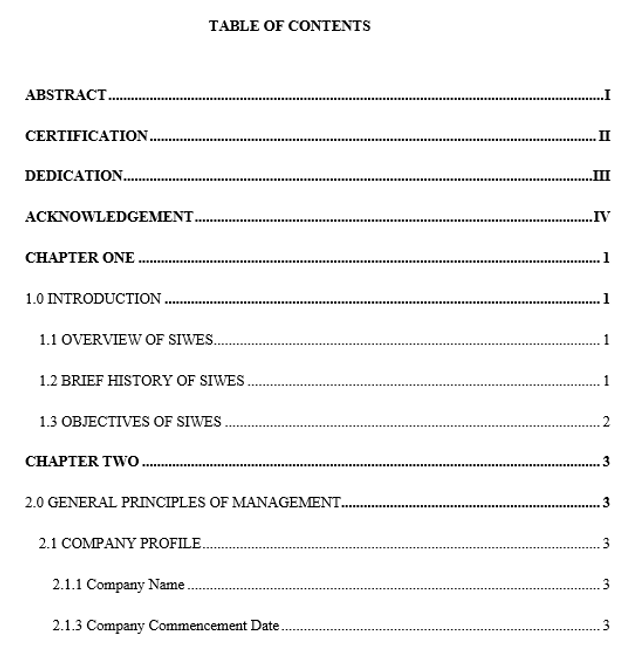
Writing Chapter One of your SIWES report is one of the easiest parts of the entire report. The content is straightforward, the structure is predictable and the information is widely available. Yet, many students lose marks because they do not know how to organize the chapter properly, what the examiner expects, or how to write in a clear and original way.
This guide gives you the complete breakdown of what belongs in Chapter One, how to format it, and a ready to use sample that you can modify for your course.
What to Include in SIWES Chapter One
Chapter One is the foundation of your SIWES report. It gives the reader an introduction to the entire training program, explains what SIWES is, why it exists and why the experience matters to your field of study.
A standard SIWES Chapter One contains the following sections:
- Introduction to SIWES
- Brief History of SIWES
- Scope of the Scheme
- Aims and Objectives of SIWES
- Relevance of SIWES to Your Field
- Chapter Summary
Let us go through each one.
1. Introduction to SIWES
This section introduces the Student Industrial Work Experience Scheme, why it exists and what it does for Nigerian students. The introduction should clearly present SIWES as a national skill acquisition initiative created to give students hands on experience before graduation.
What to write here:
- What SIWES stands for
- Why the scheme was introduced
- The gap it solves in Nigerian higher institutions
- How SIWES connects theory to real industry skills
Example points:
- SIWES prepares students for workplace conditions
- It provides exposure to equipment and tools not available on campus
- It strengthens practical knowledge and employability
2. Brief History of SIWES
This section explains how the scheme began, who established it and how it developed over the years. Do not copy from online sources word for word. Summarize it in your own clear and simple language.
Key details to mention:
- SIWES was created in 1973 by the Industrial Training Fund
- Approved by the Federal Government in 1974
- Faced funding issues in 1978
- Temporarily handed to NUC and NBTE
- Fully returned to ITF in 1984
- Currently supervised nationwide
3. Scope of the Scheme
This part explains who SIWES covers and the departments that participate in it.
Scope includes:
- Universities
- Polytechnics
- Colleges of Education
- Courses that require practical training
- Duration based on institution type
Example:
Four months for polytechnics, three to six months for universities depending on the program.
4. Aims and Objectives of SIWES
Every SIWES report must include the officially approved objectives. These show what the program is designed to achieve.
Standard SIWES objectives include:
- To expose students to the practical environment in industries
- To bridge the gap between classroom theory and workplace practice
- To help students acquire industrial skills and technical experience
- To improve students understanding of workplace ethics and professionalism
- To make the transition from school to work easier
- To enhance job readiness and employability
- To develop confidence in handling tools, machinery or real work situations
5. Relevance of SIWES to Your Field of Study
This is where most students lose marks. Examiners want to see the link between your course and the training.
Write in simple language and show how SIWES benefits your discipline.
Examples:
- For Computer Science: exposure to programming tools, software development, hardware troubleshooting
- For Business Administration: organizational processes, customer service, office management
- For Engineering: hands on experience with machines, maintenance, safety procedures
- For Mass Communication: media operations, reporting, editing, content creation
Make this part specific to your course.
6. Chapter Summary
This short concluding part summarizes what the chapter covers. Keep it short and neat.
Sample SIWES Chapter One (Complete Example)
You can customize this for any course or department.
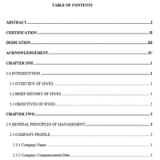
CHAPTER ONE
1.0 Introduction
The Student Industrial Work Experience Scheme is a national training program designed to give students in Nigerian tertiary institutions practical exposure to real industrial environments. The scheme enables students to gain work related skills, observe workplace ethics and apply theoretical knowledge in real situations. It was introduced to address the long standing problem of insufficient practical experience among graduates and to ensure that students understand how industries operate before they complete their academic programs.
Through SIWES, students are able to work with tools, machines, equipment and software that may not be available in schools. The scheme also supports the development of professional attitudes, teamwork, communication skills and technical competence.
1.1 Brief History of SIWES
The scheme was created in 1973 by the Industrial Training Fund. It was later approved by the Federal Government in 1974 as a national response to the growing concern that graduates lacked adequate practical experience needed in industries. During its early years, SIWES was fully managed and funded by the Industrial Training Fund.
In 1978, the cost of running the scheme increased and ITF temporarily withdrew from direct management. The Federal Government transferred the responsibility to the National Universities Commission and the National Board for Technical Education in 1979. In 1984, the scheme was officially returned to the Industrial Training Fund while the Federal Government continued to provide funding. SIWES has remained under the supervision of ITF since then.
1.2 Scope of the Scheme
SIWES is designed for students in universities, polytechnics and colleges of education whose courses require industrial attachment. The duration varies with the type of institution. Polytechnics usually undertake four months of training while university students may undergo three or six months depending on the department. The scheme covers both technical and non technical fields.
1.3 Aims and Objectives of SIWES
The major objectives of SIWES include the following:
- To expose students to practical work situations that relate to their course of study
- To provide an opportunity for students to apply theoretical classroom knowledge in the industry
- To help students acquire industrial skills and real workplace experience
- To introduce students to modern work methods, equipment and machinery
- To prepare students for the challenges of employment after graduation
- To improve industrial involvement in the academic process
- To build students confidence through hands on experience
1.4 Relevance of SIWES to My Field of Study
SIWES is highly important to my field because it exposes me to practical activities required in real industry settings. During the training, I have the opportunity to observe professionals, work with tools and equipment, participate in real tasks and gain skills that will support my career development. It also allows me to understand the standards, procedures and practices used in the industry. The experience makes it easier to relate classroom learning to actual work and prepares me for future employment.
1.5 Chapter Summary
This chapter introduced the Student Industrial Work Experience Scheme and explained why it was created and how it operates. It covered the history, scope, objectives and importance of SIWES to students. The chapter also highlighted the relevance of the training to my field of study and how it supports my academic and professional growth.
Conclusion
Your Chapter One must be clear, well structured and original. If you follow this guide, your chapter will meet every grading requirement and stand out during marking.
👉 See the full report structure → How to Write a SIWES Report in Nigeria
About the Author
Mohammad-Jamiu B. Balogun, GMNSE
AI Security Researcher · Founder, MonoEd Africa
Mohammad-Jamiu is a First-Class Telecommunications Engineer and Best Graduating Student (BUK), and an AI security researcher. He founded MonoEd Africa to give Nigerian students AI-powered academic tools — from SIWES logbooks to final year projects. His work has reached over 10,000 students across Nigeria.