Lesson Plan and Lesson Note Differences Explained for Teachers in Nigeria
Learn the difference between lesson plan and lesson note in Nigeria with clear explanations, examples, comparison table, FAQs, and practical tips for teachers, student teachers, and school owners.

Many teachers, student teachers, and even school owners often confuse lesson plans and lesson notes. Some people use the two terms as if they mean the same thing. Others believe one is more important than the other.
The truth is that lesson plans and lesson notes are related, but they are not the same.
Understanding the difference between a lesson plan and a lesson note helps teachers become more organised, more professional, and more effective in the classroom.
It also helps new teachers avoid common mistakes during supervision, teaching practice, interviews, and classroom teaching.
In this guide, you will learn:
- What a lesson plan means
- What a lesson note means
- The major differences between them
- Why teachers need both
- Common mistakes teachers make
- Simple examples to remove confusion
- Frequently asked questions by teachers in Nigeria
If you are a beginner teacher or student teacher, this article will clear up the confusion completely.
Quick Summary
A lesson plan is the teacher’s professional roadmap that explains what will be taught, how it will be taught, the objectives, teaching methods, materials, and evaluation process.
A lesson note is the detailed classroom content and teaching guide the teacher uses during the actual lesson. It contains explanations, examples, board summaries, exercises, and teaching steps.
In simple terms:
- Lesson plan = the teaching blueprint
- Lesson note = the teaching content and classroom guide
The lesson plan helps the teacher prepare professionally before class, while the lesson note helps the teacher deliver the lesson effectively inside the classroom.
What Is a Lesson Plan?
A lesson plan is a formal teaching document that shows how a teacher intends to conduct a lesson.
It is prepared before entering the classroom and serves as a guide for teaching and learning activities.
A lesson plan focuses mainly on planning the lesson properly.
Think of it as the teacher’s roadmap for the lesson.
A Lesson Plan Usually Contains:
- Subject
- Class
- Topic
- Duration
- Instructional objectives
- Previous knowledge
- Teaching materials
- Teaching methods
- Presentation steps
- Evaluation
- Assignment
A lesson plan answers questions like:
- What am I teaching today?
- What should learners achieve?
- Which teaching method will I use?
- What materials do I need?
- How will I evaluate learners?
In many Nigerian schools, lesson plans are checked by supervisors, principals, head teachers, and education inspectors.
For a complete guide on formats and samples, read:
👉 Lesson Plan Format for Secondary School in Nigeria With Sample and Explanation
What Is a Lesson Note?
A lesson note is the detailed classroom content the teacher uses while teaching.
It contains the actual explanations, examples, board summaries, exercises, diagrams, and activities that learners will interact with during the lesson.
Unlike the lesson plan, which focuses on planning, the lesson note focuses more on delivery.
Think of it as the teacher’s classroom script or working guide.
A Lesson Note Usually Contains:
- Date and week
- Subject and class
- Topic and sub topic
- Objectives
- Detailed explanations
- Definitions
- Examples
- Classroom activities
- Evaluation questions
- Board summary
- Assignment
A lesson note helps the teacher:
- Explain concepts clearly
- Stay organised during teaching
- Remember important examples
- Ask the right questions
- Guide learners properly
For detailed lesson note guides and samples, read:
- How to Write Lesson Notes for Primary School in Nigeria With Detailed Sample
- How to Write Lesson Note for Secondary School in Nigeria With Detailed JSS and SSS Samples
Difference Between Lesson Plan and Lesson Note
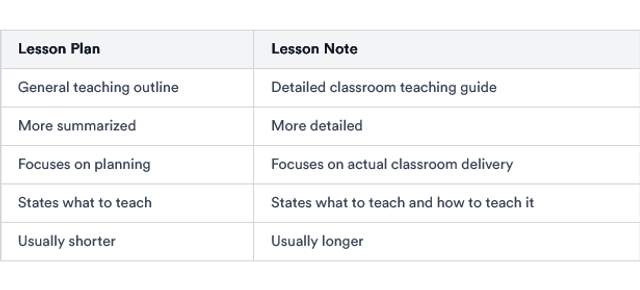
Although they work together, lesson plans and lesson notes have different purposes.
Here is a simple comparison.
| Feature | Lesson Plan | Lesson Note |
|---|---|---|
| Meaning | A structured plan for teaching | Detailed classroom teaching content |
| Main Purpose | To organise and plan the lesson | To guide actual classroom teaching |
| Focus | Objectives, methods, activities, evaluation | Explanations, examples, exercises |
| Nature | More formal and professional | More practical and classroom based |
| Audience | Teacher, supervisors, inspectors | Mainly teacher and learners |
| Content Style | Brief and structured | Detailed and explanatory |
| Use | Before teaching | During teaching |
| Flexibility | Can be adjusted easily | Usually follows lesson flow |
| Importance | Shows preparation and professionalism | Helps effective lesson delivery |
| Example | Teaching strategy for fractions | Actual explanation of fractions |
The Simplest Way to Understand the Difference
Many teachers still get confused because both documents are connected.
Here is the easiest explanation.
Lesson Plan = The Map
A map helps you know where you are going and how to get there.
A lesson plan helps the teacher know:
- What to teach
- How to teach it
- Which method to use
- What learners should achieve
It focuses on planning.
Lesson Note = The Actual Journey
The lesson note contains the actual classroom explanations and teaching content.
It shows:
- What the teacher will explain
- Examples learners will copy
- Exercises learners will solve
- Questions to ask learners
It focuses on delivery.
Example That Makes the Difference Clear
Suppose a teacher wants to teach fractions in Primary 4 Mathematics.
What the Lesson Plan May Contain
Topic:
Fractions
Objective:
Pupils should be able to define fractions and identify fractions in daily life.
Teaching Method:
Discussion and demonstration.
Teaching Materials:
Orange, cardboard, fraction chart.
Evaluation:
Define fraction and give examples.
Notice that the lesson plan only outlines the teaching process.
What the Lesson Note May Contain
Definition:
A fraction is a part of a whole.
Examples:
- Half of an orange
- One quarter of a cake
- Half of a loaf of bread
Board Summary:
1/2 means one out of two equal parts.
Exercise:
Write three examples of fractions found at home.
Notice that the lesson note contains the actual teaching details learners interact with.
Why Teachers Need Both Lesson Plans and Lesson Notes
Some teachers believe preparing only one document is enough.
However, both documents are important for effective teaching.
1. Better Classroom Organisation
A lesson plan helps the teacher prepare properly before class.
A lesson note helps the teacher stay organised during teaching.
Together, they improve lesson flow and classroom management.
2. Better Learning Outcomes
When lessons are properly planned and properly delivered:
- Learners understand faster
- Teaching becomes clearer
- Classroom participation improves
- Evaluation becomes easier
3. Professionalism
Many schools in Nigeria require teachers to prepare lesson plans and lesson notes regularly.
Having both shows that the teacher is:
- Prepared
- Organised
- Serious about teaching
- Professionally responsible
This is especially important during:
- Teaching practice
- School supervision
- Interviews
- Inspections
Common Mistakes Teachers Make
Using Lesson Note Without Proper Planning
Some teachers jump straight into lesson notes without creating proper lesson plans.
This often leads to:
- Unclear objectives
- Poor time management
- Weak classroom structure
- Confused teaching flow
Copying Lesson Plans Without Understanding Them
Some teachers copy lesson plans from colleagues or online sources without understanding the content.
This creates problems during classroom teaching because the teacher may not fully understand the lesson steps.
Treating Both as the Same Thing
This is one of the biggest mistakes.
A lesson plan and lesson note work together, but they are not identical documents.
One focuses on planning.
The other focuses on teaching delivery.
Which Comes First, Lesson Plan or Lesson Note?
This is another question many teachers ask.
Normally:
- The teacher prepares the lesson plan first.
- The lesson note is then developed from the lesson plan.
The lesson plan gives direction.
The lesson note expands the classroom content.
Can a Teacher Use Only Lesson Notes?
Some schools allow teachers to use only lesson notes, especially in lower classes.
However, professionally, teachers are encouraged to prepare both.
This is because lesson plans help maintain proper teaching structure and objectives.
Are Lesson Plan Formats the Same in Every School?
No.
Different schools, states, and education authorities may use slightly different formats.
However, most lesson plans in Nigeria usually contain:
- Objectives
- Materials
- Presentation steps
- Evaluation
- Assignment
The same applies to lesson notes.
The format may change slightly, but the purpose remains the same.
How Lesson Plan and Lesson Note Work Together
The best teaching usually happens when both documents support each other.
Step 1: Prepare the Lesson Plan
The teacher decides:
- Objectives
- Methods
- Activities
- Materials
- Evaluation
Step 2: Prepare the Lesson Note
The teacher writes:
- Explanations
- Examples
- Activities
- Board summaries
- Exercises
Step 3: Teach the Lesson
The lesson plan provides structure.
The lesson note guides classroom delivery.
Together, they make teaching smoother and more effective.
FAQs
What is the main difference between lesson plan and lesson note?
A lesson plan focuses on planning how the lesson will be taught, while a lesson note contains the detailed classroom content and explanations used during teaching.
Is lesson note the same as lesson plan?
No.
They are related but different.
The lesson plan is the teaching roadmap, while the lesson note is the detailed classroom guide.
Which is more important between lesson plan and lesson note?
Both are important.
The lesson plan helps teachers prepare professionally, while the lesson note helps teachers deliver lessons effectively.
Can lesson notes be written without lesson plans?
Yes, but it is not always advisable.
Without proper planning, teaching objectives and classroom activities may become disorganised.
Do Nigerian schools require lesson plans?
Many Nigerian schools require lesson plans, especially during supervision, inspections, and teaching practice exercises.
Is a lesson note for learners or teachers?
Mainly for teachers during teaching, although parts of the content may also be copied by learners.
Why do teachers confuse lesson plan and lesson note?
Teachers confuse them because both are used for teaching preparation and classroom instruction. However, they serve different functions.
Conclusion
The difference between lesson plan and lesson note becomes easier to understand when you remember this simple idea:
- The lesson plan helps you prepare the lesson.
- The lesson note helps you teach the lesson.
One focuses on planning.
The other focuses on classroom delivery.
Both are important tools for effective teaching in Nigerian schools.
When teachers understand how to use both correctly, classroom teaching becomes more organised, professional, and learner friendly.
If you want to improve your teaching further, you can also read:
About the Author
Mohammad-Jamiu B. Balogun, GMNSE
AI Security Researcher · Founder, MonoEd Africa
Mohammad-Jamiu is a First-Class Telecommunications Engineer and Best Graduating Student (BUK), and an AI security researcher. He founded MonoEd Africa to give Nigerian students AI-powered academic tools — from SIWES logbooks to final year projects. His work has reached over 10,000 students across Nigeria.