How to Write Lesson Note for Secondary School in Nigeria With Detailed JSS and SSS Samples
Learn how to write lesson notes for secondary school in Nigeria using the standard format. Includes detailed JSS and SSS lesson note samples, lesson note vs lesson plan explanation, examples, FAQs, and tips for teachers.

Writing lesson notes is one of the most important responsibilities of secondary school teachers in Nigeria. Whether you teach in a junior secondary school (JSS) or senior secondary school (SSS), preparing a proper lesson note helps you teach effectively, manage classroom activities, and achieve your lesson objectives.
In many Nigerian schools, lesson notes are checked regularly by principals, vice principals, HODs, supervisors, and education inspectors. A properly written lesson note shows preparation, professionalism, and understanding of the curriculum.
However, many teachers still struggle with questions like:
- What is the correct format for a lesson note?
- Is lesson note different from lesson plan?
- How detailed should a lesson note be?
- Can lesson notes be typed?
- What should be included in presentation steps?
This guide explains everything clearly with practical examples and detailed lesson note samples for both JSS and SSS classes.
You can also read our related guide on Lesson Plan Format for Secondary School in Nigeria if you want to understand lesson planning structure better.
Quick Summary
A standard Nigerian secondary school lesson note usually contains:
- Subject
- Class
- Term and Week
- Topic
- Sub-topic
- Date
- Duration
- Behavioural Objectives
- Previous Knowledge
- Instructional Materials
- Reference Materials
- Set Induction
- Content Development
- Teacher and Students Activities
- Evaluation
- Conclusion
- Assignment
The lesson note serves as a detailed classroom teaching guide.
What Is a Lesson Note?
A lesson note is a detailed teaching document prepared by a teacher before entering the classroom. It explains:
- what the teacher wants to teach
- how the lesson will be taught
- the materials needed
- teacher and students activities
- how learning will be assessed
Lesson notes help teachers stay organized and ensure effective teaching.
Difference Between Lesson Note and Lesson Plan
Many Nigerian teachers confuse lesson notes and lesson plans because the two formats look similar.
The major difference is the level of detail.
| Lesson Plan | Lesson Note |
|---|---|
| General teaching outline | Detailed classroom teaching guide |
| More summarized | More detailed |
| Focuses on planning | Focuses on actual classroom delivery |
| States what to teach | States what to teach and how to teach it |
| Usually shorter | Usually longer |
Think of it this way:
- A lesson plan is the blueprint.
- A lesson note is the detailed classroom instruction manual.
Why the Two Formats Often Look Similar
In many Nigerian schools today, lesson plans already contain teacher activities, student activities, presentation steps, evaluation, and assignments.
Because of this, both formats now overlap heavily.
However, lesson notes traditionally contain fuller teaching procedures and more classroom details.
Standard Lesson Note Format for Secondary School in Nigeria
Below is the commonly accepted format used in many Nigerian secondary schools.
| Section | Meaning |
|---|---|
| Subject | Subject being taught |
| Class | Students' class |
| Term/Week | Academic term and week |
| Topic | Main lesson topic |
| Sub-topic | Specific aspect of the topic |
| Date | Date of lesson |
| Duration | Time allocated |
| Behavioural Objectives | What students should achieve |
| Previous Knowledge | Related knowledge students already have |
| Instructional Materials | Teaching aids |
| Reference Materials | Textbooks and curriculum materials |
| Set Induction | Introduction used to gain attention |
| Content Development | Step by step teaching process |
| Teacher and Pupils Activities | Classroom interaction |
| Evaluation | Questions to test understanding |
| Conclusion | Summary of lesson |
| Assignment | Homework or follow up task |
Step by Step Guide on How to Write Lesson Notes
1. Write the Administrative Information
Start with the basic lesson details.
Example:
Subject: Basic Technology
Class: JSS2
Term: Second Term
Week: Week 5
Date: 17th May, 2026
Duration: 40 Minutes
2. State the Topic and Sub-topic
Choose the topic from the approved scheme of work.
Example:
Topic: Woodwork Tools
Sub-topic: Types and Uses of Woodwork Tools
3. Write Behavioural Objectives
Behavioural objectives explain what students should be able to do after the lesson.
Example:
By the end of the lesson, students should be able to:
- Define woodwork tools
- Mention five woodwork tools
- State the uses of woodwork tools
Common Mistake Teachers Make
Wrong:
- Students should understand woodwork tools
Correct:
- Students should be able to identify five woodwork tools
The second example can be measured during evaluation.
4. Write Previous Knowledge
This explains what students already know related to the lesson.
Example:
Students have previously learnt about workshop safety rules.
5. List Instructional Materials
Examples include:
- Charts
- Real objects
- Textbooks
- Projector / Laptop
- Chalkboard (If Projector are not available)
- Diagrams
Example:
Instructional Materials: Hammer, saw, charts, and woodwork tools.
6. Add Reference Materials
These are materials used in preparing the lesson.
Examples:
- NERDC Curriculum
- Scheme of Work
- Recommended Textbooks
7. Write the Set Induction
Set induction is the introduction stage used to capture students' attention.
Example:
The teacher displays a hammer and asks students:
“What type of work can this tool be used for?”
This naturally introduces the lesson.
8. Develop the Content Properly
This is the main body of the lesson note.
It should contain:
- teacher activities
- pupils activities
- demonstrations
- explanations
- classroom interaction
Most Nigerian schools use step by step presentation.
Detailed Sample Lesson Note for Junior Secondary School in Nigeria
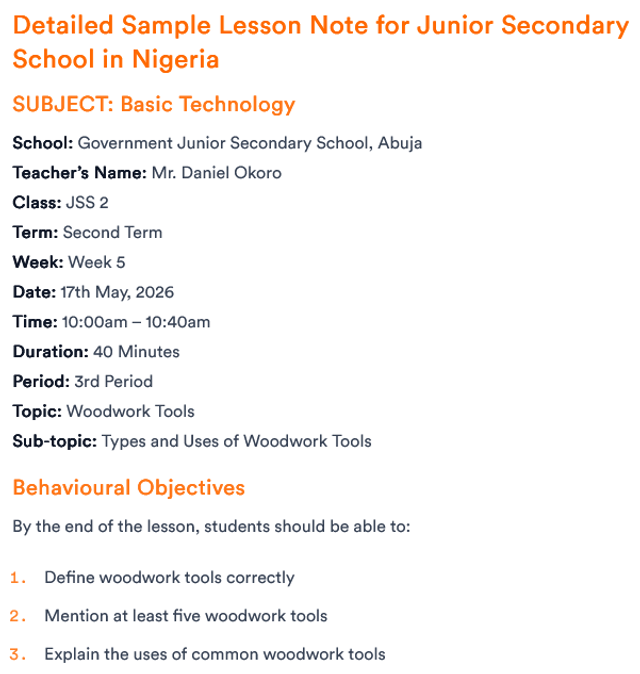
SUBJECT: Basic Technology
School: Government Junior Secondary School, Abuja
Teacher’s Name: Mr. Daniel Okoro
Class: JSS 2
Term: Second Term
Week: Week 5
Date: 17th May, 2026
Time: 10:00am – 10:40am
Duration: 40 Minutes
Period: 3rd Period
Topic: Woodwork Tools
Sub-topic: Types and Uses of Woodwork Tools
Behavioural Objectives
By the end of the lesson, students should be able to:
- Define woodwork tools correctly
- Mention at least five woodwork tools
- Explain the uses of common woodwork tools
- Identify woodwork tools when shown pictures or real objects
Previous Knowledge
Students have previously learnt workshop safety rules and simple hand tools used at home.
Instructional Materials
- Hammer
- Saw
- Chisel
- Screwdriver
- Measuring tape
- Charts showing woodwork tools
- Whiteboard and marker
Reference Materials
- NERDC Basic Technology Curriculum
- Basic Technology for Junior Secondary Schools
- Scheme of Work
Teaching Methods
- Discussion method
- Demonstration method
- Question and answer method
Set Induction / Introduction
The teacher enters the classroom carrying a hammer and a saw.
The teacher shows the hammer to the students and asks:
“Who has seen this tool before?”
Students respond.
The teacher asks:
“What is this tool used for?”
Different students give answers.
The teacher also shows the saw and asks similar questions.
The teacher then says:
“Today, we are going to learn about woodwork tools and their uses.”
Content Development / Presentation
| Step | Teacher's Activities | Students’ Activities | Teaching Method | Time |
|---|---|---|---|---|
| Step 1 | The teacher revises the previous lesson on workshop safety rules by asking students questions such as: “Why should tools be handled carefully?” and “Mention two workshop safety rules.” | Students answer revision questions based on previous lesson. | Question and Answer | 5 mins |
| Step 2 | The teacher introduces the meaning of woodwork tools. The teacher explains that woodwork tools are tools used for cutting, shaping, measuring, and joining wood during woodwork activities. The teacher writes the definition on the board. | Students listen attentively and copy the note from the board. | Discussion Method | 5 mins |
| Step 3 | The teacher displays different woodwork tools one after another. The teacher explains the name and use of each tool carefully. The hammer is used for driving nails into wood. The saw is used for cutting wood. The screwdriver is used for tightening and loosening screws. The chisel is used for shaping wood. The measuring tape is used for taking measurements. | Students observe the tools carefully, identify tools they already know, and ask questions where necessary. | Demonstration Method | 10 mins |
| Step 4 | The teacher demonstrates how to hold and use some of the tools safely. The teacher explains safety precautions while handling sharp tools like saws and chisels. | Students pay attention to the demonstration and respond to safety questions. | Demonstration Method | 5 mins |
| Step 5 | The teacher asks students to mention the names and uses of the tools displayed. The teacher corrects wrong answers and guides students appropriately. | Students participate actively by identifying tools and stating their uses. | Discussion Method | 5 mins |
| Step 6 | The teacher summarizes the lesson by reviewing the meaning of woodwork tools and the uses of each tool discussed. | Students listen and contribute during summary. | Discussion Method | 3 mins |
Board Summary
WOODWORK TOOLS
Woodwork tools are tools used for cutting, shaping, measuring, and joining wood.
Examples of Woodwork Tools and Their Uses
- Hammer
Used for driving nails into wood. - Saw
Used for cutting wood. - Screwdriver
Used for tightening and loosening screws. - Chisel
Used for shaping wood. - Measuring Tape
Used for taking measurements.
Evaluation
The teacher asks the following questions:
- What are woodwork tools?
- Mention five woodwork tools.
- State one use of a hammer.
- Which tool is used for cutting wood?
- Why should tools be handled carefully?
Expected Answers
- Woodwork tools are tools used for cutting, shaping, measuring, and joining wood.
- Hammer, saw, screwdriver, chisel, measuring tape.
- A hammer is used for driving nails into wood.
- Saw.
- To avoid accidents and injuries.
Conclusion
The teacher revises the important points discussed during the lesson and reminds students that proper handling of tools helps prevent accidents in the workshop.
Assignment
Draw and label five woodwork tools in your exercise book and state one use of each.
Teacher’s Remark
The lesson was successfully taught and the students understood the topic properly.
Detailed Sample Lesson Note for Senior Secondary School in Nigeria
SUBJECT: Geography
School: Government Senior Secondary School, Abuja
Teacher’s Name: Mrs. Grace Adeyemi
Class: SS 2
Term: Second Term
Week: Week 6
Date: 17th May, 2026
Time: 11:40am – 12:20pm
Duration: 40 Minutes
Period: 5th Period
Topic: Tourism
Sub-topic: Importance and Problems of Tourism in Nigeria
Behavioural Objectives
By the end of the lesson, students should be able to:
- Define tourism correctly
- Mention at least four importance of tourism
- State at least four problems affecting tourism in Nigeria
- Mention some tourist centres and major hotels in Nigeria
Previous Knowledge
Students have previously learnt recreational activities and environmental resources.
Instructional Materials
- Map of Nigeria
- Charts showing tourist centres in Nigeria
- Pictures of Obudu Cattle Ranch, Yankari Game Reserve, and Zuma Rock
- Geography textbook
- Whiteboard and marker
Reference Materials
- Essential Geography for Senior Secondary Schools by O.A. Iwena
- NERDC Geography Curriculum
- Scheme of Work
Teaching Methods
- Discussion method
- Demonstration method
- Question and answer method
Set Induction / Introduction
The teacher asks students:
“How many of you have travelled outside your town or state during holidays?”
Many students respond.
The teacher further asks:
“What interesting places did you visit?”
Students mention places like parks, hotels, beaches, and tourist centres.
The teacher then displays pictures of popular tourist centres in Nigeria and asks students if they can identify any of them.
After students respond, the teacher introduces the topic:
“Today, we are going to study tourism, its importance, and the problems affecting tourism in Nigeria.”
Content Development / Presentation
| Step | Teacher's Activities | Students’ Activities | Teaching Method | Time |
|---|---|---|---|---|
| Step 1 | The teacher revises the previous lesson by asking students questions related to recreation and leisure activities. | Students answer revision questions and participate actively. | Question and Answer | 5 mins |
| Step 2 | The teacher explains the meaning of tourism. The teacher defines tourism as the movement of people from one place to another for leisure, relaxation, business, or educational purposes. The teacher writes the definition on the board. | Students listen attentively, copy notes, and ask questions where necessary. | Discussion Method | 5 mins |
| Step 3 | The teacher explains the importance of tourism in Nigeria. The teacher explains that tourism generates revenue for the government, creates employment opportunities, promotes national unity, and encourages cultural exchange. The teacher uses examples of tourist centres and hotels in Nigeria. | Students listen carefully, contribute examples, and participate in class discussion. | Discussion Method | 10 mins |
| Step 4 | The teacher discusses problems affecting tourism in Nigeria. The teacher explains issues such as poor road networks, insecurity, lack of proper funding, environmental pollution, and poor maintenance of tourist centres. | Students listen attentively and mention additional problems affecting tourism in their areas. | Discussion Method | 7 mins |
| Step 5 | The teacher displays the map of Nigeria and points out major tourist centres such as Obudu Cattle Ranch, Yankari Game Reserve, Zuma Rock, and Tinapa Resort. The teacher also mentions popular hotels like Transcorp Hilton Abuja and Eko Hotel Lagos. | Students observe the map and identify tourist locations. | Demonstration Method | 5 mins |
| Step 6 | The teacher summarizes the lesson by revising the meaning, importance, and problems of tourism. | Students participate during summary and answer oral questions. | Discussion Method | 3 mins |
Board Summary
TOURISM
Tourism is the movement of people from one place to another for relaxation, leisure, business, or educational purposes.
Importance of Tourism
- Generates revenue for the government
- Creates employment opportunities
- Promotes cultural exchange
- Encourages national unity
- Develops infrastructure
Problems of Tourism in Nigeria
- Poor transportation system
- Insecurity
- Poor maintenance of tourist centres
- Environmental pollution
- Lack of adequate funding
Examples of Tourist Centres in Nigeria
- Obudu Cattle Ranch
- Yankari Game Reserve
- Zuma Rock
- Tinapa Resort
Evaluation
The teacher asks the following questions:
- Define tourism.
- Mention four importance of tourism.
- State four problems affecting tourism in Nigeria.
- Mention two tourist centres in Nigeria.
- Explain how tourism creates employment opportunities.
Expected Answers
- Tourism is the movement of people from one place to another for leisure, relaxation, business, or educational purposes.
- Revenue generation, employment creation, cultural exchange, national unity.
- Poor roads, insecurity, poor funding, environmental pollution.
- Obudu Cattle Ranch and Yankari Game Reserve.
- Tourism creates jobs in hotels, transport services, tour operations, and tourist centres.
Conclusion
The teacher emphasizes that tourism contributes greatly to Nigeria’s economy and national development but can only improve when government and citizens properly maintain tourist centres and provide adequate security.
Assignment
- Mention five tourist centres in Nigeria and state their locations.
- Explain three ways tourism can improve Nigeria’s economy.
Teacher’s Remark
The lesson was successfully taught. Students participated actively and understood the topic clearly.
Why This Is a Proper Lesson Note
This lesson note is classroom ready because it contains:
- detailed teaching procedures
- teacher and students activities
- classroom interaction
- examples relevant to Nigeria
- board summary
- expected answers
- instructional materials
- teaching methods
- time allocation
- practical explanations
This is the type of lesson note commonly accepted during teaching practice, school supervision, inspections, interviews, and classroom teaching in many Nigerian secondary schools.
Important Tips for Writing Better Lesson Notes
Follow the Curriculum
Always use the approved NERDC curriculum and scheme of work.
Use Clear Objectives
Objectives should be measurable and realistic.
Encourage Student Participation
Avoid excessive lecturing.
Use Instructional Materials
Teaching aids improve understanding and retention.
Manage Time Properly
Ensure each stage fits within the lesson duration.
Relate Lessons to Real Life
Students understand lessons better when examples relate to their environment.
Common Questions Teachers Ask
Can Lesson Notes Be Typed?
Yes. Many schools now accept typed lesson notes, although some still prefer handwritten copies.
Is Set Induction Necessary?
In most schools, yes.
It helps capture students' attention before teaching begins.
How Many Objectives Should a Lesson Have?
Most lessons contain between 3 and 5 behavioural objectives.
Can I Reuse Lesson Notes?
Yes, but they should be updated regularly.
Should Evaluation Come Before Conclusion?
Different schools use slightly different formats.
However, many schools prefer:
- Evaluation
- Conclusion
- Assignment
FAQs
What is a lesson note?
A lesson note is a detailed classroom teaching guide prepared before teaching a lesson.
What is the difference between lesson note and lesson plan?
A lesson plan gives a summarized overview while a lesson note contains detailed teaching procedures.
Why are instructional materials important?
Instructional materials make lessons easier, more practical, and more engaging.
What are behavioural objectives?
Behavioural objectives explain what students should be able to do after the lesson.
What is set induction?
Set induction is the introduction stage used to gain students' attention before teaching begins.
Conclusion
Writing lesson notes becomes easier with practice and consistency.
A good lesson note helps teachers stay organized, improve classroom teaching, manage time effectively, and achieve lesson objectives successfully.
Whether you teach in JSS or SSS classes, understanding how to prepare detailed lesson notes is an important teaching skill that improves both teaching quality and students' learning outcomes.
About the Author
Mohammad-Jamiu B. Balogun, GMNSE
AI Security Researcher · Founder, MonoEd Africa
Mohammad-Jamiu is a First-Class Telecommunications Engineer and Best Graduating Student (BUK), and an AI security researcher. He founded MonoEd Africa to give Nigerian students AI-powered academic tools — from SIWES logbooks to final year projects. His work has reached over 10,000 students across Nigeria.