Lesson Plan Format for Secondary School in Nigeria With Sample and Explanation
Learn the standard lesson plan format for secondary schools in Nigeria with clear explanations, examples, samples, objectives, presentation steps, evaluation methods, and FAQs for teachers.

Writing a proper lesson plan is one of the most important responsibilities of a teacher in Nigerian secondary schools. Whether you are a student teacher, newly employed teacher, SIWES/IT trainee, or experienced educator, understanding the correct lesson plan format helps you teach effectively and meet school requirements.
In many Nigerian schools, lesson plans are inspected by principals, HODs, supervisors, and external evaluators. A well prepared lesson plan shows that the teacher understands the topic, learning objectives, teaching methods, and classroom management.
This guide explains the standard lesson plan format used in secondary schools in Nigeria, the meaning of each section, practical examples, and common mistakes teachers should avoid.
Quick Summary
A standard Nigerian secondary school lesson plan usually contains:
- Date
- Class
- Subject
- Topic
- Sub-topic
- Duration
- Behavioural Objectives
- Instructional Materials
- Entry Behaviour
- Set Induction
- Presentation Steps
- Evaluation
- Conclusion or Summary
- Assignment
- References
The aim is to help the teacher organize the lesson properly within 35 to 40 minutes while ensuring students understand the topic.
What Is a Lesson Plan?
A lesson plan is a detailed guide prepared by a teacher before teaching a lesson. It explains what the teacher intends to teach, how the lesson will be taught, the materials needed, and how students will be assessed.
A lesson plan helps teachers:
- Teach in an organized manner
- Manage classroom time effectively
- Achieve learning objectives
- Improve student participation
- Monitor students' understanding
- Meet school supervision standards
Standard Lesson Plan Format for Secondary Schools in Nigeria
Below is the commonly accepted lesson plan format used in Nigerian secondary schools.
| Section | Meaning |
|---|---|
| Date | The day the lesson will be taught |
| Class | The class level such as JSS1 or SS2 |
| Subject | The subject being taught |
| Topic | Main lesson topic |
| Sub-topic | Smaller aspect of the topic |
| Duration | Time allocated for the lesson |
| Behavioural Objectives | What students should achieve after the lesson |
| Instructional Materials | Teaching aids and learning materials |
| Entry Behaviour | Previous knowledge students already have |
| Set Induction | Activity or question used to gain students' attention |
| Presentation | Step by step teaching process |
| Evaluation | Questions used to test understanding |
| Conclusion/Summary | Recap of important points |
| Assignment | Homework or follow up task |
| References | Textbooks and materials consulted |
Explanation of Each Part of a Lesson Plan
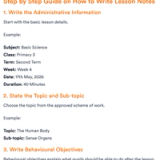
1. Date
This shows the exact day the lesson will be taught.
Example:
Date: 17th May, 2026
2. Class
Indicate the class level of the students.
Examples:
- JSS1
- JSS2
- SS1
- SS3
3. Subject
Write the subject clearly.
Examples:
- Mathematics
- English Language
- Geography
- Computer Studies
4. Topic
The topic is the main lesson for the day.
Example:
Topic: Tourism
5. Sub-topic
This is the smaller area under the main topic.
Example:
Sub-topic: Importance of Tourism
6. Duration
Most Nigerian secondary school lessons last between 35 and 40 minutes.
Example:
Duration: 40 Minutes
7. Behavioural Objectives
Behavioural objectives explain what students should be able to do at the end of the lesson.
Good objectives must be measurable and action based.
Use verbs such as:
- Define
- Explain
- Mention
- List
- Identify
- Compare
- Differentiate
- State
Example:
By the end of the lesson, students should be able to:
- Define tourism
- Mention three importance of tourism
- State two problems of tourism
Common Mistake Teachers Make in Objectives
Wrong:
- Students should understand tourism
Correct:
- Students should be able to explain tourism
The second example is measurable and easier to evaluate.
8. Instructional Materials
These are teaching aids used during the lesson.
Examples include:
- Charts
- Chalkboard
- Laptop
- Maps
- Flashcards
- Pictures
- Real objects
- Textbooks
Example:
Instructional Materials: Chart showing tourist centres in Nigeria, textbook, chalkboard.
9. Entry Behaviour
This refers to students' previous knowledge related to the topic.
Example:
Students have previously learnt about recreation and leisure activities.
10. Set Induction
Set induction is used to capture students' attention at the beginning of the lesson.
A teacher may use:
- Stories
- Questions
- Demonstrations
- Pictures
- Real life examples
Example:
The teacher asks students to mention places they visited during holidays.
This helps students connect with the lesson immediately.
11. Presentation or Content Development
This is the main teaching stage. It is usually divided into steps.
Many Nigerian schools use Step I to Step V.
Example of Presentation Format
| Step | Teacher's Activities | Students' Activities |
|---|---|---|
| Step I | Revises previous lesson | Respond to questions |
| Step II | Introduces new topic | Listen attentively |
| Step III | Explains concepts using materials | Observe and participate |
| Step IV | Gives class activities | Answer questions |
| Step V | Evaluates students | Respond appropriately |
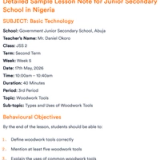
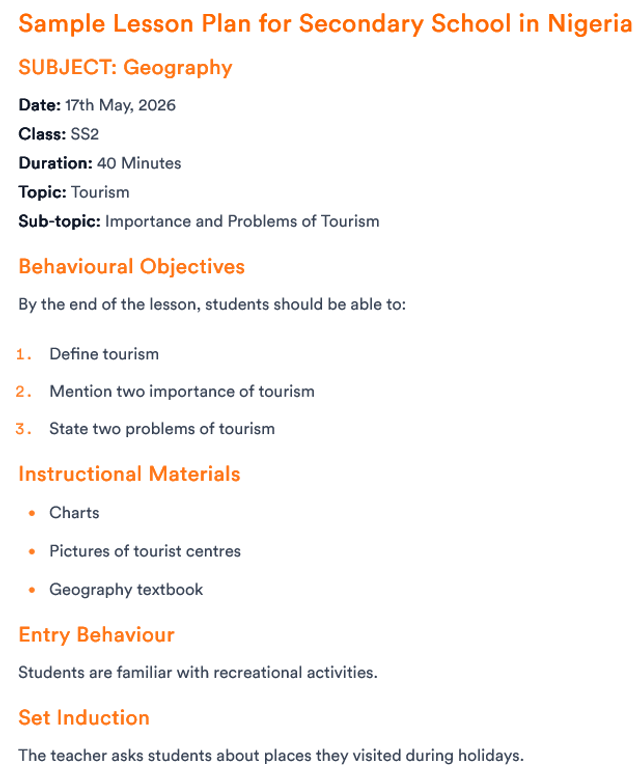
Sample Lesson Plan for Secondary School in Nigeria
SUBJECT: Geography
Date: 17th May, 2026
Class: SS2
Duration: 40 Minutes
Topic: Tourism
Sub-topic: Importance and Problems of Tourism
Behavioural Objectives
By the end of the lesson, students should be able to:
- Define tourism
- Mention two importance of tourism
- State two problems of tourism
Instructional Materials
- Charts
- Pictures of tourist centres
- Geography textbook
Entry Behaviour
Students are familiar with recreational activities.
Set Induction
The teacher asks students about places they visited during holidays.
Presentation
Step I
Teacher revises previous lesson.
Students respond to questions.
Step II
Teacher introduces tourism and explains its meaning.
Students listen and take notes.
Step III
Teacher explains the importance of tourism using charts and examples.
Students participate in discussion.
Step IV
Teacher explains problems affecting tourism in Nigeria.
Students ask and answer questions.
Step V
Teacher evaluates students.
Students respond appropriately.
Evaluation
- What is tourism?
- Mention two importance of tourism.
- State two problems of tourism in Nigeria.
Conclusion
Teacher summarizes the lesson by highlighting major points discussed.
Assignment
Mention five tourist centres in Nigeria.
References
Iwena, O.A. Essential Geography for Senior Secondary Schools.
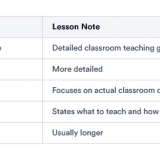
Difference Between Lesson Plan and Lesson Note
Many teachers and student teachers confuse lesson plan with lesson note.
Lesson Plan
A lesson plan is the teacher's organized guide for teaching a lesson.
Lesson Note
A lesson note is the expanded classroom record containing detailed explanations and notes prepared for teaching.
In many Nigerian schools, both terms are sometimes used interchangeably, but technically they are not exactly the same.
How Long Should a Lesson Plan Be?
There is no fixed length.
However, a good lesson plan should:
- Be clear
- Be organized
- Fit the lesson duration
- Cover all important sections
Most lesson plans are between 2 to 5 pages depending on school requirements.
Important Tips for Writing a Good Lesson Plan
Follow the Nigerian Curriculum
Ensure your lesson aligns with the approved NERDC curriculum and scheme of work.
Use Simple Objectives
Objectives should be specific and measurable.
Encourage Student Participation
Avoid excessive lecturing. Allow students to answer questions and participate actively.
Use Instructional Materials
Teaching aids improve understanding and retention.
Manage Time Properly
Ensure all lesson stages fit into the available time.
Relate Lessons to Real Life
Students learn faster when examples are connected to their environment.
Common Questions Teachers Ask
Can a Lesson Plan Be Typed?
Yes. Many schools now accept typed lesson plans, although some still prefer handwritten copies.
Always follow your school's instruction.
Is Set Induction Compulsory?
In most schools, yes.
Set induction helps prepare students mentally for the lesson and improves attention.
Should Evaluation Come Before Conclusion?
Different schools use slightly different formats.
However, many schools prefer:
- Evaluation
- Conclusion/Summary
- Assignment
Always follow your school's approved format.
Can I Use the Same Lesson Plan Every Year?
Yes, but it should be updated when necessary to match curriculum changes and students' needs.
How Many Behavioural Objectives Should a Lesson Have?
Most lessons contain between 3 and 5 behavioural objectives.
Too many objectives may become unrealistic within one lesson period.
FAQs
What is the standard lesson plan format in Nigeria?
The standard format includes date, class, subject, topic, objectives, instructional materials, presentation steps, evaluation, conclusion, and assignment.
What is the difference between entry behaviour and set induction?
Entry behaviour checks previous knowledge while set induction captures students' attention and introduces the lesson.
How many steps should a lesson presentation have?
Most Nigerian schools use between 4 and 5 teaching steps.
What are behavioural objectives in lesson plans?
Behavioural objectives describe what students should be able to do after the lesson.
What is the purpose of instructional materials?
Instructional materials make learning easier, practical, and more engaging for students.
Conclusion
A good lesson plan helps teachers teach confidently and effectively. It improves classroom organization, student participation, and learning outcomes.
For teachers in Nigerian secondary schools, mastering the correct lesson plan format is essential for professional growth and successful classroom teaching.
Whether you are preparing for teaching practice, classroom supervision, or daily teaching activities, using the proper lesson plan structure will make your work easier and more effective.
About the Author
Mohammad-Jamiu B. Balogun, GMNSE
AI Security Researcher · Founder, MonoEd Africa
Mohammad-Jamiu is a First-Class Telecommunications Engineer and Best Graduating Student (BUK), and an AI security researcher. He founded MonoEd Africa to give Nigerian students AI-powered academic tools — from SIWES logbooks to final year projects. His work has reached over 10,000 students across Nigeria.