How to Write Lesson Notes for Primary School in Nigeria With Detailed Sample
Learn how to write lesson notes for primary school in Nigeria using the standard format. Includes detailed sample lesson note, lesson note vs lesson plan explanation, examples, FAQs, and tips for teachers.

Writing lesson notes is one of the most important responsibilities of a primary school teacher in Nigeria. Whether you are a student teacher, classroom teacher, newly employed teacher, or NYSC member, understanding how to prepare a proper lesson note is essential.
In many Nigerian schools, lesson notes are checked regularly by head teachers, supervisors, and education inspectors. A well prepared lesson note helps teachers organize lessons properly, manage classroom activities effectively, and improve pupils' understanding.
However, many teachers still struggle with questions like:
- What exactly is a lesson note?
- Is lesson note different from lesson plan?
- What is the correct Nigerian format?
- How detailed should a lesson note be?
- Can a lesson note be typed?
This guide explains everything clearly with examples and a detailed sample lesson note you can use as a guide.
If you also want to understand lesson plans better, you can read our related guide on Lesson Plan Format for Secondary School in Nigeria.
Quick Summary
A standard lesson note for Nigerian primary schools usually contains:
- Subject
- Class
- Term and Week
- Topic
- Sub-topic
- Date
- Duration
- Behavioural Objectives
- Previous Knowledge
- Instructional Materials
- Reference Materials
- Set Induction
- Content Development
- Teacher and Pupils Activities
- Evaluation
- Conclusion
- Assignment
The major purpose of a lesson note is to guide classroom teaching step by step.
What Is a Lesson Note?
A lesson note is a detailed teaching guide prepared by a teacher before entering the classroom. It explains:
- what the teacher wants to teach
- how the lesson will be taught
- the activities pupils will perform
- the teaching materials needed
- how pupils will be evaluated
A lesson note helps teachers teach in an organized and effective manner.
In Nigerian schools, lesson notes are often submitted weekly for supervision and approval.
Difference Between Lesson Note and Lesson Plan
This is one of the biggest areas of confusion among Nigerian teachers.
The reason many people get confused is because some schools use the two terms interchangeably. Also, both formats contain similar headings like topic, objectives, instructional materials, evaluation, and assignment.
However, there is still a technical difference.
| Lesson Plan | Lesson Note |
|---|---|
| A teaching outline | A detailed classroom teaching guide |
| Focuses mainly on planning | Focuses on actual classroom delivery |
| More summarized | More detailed |
| States what to teach | States what to teach and how to teach it |
| Usually shorter | Usually longer |
| Often 1 to 2 pages | Usually 2 to 5 pages |
Think of it this way:
- A lesson plan is the blueprint.
- A lesson note is the detailed classroom guide.
Why Lesson Plan and Lesson Note Sometimes Look Similar
In many Nigerian schools today, teachers combine both formats together. This is why many lesson plans already contain teacher activities, pupils activities, evaluation, and presentation steps.
But traditionally:
- lesson plans are more summarized
- lesson notes contain fuller classroom teaching details
For example:
Simple Lesson Plan Example
Topic: Sense Organs
Objective:
Pupils should be able to identify the five sense organs.
Presentation:
Teacher explains the five sense organs using charts.
Evaluation:
Mention the five sense organs.
This is brief and summarized.
Detailed Lesson Note Example
Step 1:
Teacher displays a chart showing the five sense organs and asks pupils what they use their eyes for.
Pupils respond to the teacher's questions.
Step 2:
Teacher explains the meaning of sense organs and lists them on the board.
Pupils repeat after the teacher and copy notes.
Step 3:
Teacher uses real objects and pictures to explain the functions of each sense organ.
Pupils observe, identify, and answer questions.
This version contains fuller classroom procedures, which makes it a lesson note.
Standard Lesson Note Format for Primary School in Nigeria
Below is the commonly accepted lesson note format used in many Nigerian primary schools.
| Section | Meaning |
|---|---|
| Subject | Subject being taught |
| Class | Pupils' class |
| Term/Week | Academic term and week |
| Topic | Main lesson topic |
| Sub-topic | Specific aspect of the topic |
| Date | Date of lesson |
| Duration | Time allocated |
| Behavioural Objectives | What pupils should achieve |
| Previous Knowledge | What pupils already know |
| Instructional Materials | Teaching aids |
| Reference Materials | Books and curriculum materials |
| Set Induction | Introduction used to gain attention |
| Content Development | Step by step teaching procedure |
| Teacher and Pupils Activities | Classroom interaction |
| Evaluation | Questions to test understanding |
| Conclusion | Summary of lesson |
| Assignment | Homework or follow up activity |
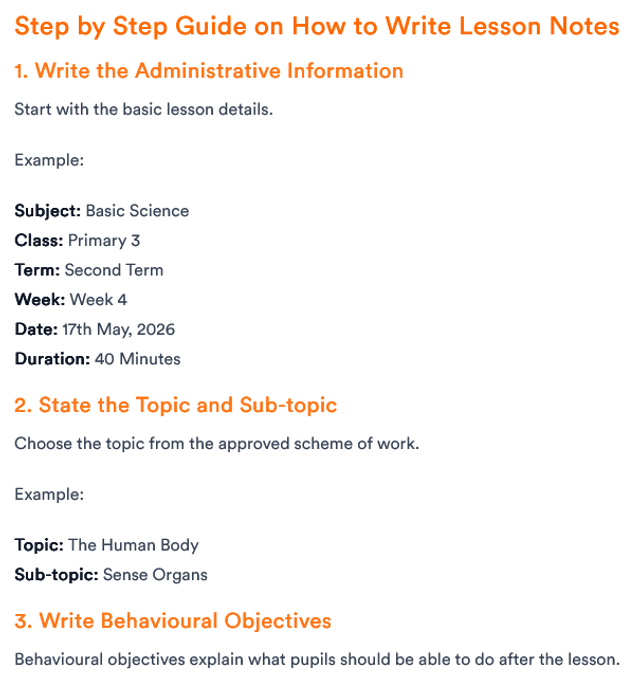
Step by Step Guide on How to Write Lesson Notes
1. Write the Administrative Information
Start with the basic lesson details.
Example:
Subject: Basic Science
Class: Primary 3
Term: Second Term
Week: Week 4
Date: 17th May, 2026
Duration: 40 Minutes
2. State the Topic and Sub-topic
Choose the topic from the approved scheme of work.
Example:
Topic: The Human Body
Sub-topic: Sense Organs
3. Write Behavioural Objectives
Behavioural objectives explain what pupils should be able to do after the lesson.
Good objectives must be measurable.
Start with:
“By the end of the lesson, pupils should be able to:”
Example:
- Mention the five sense organs
- State the functions of each sense organ
- Draw two sense organs correctly
Common Mistake Teachers Make
Wrong:
- Pupils should understand sense organs
Correct:
- Pupils should be able to identify the five sense organs
The second example is measurable and easier to evaluate.
4. Write Previous Knowledge
This explains what pupils already know related to the topic.
Example:
Pupils know that different parts of the body perform different functions.
5. List Instructional Materials
Instructional materials help pupils understand lessons faster, especially at the primary school level.
Examples include:
- Charts
- Flashcards
- Pictures
- Real objects
- Toys
- Posters
- Chalkboard
Example:
Instructional Materials: Chart showing the five sense organs, flashcards, and real objects.
6. Add Reference Materials
These are materials used in preparing the lesson.
Examples:
- NERDC Curriculum
- Scheme of Work
- Textbooks
7. Write the Set Induction
Set induction is the introduction stage used to gain pupils' attention before teaching begins.
Primary school pupils learn better when lessons begin with interesting activities.
You can use:
- songs
- stories
- questions
- demonstrations
- real objects
Example:
The teacher shows an orange fruit and asks:
“What part of your body helps you smell this orange?”
This naturally introduces the topic of sense organs.
8. Develop the Content Properly
This is the main body of the lesson note.
It should contain:
- teacher activities
- pupils activities
- demonstrations
- explanations
- classroom interaction
Most Nigerian schools use step by step presentation.
Detailed Sample Lesson Note for Primary School in Nigeria
SUBJECT: Basic Science
School: Bright Future Primary School
Class: Primary 3
Term: Second Term
Week: Week 4
Date: 17th May, 2026
Duration: 40 Minutes
Topic: The Human Body
Sub-topic: Sense Organs
Behavioural Objectives
By the end of the lesson, pupils should be able to:
- Mention the five sense organs
- State the functions of each sense organ
- Identify sense organs from charts and real objects
- Draw and label at least two sense organs correctly
Previous Knowledge
Pupils already know that the body is made up of different parts that help us perform activities.
Instructional Materials
- Chart showing the five sense organs
- Flashcards
- Mirror
- Bell
- Orange fruit
- Chalkboard and marker
Reference Materials
- NERDC Basic Science Curriculum
- Scheme of Work
- Basic Science for Primary Schools Textbook
Set Induction / Introduction
The teacher enters the classroom holding an orange fruit and a bell.
The teacher rings the bell and asks:
“What part of the body helps us hear this sound?”
Expected response: “Ear.”
The teacher then brings the orange closer to some pupils and asks:
“What part of the body helps us smell this orange?”
Expected response: “Nose.”
The teacher then tells the pupils that today's lesson is about the parts of the body that help us see, hear, smell, taste, and feel things around us.
The teacher writes the topic on the board:
SENSE ORGANS
Content Development / Presentation
| Step | Teacher's Activities | Pupils' Activities |
|---|---|---|
| Step 1 | The teacher revises the previous lesson by asking pupils to mention parts of the body they already know. | Pupils mention body parts such as hand, leg, eye, and nose. |
| Step 2 | The teacher explains that sense organs are special parts of the body that help us know what is happening around us. | Pupils listen attentively. |
| Step 3 | The teacher displays a chart showing the five sense organs and mentions them one after another: eyes, ears, nose, tongue, and skin. | Pupils observe the chart and repeat the names after the teacher. |
| Step 4 | The teacher explains the functions of each sense organ. Eye helps us to see. Ear helps us to hear. Nose helps us to smell. Tongue helps us to taste. Skin helps us to feel or touch. | Pupils listen, repeat the functions, and ask questions where necessary. |
| Step 5 | The teacher uses real objects for demonstration. The teacher rings a bell, shows a colourful object, gives pupils orange to smell, and asks pupils to touch objects around them. | Pupils participate actively in the demonstration activities. |
| Step 6 | The teacher asks pupils to identify different sense organs on the chart and point to them on their bodies. | Pupils identify and point correctly to their sense organs. |
| Step 7 | The teacher draws two sense organs on the chalkboard and demonstrates proper labeling. | Pupils observe carefully and copy into their notebooks. |
| Step 8 | The teacher summarizes the lesson by repeating the names and functions of the sense organs. | Pupils repeat the summary with the teacher. |
Evaluation
The teacher asks the following questions:
- Mention the five sense organs.
- Which sense organ helps us to hear?
- What is the function of the tongue?
- Which sense organ helps us smell things?
- Draw and label any two sense organs.
Expected Answers:
- Eye, ear, nose, tongue, skin
- Ear
- The tongue helps us to taste
- Nose
Conclusion
The teacher revises the major points taught during the lesson and reminds pupils that sense organs help us understand our environment.
The teacher encourages pupils to take care of their sense organs by maintaining proper hygiene.
Assignment
- Draw and label the five sense organs.
- Write one function of each sense organ.
Why This Is a Proper Lesson Note
This sample is considered a proper lesson note because it contains:
- detailed teaching procedures
- teacher and pupils activities
- classroom interaction
- demonstrations
- instructional flow
- evaluation methods
- practical classroom guidance
A teacher can enter the classroom and teach directly from this note.
Important Tips for Writing Better Lesson Notes
Follow the Curriculum
Always use the approved NERDC curriculum and scheme of work.
Make Lessons Child Friendly
Primary school pupils learn faster through activities, demonstrations, songs, and simple explanations.
Use Simple Language
Avoid complicated explanations.
Encourage Participation
Allow pupils to ask questions and participate actively.
Use Real Life Examples
Relating lessons to pupils' environment improves understanding.
Manage Time Properly
Allocate time to each stage of the lesson.
Common Questions Teachers Ask
Can Lesson Notes Be Typed?
Yes. Many schools now accept typed lesson notes, although some schools still prefer handwritten copies.
Always follow your school's instruction.
Is Set Induction Compulsory?
In most schools, yes.
Set induction helps capture pupils' attention before teaching begins.
How Many Behavioural Objectives Should a Lesson Have?
Most lessons contain about 3 to 5 objectives.
Can I Reuse Lesson Notes?
Yes, but lesson notes should be updated regularly to suit pupils' needs and curriculum changes.
Should Evaluation Come Before Conclusion?
Different schools use slightly different formats.
However, many schools use:
- Evaluation
- Conclusion
- Assignment
FAQs
What is a lesson note?
A lesson note is a detailed classroom teaching guide prepared by a teacher before teaching a lesson.
What is the difference between lesson note and lesson plan?
A lesson plan gives a summarized overview of the lesson, while a lesson note contains detailed classroom teaching procedures.
What is set induction?
Set induction is the introduction stage used to gain pupils' attention before teaching begins.
Why are instructional materials important?
Instructional materials make learning easier, practical, and more interesting for pupils.
What are behavioural objectives?
Behavioural objectives explain what pupils should be able to do after the lesson.
Conclusion
Writing lesson notes may seem difficult at first, especially for new teachers, but it becomes easier with practice and consistency.
A good lesson note helps teachers stay organized, teach confidently, manage classroom activities properly, and improve pupils' learning outcomes.
Whether you are a classroom teacher, teaching practice student, or NYSC member, learning how to prepare effective lesson notes is an important teaching skill that will help throughout your career.
About the Author
Mohammad-Jamiu B. Balogun, GMNSE
AI Security Researcher · Founder, MonoEd Africa
Mohammad-Jamiu is a First-Class Telecommunications Engineer and Best Graduating Student (BUK), and an AI security researcher. He founded MonoEd Africa to give Nigerian students AI-powered academic tools — from SIWES logbooks to final year projects. His work has reached over 10,000 students across Nigeria.