SIWES Report for Architecture Students in Nigeria (Full Guide, Format, Sample & A+ Tips)
Complete guide on how to write a SIWES report for architecture students in Nigeria. Includes full structure, office and site experience, CAD/BIM skills, project samples, formatting tips, and FAQs.

Architecture SIWES is where studio theory meets construction reality.
As an architecture student in Nigeria, your Student Industrial Work Experience Scheme report is not just a requirement. It is proof that you understand how design moves from paper to site.
This guide explains:
- The correct SIWES report structure for architecture students
- What to write in each chapter
- How to present office and site experience properly
- Software and technical skills to highlight
- A real placement example at the Lagos State Ministry of Housing
- Formatting requirements
- Frequently asked questions
Let us structure it properly.
What Is SIWES?
The Student Industrial Work Experience Scheme was established to bridge the gap between classroom learning and professional practice. It is supervised nationally by the Industrial Training Fund.
For architecture students, SIWES helps you:
- Understand real construction processes
- Work in architectural offices
- Learn CAD and BIM tools
- Supervise projects on site
- Experience client interaction
- Develop professional discipline
💡 You May Also Read on:
- SIWES Report Format in Nigeria: Complete Guide, Samples, Structure, and A Plus Writing Tips
- How to Write SIWES Chapter One: Full Guide, Structure, Format and A Grade Example
Standard SIWES Report Structure for Architecture Students
A well structured architecture SIWES report usually contains five or six chapters.
Preliminary Pages
- Cover page
- Title page
- Dedication
- Acknowledgement
- Abstract
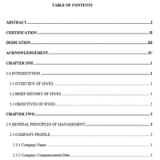
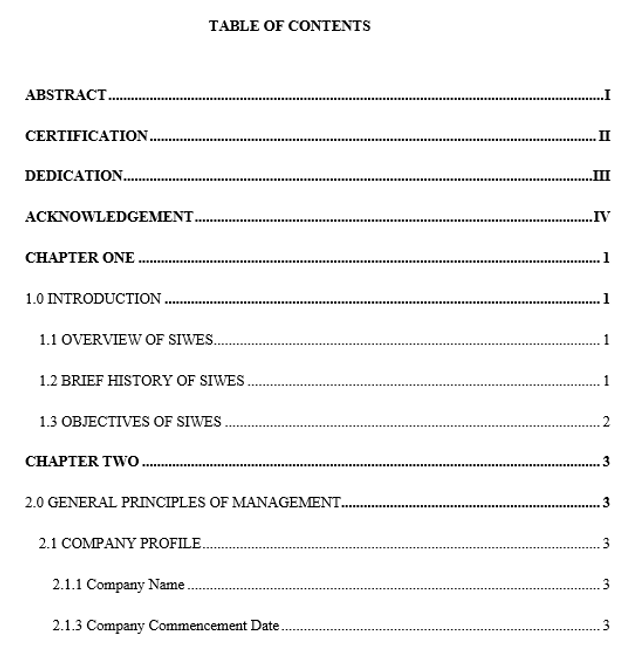
- Table of contents
- List of figures
Chapter Outline
- Introduction
- Organization Profile
- Office and Site Experience
- Selected Projects Undertaken
- Challenges, Conclusion and Recommendations
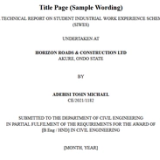
Sample Title Page (Architecture SIWES)
TECHNICAL REPORT
ON
STUDENT INDUSTRIAL WORK EXPERIENCE SCHEME (SIWES)
Undertaken At:
Lagos State Ministry of Housing
Block 3, Lagos State Secretariat, Alausa, Ikeja, Lagos
Submitted By:
Your Name
Matric Number
Department of Architecture
University Name
In Partial Fulfillment of the Requirement for the Award of Bachelor of Technology Degree in Architecture
Month, Year
CHAPTER ONE
Introduction
This chapter explains:
- History of SIWES
- Objectives of the scheme
- Importance to architecture students
- Scope of training
SIWES was introduced to expose students to practical realities that academic environments cannot fully provide. It prepares students for professional practice and improves technical competence.
Objectives of SIWES
- Prepare students for post graduation employment
- Provide industrial skills
- Bridge theory and practice
- Improve professional ethics
- Strengthen employer involvement in education
For architecture students, this means understanding:
- Studio workflow
- Construction methods
- Project supervision
- Professional responsibility
CHAPTER TWO
Profile of the Organization
Example placement:
Lagos State Ministry of Housing
The Lagos State Ministry of Housing was established in 1999. It is responsible for providing affordable housing across the state.
Departments Include:
- Architectural and Building Services
- Quantity Surveying
- Engineering Services
- Physical Planning
- Estate Department
- Legal Services
Major Scheme:
Lagos Home Ownership Mortgage Scheme also known as LAGOSHOMS.
This chapter should include:
- Vision and mission
- Organizational structure
- Organogram
- Key personnel
- Range of services
CHAPTER THREE
Office and Site Experience
This is the most important chapter. It carries the highest marks.
Divide it into:
- Technical Experience
- Administrative Experience
- Field Experience
3.1 Office Experience
This covers studio work and CAD drafting.
Software Skills to Highlight
- AutoCAD for 2D drafting
- Revit for BIM modeling
- SketchUp for conceptual modeling
- Lumion or 3ds Max for rendering
- Microsoft Excel for reports
- Microsoft Word for documentation
Tasks You Should Document
- Preparing working drawings
- Site plans
- Floor plans
- Elevations
- Sections
- Detailing
- 3D modeling
- Rendering
Explain what you personally did, not what the firm generally does.
3.2 Administrative Experience
Architecture is not only design.
Mention:
- Filing drawings
- Preparing reports
- Taking meeting minutes
- Writing site reports
- Client presentation support
- Budget documentation
These show professional maturity.
3.3 Field Experience
Site exposure is critical.
Construction Activities to Describe
- Setting out using 3 4 5 method
- Strip foundation excavation
- Formwork and reinforcement
- Casting of slabs
- Block laying
- Roofing
- Installation of doors
- Tiling
- Painting
- Electrical fixtures
- Sanitary fittings
Explain materials used and technical reasoning.
Site Safety Precautions
- Safety helmet
- Safety boots
- Safety mesh
- First aid box
- Avoid handling unfamiliar equipment
Always include safety discussion for higher marks.
CHAPTER FOUR
Selected Projects Undertaken
This chapter differentiates average reports from excellent ones.
Include:
- Project name
- Location
- Design concept
- Your role
- Technical challenges
- Visual documentation
Example Projects
- Housing estate supervision
- Office interior rendering
- Community gatehouse design
- 4 bedroom duplex prototype
- Art gallery design
Describe:
- Spatial arrangement
- Material choice
- Structural considerations
- Aesthetic philosophy
- BIM modeling process
Add screenshots of drawings and site photographs.
CHAPTER FIVE
Challenges, Conclusion and Recommendations
Challenges Faced
- Learning new software
- Site logistics
- Contractor coordination
- Material delays
- Technical errors
Explain how you overcame them.
Conclusion
Summarize:
- Skills gained
- Professional growth
- Improved design understanding
- Practical construction knowledge
Recommendations
- More CAD training in universities
- Better placement support from ITF
- Encourage BIM adoption
- Stronger collaboration between schools and firms
Key Skills Architecture Students Must Highlight
Software Proficiency
- BIM tools
- Revit
- AutoCAD
- Rendering software
Technical Knowledge
- Foundation types
- Concrete mix ratios
- Structural elements
- Material properties
Professional Practice
- Teamwork
- Client management
- Project management
- Ethics
- Communication
Documentation Requirements
Logbook
You must:
- Record daily activities
- Include sketches
- Get weekly supervisor signature
Visual Evidence
Your report should include:
- Site photographs
- CAD screenshots
- Rendered images
- Construction stages
- Organogram
This validates your experience.
Formatting Guidelines
- Font: Times New Roman
- Size: 12
- Line spacing: Double
- A4 paper
- 30 to 60 pages recommended
- Roman numerals for preliminary pages
- Arabic numerals for main chapters
Common Mistakes to Avoid
- Copying another student’s report
- Writing generic descriptions
- Not explaining your personal contribution
- No images or drawings
- Poor formatting
- Weak conclusion
Supervisors can detect recycled reports immediately.
FAQs
1. How long should an architecture SIWES report be?
Between 30 and 60 pages depending on university requirements.
2. Can I include my CAD screenshots?
Yes. In fact, you should. It strengthens your report.
3. Is site experience compulsory?
Yes. Architecture SIWES must include construction exposure.
4. What software should I know before SIWES?
AutoCAD is essential. Revit and other BIM tools give you advantage.
5. Can I do SIWES in a government ministry?
Yes. Ministries, private firms, construction companies, and real estate firms are all acceptable placements.
About the Author
Mohammad-Jamiu B. Balogun, GMNSE
AI Security Researcher · Founder, MonoEd Africa
Mohammad-Jamiu is a First-Class Telecommunications Engineer and Best Graduating Student (BUK), and an AI security researcher. He founded MonoEd Africa to give Nigerian students AI-powered academic tools — from SIWES logbooks to final year projects. His work has reached over 10,000 students across Nigeria.