SIWES Report for Food Science and Technology in Nigeria (Full Sample + Production Guide)
Complete SIWES report for Food Science and Technology students in Nigeria. Includes full sample, yoghurt, soy kunu and poundo yam production processes, quality control, challenges, and formatting guide.

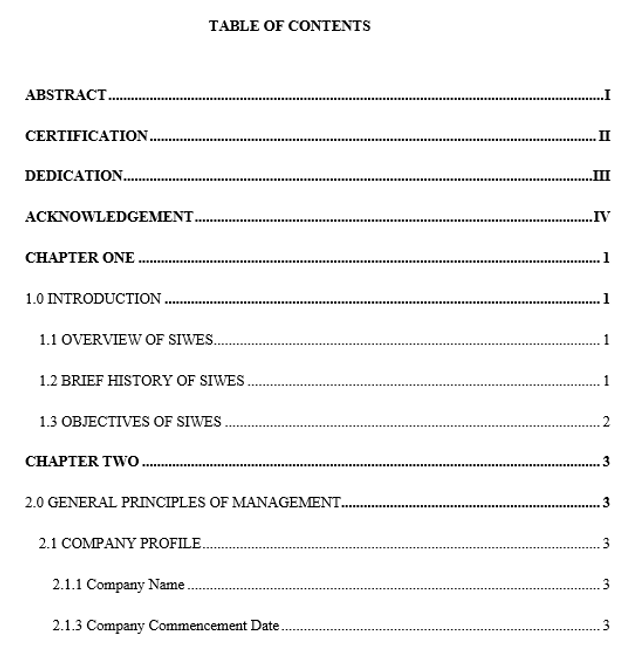
If you are a Food Science and Technology student preparing your SIWES report, this comprehensive guide will help you structure it correctly, write professionally, and present strong technical content that earns high marks.
This post includes:
- Complete SIWES report structure
- Department based case study
- Detailed production processes
- Microbial analysis and quality control sections
- Challenges and recommendations
- Formatting guide used in Nigerian universities
- Frequently asked questions
You can adapt this whether you trained in a university laboratory, food processing company, research institute, bakery, beverage factory, or agricultural processing firm.
What is SIWES?
The Students Industrial Work Experience Scheme is a structured industrial training program established in 1973 by the Industrial Training Fund.
It was introduced to bridge the gap between theoretical classroom learning and practical industry skills. Food Science students particularly benefit because food production, preservation, safety testing, and quality control require hands on laboratory and processing experience.
💡 You May Also Read on:
- SIWES Report Format in Nigeria: Complete Guide, Samples, Structure, and A Plus Writing Tips
- How to Write SIWES Chapter One: Full Guide, Structure, Format and A Grade Example
Standard SIWES Report Structure for Food Science and Technology
Most Nigerian universities use the following format:
Preliminary Pages
- Title Page
- Certification
- Dedication
- Acknowledgement
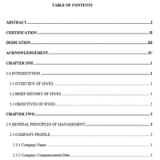
- Table of Contents
- List of Tables
- List of Plates
- Abstract
Main Chapters
- Chapter One: Introduction to SIWES
- Chapter Two: Organization Overview
- Chapter Three: Areas of Participation and Technical Activities
- Chapter Four: Challenges, Recommendations and Conclusion
- References
COMPLETE SIWES REPORT SAMPLE
(Food Science and Technology – Laboratory Based Training)
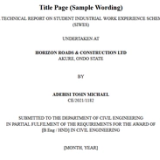
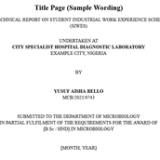
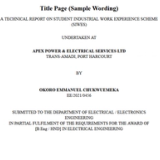
TITLE PAGE (Sample)
A TECHNICAL REPORT ON STUDENT INDUSTRIAL WORK EXPERIENCE SCHEME (SIWES)
Undertaken at
Food Science and Technology Departmental Laboratory
Compiled by:
[Your Name]
FST/2019/XXXX
Submitted to:
Department of Food Science and Technology
Faculty of Agriculture
Federal University Oye Ekiti
In partial fulfilment of the requirements for the award of
Bachelor of Science (B.Sc.) Degree in Food Science and Technology
September, 2024
CERTIFICATION (Sample)
This is to certify that this report was prepared by [Your Name] in partial fulfilment of the requirements for the award of B.Sc. in Food Science and Technology.
Supervisor Signature
SIWES Coordinator Signature
Head of Department Signature
ABSTRACT (Sample)
This report presents practical training undertaken in the Food Science and Technology Departmental Laboratory. The training focused on the production and evaluation of yoghurt drinks, soy kunu beverage, and poundo yam flour. It also covered microbial analysis, quality control procedures, sensory evaluation, and packaging techniques.
The training enhanced knowledge in food processing, fermentation technology, food safety management, and product development.
CHAPTER ONE
INTRODUCTION TO SIWES
The Students Industrial Work Experience Scheme was introduced by the Industrial Training Fund to provide students with practical industrial exposure.
Food Science students require hands on experience in:
- Food processing
- Fermentation
- Quality control
- Microbial testing
- Packaging
- Food safety management
The training period usually lasts six months for most universities.
CHAPTER TWO
ORGANIZATION OVERVIEW
2.1 History of the Department
The Department of Food Science and Technology at Federal University Oye Ekiti was established to train students in food processing, preservation, safety, and research.
The department operates laboratory units such as:
- Food Microbiology Laboratory
- Food Processing Laboratory
- Sensory Evaluation Unit
- Quality Control Unit
2.2 Aim of the Programme
- To produce skilled food technologists
- To promote food innovation
- To improve food safety standards
- To reduce post harvest losses
CHAPTER THREE
AREAS OF PARTICIPATION DURING SIWES
During my industrial training, I participated in the production and analysis of three major food products:
- Yoghurt Drinks
- Soy Kunu Beverage
- Poundo Yam Flour
3.1 YOGHURT DRINK PRODUCTION
Types of Yoghurt
- Plain yoghurt
- Flavoured yoghurt
- Drinking yoghurt
Ingredients
- Fresh milk or powdered milk
- Sugar
- Starter culture (Lactobacillus bulgaricus and Streptococcus thermophilus)
- Flavoring
Production Steps
- Standardization of milk
- Pasteurization at 85 to 90°C
- Cooling to 43 to 45°C
- Inoculation with starter culture
- Fermentation for 4 to 6 hours
- Cooling
- Packaging and storage
Microbial Analysis
- Total viable count
- Coliform test
- Yeast and mould count
Nutritional Benefits
- Rich in protein
- Source of probiotics
- Improves digestion
- Provides calcium
Market Trends
Increasing demand for probiotic and low sugar yoghurt products.
3.2 SOY KUNU PRODUCTION
Soy kunu is a plant based beverage made from soybeans and millet.
Ingredients
- Soybeans
- Millet
- Ginger
- Cloves
- Sugar
Production Steps
- Sorting and washing
- Soaking
- Wet milling
- Filtration
- Cooking
- Cooling
- Packaging
Quality Control
- pH measurement
- Microbial load testing
- Sensory evaluation
Nutritional Benefits
- High protein content
- Lactose free
- Rich in essential amino acids
Market Trends
Growing popularity due to plant based diet awareness.
3.3 POUNDO YAM FLOUR PRODUCTION
Poundo yam flour is a processed yam product used as a staple in many Nigerian homes.
Ingredients
- Fresh yam tubers
Production Process
- Peeling
- Washing
- Slicing
- Blanching
- Drying using dehydrator
- Milling
- Sieving
- Packaging
Quality Control
- Moisture content analysis
- Microbial testing
- Texture analysis
Nutritional Benefits
- Carbohydrate rich
- Energy source
- Gluten free
Market Trends
High demand due to convenience and longer shelf life.
CHAPTER FOUR
CHALLENGES, RECOMMENDATIONS AND CONCLUSION
Challenges
- Limited laboratory equipment
- Irregular power supply
- Insufficient raw materials at times
- Limited funding for research
Recommendations
- Improved laboratory funding
- Modern equipment acquisition
- Stronger industry partnerships
- Regular practical workshops
Conclusion
The SIWES training enhanced my practical knowledge in food fermentation, processing technology, microbial analysis, and quality control. It bridged the gap between theory and practical application and improved my professional competence.
Formatting Guidelines for Food Science SIWES Report
- Font: Times New Roman
- Font Size: 12
- Line Spacing: Double
- Paper Size: A4
- Proper referencing style (APA or as required)
- 30 to 50 pages recommended
Common Mistakes to Avoid
- Writing only theory without practical explanation
- No production steps
- No microbial analysis section
- Poor formatting
- Copying another student’s report
FAQs
How long should a Food Science SIWES report be?
Usually between 30 and 50 pages depending on your university.
Should I include production flow charts?
Yes. Flow charts improve clarity and technical presentation.
Is microbial analysis compulsory?
For Food Science students, yes. It strengthens your technical report.
Can I include pictures?
Yes. Include laboratory equipment, finished products, and processing stages.
Does SIWES affect my final CGPA?
Yes. It contributes significantly to your graduation requirement.
About the Author
Mohammad-Jamiu B. Balogun, GMNSE
AI Security Researcher · Founder, MonoEd Africa
Mohammad-Jamiu is a First-Class Telecommunications Engineer and Best Graduating Student (BUK), and an AI security researcher. He founded MonoEd Africa to give Nigerian students AI-powered academic tools — from SIWES logbooks to final year projects. His work has reached over 10,000 students across Nigeria.