SIWES Report for Mass Communication: Full Sample (NTA Abuja Case Study) + How to Write Yours
Complete SIWES report guide for Mass Communication students in Nigeria. Includes full NTA sample, chapter by chapter structure, weekly activities, formatting tips, and writing guide.

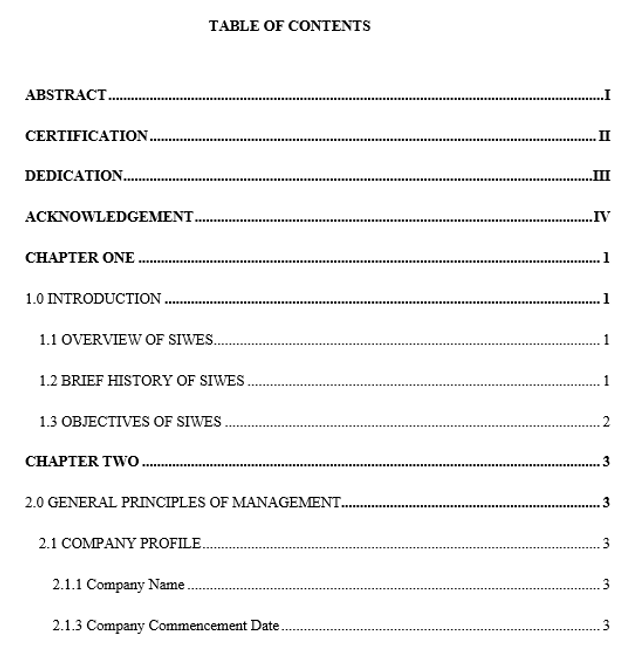
If you are a Mass Communication student preparing your SIWES report, this detailed guide will help you structure it properly, write it professionally, and score high.
This article includes:
- Complete SIWES report structure
- Real case study based on training at Nigerian Television Authority Headquarters, Abuja FCT
- Chapter by chapter breakdown
- Weekly activity sample
- Problems encountered and solutions
- Formatting guide used in Nigerian universities
- Frequently asked questions
You can adapt this whether you trained in a TV station, radio house, newspaper organization, PR agency, or digital media firm.
💡 You can also read on: SIWES Report at Radio Station (FM): Full Guide, Equipment, Work Done and Sample
What is SIWES?
The Student Industrial Work Experience Scheme is a national industrial training program created to expose Nigerian students to real work environments before graduation.
It was established in 1973 by the Industrial Training Fund to bridge the gap between classroom theory and practical industry experience.
Before SIWES, many graduates lacked hands on skills. The scheme ensures students gain real experience with tools, equipment, and professional standards in their field.
💡 You May Also Read on:
- SIWES Report Format in Nigeria: Complete Guide, Samples, Structure, and A Plus Writing Tips
- How to Write SIWES Chapter One: Full Guide, Structure, Format and A Grade Example
Standard SIWES Report Structure for Mass Communication
Most Nigerian universities use this format:
Preliminary Pages
- Title Page
- Dedication
- Acknowledgement
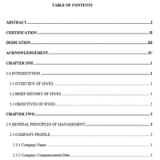
- Table of Contents
Main Chapters
- Chapter One: About SIWES and Organization Background
- Chapter Two: Department Overview
- Chapter Three: Work Experience and Challenges
- Chapter Four: Summary, Conclusion, Recommendation
- References
COMPLETE SIWES REPORT SAMPLE
(Mass Communication – NTA Headquarters Abuja Case Study)
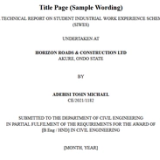
TITLE PAGE (Sample)
STUDENT INDUSTRIAL WORK EXPERIENCE SCHEME (SIWES) REPORT
Undertaken at
Nigerian Television Authority Headquarters, Abuja FCT
Submitted by:
AJAYI-OBE TAIWO JANET
21/15MCA007
Department of Mass Communication
Thomas Adewumi University, Oko
Kwara State
In partial fulfilment of the requirements for the award of
Bachelor of Science (B.Sc.) Degree in Mass Communication
2024
DEDICATION (Sample)
This work is dedicated to my family and mentors whose encouragement and support made this training successful.
ACKNOWLEDGEMENT (Sample)
I sincerely appreciate God Almighty for guidance throughout my industrial training.
My gratitude goes to my supervisor, Mr. Adediran, for his mentorship and professional guidance during my training at NTA Abuja.
I also appreciate the management and staff of the Nigerian Television Authority Headquarters for creating a conducive learning environment.
CHAPTER ONE
1.1 Introduction to SIWES
The Student Industrial Work Experience Scheme is a structured training program designed to expose students to real industrial environments related to their field of study.
It provides opportunities to operate equipment and participate in practical activities that are not always available in universities.
1.2 Brief History of SIWES
The scheme was introduced in 1973 by the Industrial Training Fund.
In 1978, due to financial challenges, supervision was temporarily transferred to the National Universities Commission and the National Board for Technical Education.
In 1984, the Industrial Training Fund resumed management of the scheme and has supervised it nationwide since then.
1.3 Aims and Objectives of SIWES
- To expose students to industrial work environments
- To bridge theory and practice
- To help students acquire professional skills
- To prepare students for employment
- To improve confidence and responsibility
1.4 History and Background of Nigerian Television Authority
The Nigerian Television Authority was established in 1977 by Decree 24 of 1977.
It became the only body authorized to regulate television broadcasting in Nigeria at the time.
Today, NTA operates over 100 stations across Nigeria and functions under the Federal Ministry of Information.
Its mission includes:
- Informing the public
- Educating citizens
- Promoting Nigerian culture
- Providing balanced news
NTA has divisions such as NTA News 24, NTA Sports 24, NTA Knowledge, NTA Hausa, NTA Igbo, NTA Yoruba, and NTA Entertainment.
CHAPTER TWO
THE NEWS DEPARTMENT
2.1 Introduction to the Department
I was posted to NTA Yoruba, also known as Ikanni Oodua. The department focuses on:
- News production
- Cultural programming
- Educational content
- Community engagement
- Entertainment
2.2 Objectives of NTA
- Provide quality broadcasting
- Deliver accurate and unbiased news
- Promote national unity
- Preserve culture
- Support public awareness
2.3 Rules of the Department
- Punctuality from 8am to 5pm
- Professional dressing
- Respect for hierarchy
- Protection of equipment
- Participation in meetings
2.4 Observations
- Reporters going on assignments
- Daily news bulletin preparation
- Ticker injection for live broadcast
- Logbook documentation
- Editorial meetings every Thursday
2.5 Materials Used
- DSLR Camera
- Microphones
- Editing software such as Adobe Premiere Pro
- Adobe Photoshop
- Audio mixer and console
- News logbook
- Monitor and computers
CHAPTER THREE
3.1 Weekly Activities
Week 1
Introduction to departments, learned 5Ws and H in reporting, ticker injection.
Week 2
Translated news to Yoruba, editing with Adobe Premiere Pro, observed live program presentation.
Week 3
Script writing and Vox Pop production.
Week 4
Camera handling and program monitoring.
Week 5
Different camera shots, microphone types, report writing.
Week 6
News log writing, exporting from Master Control Room, writing ticker.
Week 7
Entertainment program coverage and filler writing.
Week 8
News monitoring and DSLR practice.
Week 9
Learned news values such as prominence and proximity.
Week 10
Library assistance and understanding end credits.
Week 11
Video editing and chest caption design using Photoshop.
Week 12
Documentary script writing and outside broadcast exposure.
3.2 Problems Encountered
- Inadequate chairs
- Limited computers for practice
- Limited mentorship
- Transportation challenges
3.3 Solutions
- Made formal complaints
- Learned from other departments
- Observed live programs such as Good Morning Nigeria
- Learned streaming software like Vmix and Wirecast
CHAPTER FOUR
4.1 Summary
The training at NTA Abuja provided hands on experience in television broadcasting, editing, scripting, and newsroom operations.
4.2 Conclusion
The twelve week experience enhanced my professional skills, improved my confidence, and strengthened my passion for broadcasting.
4.3 Recommendation
- More access to equipment for students
- Improved mentorship structure
- Better logistical support
4.4 References
- Industrial Training Fund official publications
- Nigerian Television Authority official website
Formatting Requirements for SIWES Report in Nigeria
- Font: Times New Roman
- Font size: 12
- Line spacing: Double
- Paper size: A4
- Justified alignment
- Roman numerals for preliminary pages
- Arabic numerals for chapters
Length: 30 to 50 pages depending on department requirement.
Common Mistakes to Avoid
- Copying another student’s report
- Weak Chapter Three
- No references
- Poor formatting
- No evidence of learning
FAQs
How long should a Mass Communication SIWES report be?
Between 30 and 50 pages depending on university guidelines.
Can I include pictures?
Yes. Studio pictures, newsroom photos, and equipment images strengthen your report.
Is Chapter Three the most important?
Yes. Examiners focus heavily on your practical experience.
Can I copy this sample?
No. Use it as a guide and rewrite based on your own training experience.
Does SIWES report affect my grade?
Yes. It can contribute 30 to 40 percent of your SIWES score.
About the Author
Mohammad-Jamiu B. Balogun, GMNSE
AI Security Researcher · Founder, MonoEd Africa
Mohammad-Jamiu is a First-Class Telecommunications Engineer and Best Graduating Student (BUK), and an AI security researcher. He founded MonoEd Africa to give Nigerian students AI-powered academic tools — from SIWES logbooks to final year projects. His work has reached over 10,000 students across Nigeria.