How to Write a SIWES Report in Nigeria (2026): Free Template, Sample PDF & A-Grade Format
Learn how to write a SIWES report in Nigeria step by step. Free template, sample PDF, formatting rules, and A-grade tips for university and polytechnic students.

Writing your SIWES report is one of the most important parts of your industrial training.
In many Nigerian universities and polytechnics, the SIWES report can carry 30% to 40% of your total score, which means your final grade depends heavily on how well your report is written and structured.
A lot of students lose marks not because they lack experience, but because:
- their report is poorly structured
- formatting is incorrect
- explanations are too vague
This guide shows you the complete SIWES report format used in Nigeria, with a free template, a full sample report, and writing tips to help you produce a professional, high-scoring report.
📝 Free SIWES Report Template (Word)
Download the fill-in-the-blanks template used by 500+ students. Includes title page, all 5 chapters, and proper formatting.
Quick Answer: How to Write a SIWES Report
A standard SIWES report in Nigeria has 3 sections and 5 chapters:
- Preliminary Pages: Title page, certification, dedication, acknowledgement, abstract, table of contents
- Chapter 1: Introduction — background, aims, and objectives of SIWES
- Chapter 2: Company Profile — history, mission, organizational structure
- Chapter 3: Training Activities — tasks, tools, skills acquired (carries the most marks)
- Chapter 4: Challenges & Recommendations — problems faced and solutions
- Chapter 5: Conclusion & References — summary and APA/Harvard citations
- Appendices: Photos, screenshots, codes, certificates
Formatting: A4 paper, Times New Roman 12pt, double spacing, 30–50 pages.
1. Standard SIWES Report Format in Nigeria
Almost every tertiary institution uses a similar structure. The format is divided into:
A. Preliminary Pages
B. Main Chapters
C. References and Appendices
Here is the recommended order:
- Title Page
- Declaration (optional)
- Certification
- Dedication
- Acknowledgements
- Abstract
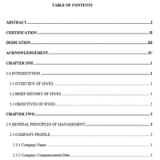
- Table of Contents
- List of Figures
- List of Tables
- List of Plates or Pictures
- List of Abbreviations
- Main Report (Chapters One to Five)
- References
- Appendices
Most Nigerian universities and polytechnics follow this exact order. If your department has a custom format, use theirs — but this structure is accepted everywhere.
2. Preliminary Pages Explained
These pages appear at the beginning of the report but are usually written last.
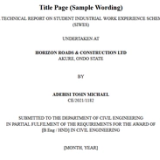
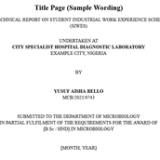
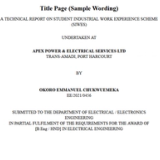
2.1 Title Page
Your title page must contain:
- Report title
- Your full name
- Matric or registration number
- Course and department
- Institution name
- Company name and location
- Duration of training
- Submission month and year
- Institution or department logo (if required)
Title Page Example
A Technical Report on Student Industrial Work Experience Scheme
Carried out at:
XYZ Technologies Limited, Lagos State
Submitted by:
Adeola Fatai Musa
Matric Number: CSC/2021/1042
Department of Computer Science
University of Lagos
Duration: July 2025 to December 2025
Submission Date: January 2026
2.2 Declaration (Optional)
A simple academic honesty statement.
Sample Declaration
I, Adeola Fatai Musa, declare that this SIWES report was written by me and is based on the activities and experiences obtained during my industrial training at XYZ Technologies Limited. All sources used have been acknowledged.
2.3 Certification Page
This confirms that you completed the training period.
It must include:
- Student name
- Matric or reg number
- Company name
- Supervisor signature
- Official company stamp
- SIWES coordinator signature
2.4 Dedication
Keep it short.
Example
This report is dedicated to God Almighty and to my parents for their support during my training.
2.5 Acknowledgements
Appreciate people who supported your training.
Include:
- Company supervisor
- SIWES coordinator
- HOD or lecturers
- Colleagues
One page is enough.
2.6 Abstract
The abstract is very important because examiners read it first. A poor abstract can reduce your score.
Write it last.
Abstract Example
This report summarizes the six month industrial training carried out at XYZ Technologies Limited, Lagos. During this period, I worked with the Web Development Unit where I gained skills in HTML, CSS, React, MySQL, and JavaScript debugging. I assisted in building responsive websites for clients and participated in database management tasks. Although there were challenges such as limited internet access and tight project deadlines, the training improved my technical skills, communication, teamwork, and problem solving abilities.
💡 You can read more on: SIWES Report Abstract: How to Write a Clear, High Scoring Abstract (With Samples)
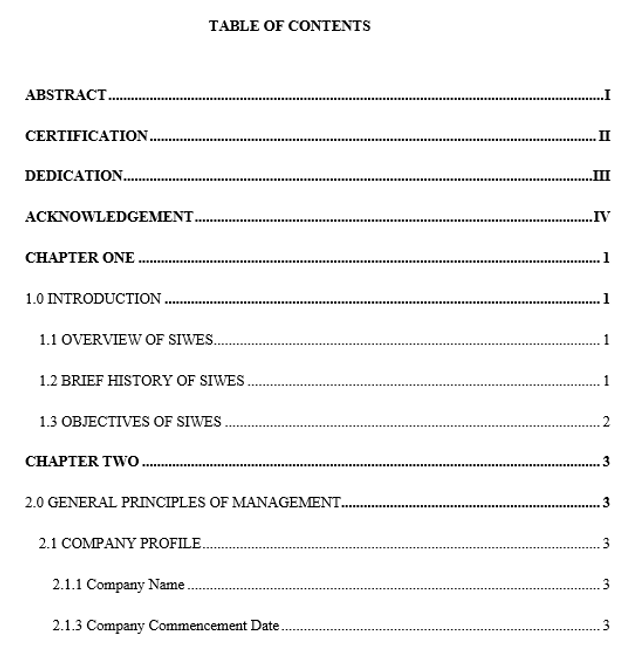
2.7 Table of Contents
Make sure the page numbers match the final layout.
2.8 List of Figures, Tables, Plates, and Abbreviations
Optional but recommended.
- Figures include charts and diagrams
- Plates include photographs
- Abbreviations help readers understand technical short forms
Example abbreviations:
HTML: HyperText Markup Language
ICT: Information and Communication Technology
3. Main SIWES Report Chapters (Standard Structure)
Most schools use a five chapter structure. Below is the most accepted format with variations for engineering, science, ICT, management, and polytechnic programs.
💡 Note: Some departments combine Chapter 4 (Challenges) and Chapter 5 (Conclusion) into a single Chapter 4 titled "Conclusion, Limitations, and Recommendations." Always confirm your department's specific format with your supervisor before writing.
Chapter One: Introduction
This chapter provides context and background.
Recommended subheadings
- 1.1 Background of SIWES
- 1.2 Brief History of SIWES
- 1.3 Aims of SIWES
- 1.4 Objectives of SIWES
- 1.5 Relevance of SIWES to Your Field of Study
- 1.6 Purpose of the Training
- 1.7 Rationale for Choosing the Organization
Sample writing (short)
The Student Industrial Work Experience Scheme was introduced to expose students to practical knowledge in real workplaces. It helps bridge the gap between classroom theories and industry applications.
💡 Read more on: How to Write SIWES Chapter One: Full Guide, Structure, Format and A Grade Example
Chapter Two: Organizational Profile
Explain the company where you trained. Include:
- 2.1 Company Background
- 2.2 Mission and Vision
- 2.3 Organizational Structure
- 2.4 Departments and Functions
- 2.5 Products or Services
- 2.6 Professional Ethics and Workplace Conduct
Organogram Tip
Use a simple chart showing:
Managing Director
⬇️
Operations Manager
⬇️
ICT Unit
⬇️
HR Unit
⬇️
Finance Department
⬇️
Technical Support Unit
Chapter Three: Training Activities and Practical Experiences
This is the most important chapter. Examiners focus heavily on this section.
Include:
- 3.1 Units or Departments Worked In
- 3.2 Daily or Weekly Tasks
- 3.3 Tools, Machines, Software or Equipment Used
- 3.4 Step by Step Explanation of Procedures
- 3.5 Projects You Contributed To
- 3.6 Skills Acquired
- 3.7 Workplace Safety Practices
- 3.8 Images of Work Activities (if allowed)
Example for ICT students
- Created website UI using HTML and CSS
- Debugged JavaScript based errors
- Assisted with MySQL database updates
- Participated in software testing
- Used Git for version control
Example for engineering students
- Operated drilling machine
- Prepared site measurements
- Assisted with wiring and panel installation
- Conducted equipment maintenance
📝 Chapter 3 is where most students lose marks. Our generator creates detailed, department-specific Chapter 3 content in minutes →
Chapter Four: Challenges, Observations and Problem Solving
Include:
- 4.1 Challenges Encountered
- 4.2 How You Solved or Managed Them
- 4.3 Organizational Challenges You Observed
- 4.4 Suggested Improvements
- 4.5 Limitations
Be honest and specific.
Example:
Poor internet, shortage of tools, outdated machines, limited supervision.
Chapter Five: Summary, Conclusion and Recommendations
- 5.1 Summary of Training
- 5.2 Conclusion
- 5.3 Recommendations to:
- Company
- School
- SIWES body
- Future students
Alternative Format: Combined Chapter 4
Some Nigerian universities and polytechnics use a four-chapter structure where Chapter 4 and 5 are merged:
CHAPTER FOUR
4.0 CONCLUSION, LIMITATIONS, RECOMMENDATION4.1 CONCLUSION
[Paste your conclusion text here — summarize what you achieved during training, key skills gained, and how the experience prepared you for your career.]
4.2 LIMITATIONS
[Paste limitations text here — discuss constraints you faced such as time, resources, access to equipment, or scope of work.]
4.3 RECOMMENDATIONS
[Paste recommendations text here — suggest improvements for the company, your school, the SIWES body, and advice for future students.]
💡 There is no strict format. Just make sure you present a clear report that is understandable and structured.
4. Formatting Requirements for SIWES Reports in Nigeria
These rules are common across most institutions.
| Requirement | Specification |
|---|---|
| Paper size | A4 |
| Font | Times New Roman |
| Font size | 12 |
| Line spacing | Double |
| Alignment | Justify |
| Margins | 1.25 inches (sides), 1 inch (top and bottom) |
| Page numbers | Roman for front pages, Arabic for chapters |
| Length | 30 to 50 pages |
Some supervisors may ask for font size 13. Follow instructions from your department.
5. Referencing and Citation Guide
Your SIWES report is not complete without a reference list. Examiners want to see that you consulted textbooks, articles, or credible websites.
There are different citation styles, but most Nigerian schools accept APA, Harvard, or IEEE. Below are examples:
APA Style (7th Edition)
In-text citation:
- One author → (Okafor, 2020)
- Two authors → (Okafor & Musa, 2021)
- Three or more authors → (Okafor et al., 2022)
Reference List Examples:
Book:
Okafor, J. A. (2020). Introduction to Database Systems. Lagos: University Press.
Journal Article:
Musa, T., & Ibrahim, L. (2021). The role of SIWES in bridging theory and practice. Journal of Nigerian Higher Education, 14(2), 45–53.
Website:
Siwes Beginner. (2021, November 10). SIWES Introduction, Aim & Objectives in Nigeria. https://siwesbeginner.com/siwes-introduction
👉 Read more on: Ultimate Guide to APA 7th and MLA 9th Referencing for Nigerian Final Year Projects
IEEE Style
In-text citation:
- Use numbers in square brackets → [1], [2], [3].
- Example: "SIWES helps to bridge theory with practice [2]."
Reference List Examples:
Book:
[1] J. A. Okafor, Introduction to Database Systems. Lagos: University Press, 2020.
Journal Article:
[2] T. Musa and L. Ibrahim, "The role of SIWES in bridging theory and practice," Journal of Nigerian Higher Education, vol. 14, no. 2, pp. 45–53, 2021.
Website:
[3] Siwes Beginner, "SIWES Introduction, Aim & Objectives in Nigeria," Nov. 10, 2021. [Online]. Available: https://siwesbeginner.com/siwes-introduction
Harvard Style
In-text citation:
- One author → (Okafor 2020)
- Two authors → (Okafor & Musa 2021)
- Three or more authors → (Okafor et al. 2022)
Reference List Examples:
Book:
Okafor, JA 2020, Introduction to Database Systems, University Press, Lagos.
Journal Article:
Musa, T & Ibrahim, L 2021, 'The role of SIWES in bridging theory and practice', Journal of Nigerian Higher Education, vol. 14, no. 2, pp. 45–53.
Website:
Siwes Beginner 2021, SIWES Introduction, Aim & Objectives in Nigeria, viewed 20 August 2023, https://siwesbeginner.com/siwes-introduction
Use one style consistently.
6. Appendix Section
Include supporting materials like:
- Pictures
- Screenshots
- Codes
- Tables
- Sample forms
- Work schedules
- Certificates
7. Common Mistakes That Reduce SIWES Scores
Avoid:
- Copying other students reports
- Weak or vague descriptions of tasks
- Missing abstract
- No references
- No photos or evidence
- Poor grammar
- Wrong formatting
- Misaligned page numbers
8. How to score high in your SIWES report
- Write a strong, clear abstract
- Be detailed in Chapter Three
- Include real images from your training
- Show skills you learned
- Keep formatting neat and consistent
- Use simple, clear English
9. Full SIWES Report Sample: Computer Science Student
Below is a realistic sample of a complete SIWES report for a Computer Science student who trained at a web development company. Use it as a reference for your own report.
Title Page
A TECHNICAL REPORT ON STUDENT INDUSTRIAL WORK EXPERIENCE SCHEME (SIWES)
CARRIED OUT AT
XYZ TECHNOLOGIES LIMITED,
12, ADEOLA HOPEWELL STREET, VICTORIA ISLAND, LAGOS STATE
SUBMITTED BY
ADEOLA FATI MUSA
MATRIC NUMBER: CSC/2021/1042
DEPARTMENT OF COMPUTER SCIENCE
FACULTY OF SCIENCE
UNIVERSITY OF LAGOS
IN PARTIAL FULFILMENT OF THE REQUIREMENTS FOR THE AWARD OF BACHELOR OF SCIENCE (B.Sc.) DEGREE IN COMPUTER SCIENCE
DURATION: JULY 2025 TO DECEMBER 2025
SUBMISSION DATE: JANUARY 2026
Certification
This is to certify that this report was written by Adeola Fatai Musa (CSC/2021/1042) and is based on the industrial training carried out at XYZ Technologies Limited, Lagos, from July 2025 to December 2025.
Mr. Chinedu Okafor
Student Supervisor
XYZ Technologies Limited
Dr. Amina Bello
SIWES Coordinator
Department of Computer Science
University of Lagos
Date: ___________________
Dedication
This report is dedicated to God Almighty and to my parents for their unwavering support during my academic journey.
Acknowledgement
I wish to express my sincere gratitude to Mr. Chinedu Okafor, my supervisor at XYZ Technologies Limited, for his patience, guidance, and mentorship throughout my training period. I also thank Dr. Amina Bello, the SIWES Coordinator at the University of Lagos, for her support. My appreciation goes to my colleagues at XYZ Technologies for creating a conducive learning environment.
Abstract
This report summarizes the six-month industrial training carried out at XYZ Technologies Limited, Lagos. During this period, I was attached to the Web Development Unit where I gained hands-on experience in frontend development, database management, and software testing. I contributed to the development of responsive websites for clients using HTML, CSS, JavaScript, and React. I also assisted in MySQL database administration and participated in quality assurance testing. Challenges encountered included intermittent internet connectivity and tight project deadlines. However, the training significantly improved my technical skills, teamwork, communication, and problem-solving abilities.
Chapter One: Introduction
1.1 Background of SIWES
The Student Industrial Work Experience Scheme (SIWES) was established in 1973 by the Industrial Training Fund (ITF) to bridge the gap between theoretical knowledge acquired in the classroom and practical skills required in the industry. The scheme is a mandatory training program for students in science, engineering, technology, and related courses in Nigerian universities and polytechnics.
1.2 Brief History of SIWES
SIWES was introduced to address the growing concern about the lack of practical experience among Nigerian graduates. The program is funded by the Federal Government and administered by the ITF in collaboration with universities, polytechnics, and industrial establishments.
1.3 Aims of SIWES
The primary aim of SIWES is to provide students with an opportunity to apply theoretical knowledge to real-world industrial processes and operations.
1.4 Objectives of SIWES
- To expose students to work methods and techniques relevant to their field of study.
- To provide an avenue for students to acquire industrial skills and experience.
- To prepare students for the work situations they are likely to encounter after graduation.
- To familiarize students with organizational structures and professional ethics.
1.5 Relevance of SIWES to Computer Science
For Computer Science students, SIWES provides practical exposure to software development, database management, network administration, and IT support. It helps students understand industry-standard tools and methodologies that are not fully covered in academic curricula.
1.6 Purpose of the Training
The purpose of this training was to gain practical experience in web development, software engineering, and database administration at XYZ Technologies Limited.
1.7 Rationale for Choosing the Organization
XYZ Technologies Limited was chosen because of its reputation in software development and its commitment to training students. The company offered exposure to modern web technologies and a structured learning environment.
Chapter Two: Organization Profile
2.1 Company Background
XYZ Technologies Limited is a software development company founded in 2010 and located in Victoria Island, Lagos. The company specializes in building custom web applications, mobile apps, and enterprise software solutions for clients across Nigeria and West Africa.
2.2 Mission and Vision
Mission: To deliver innovative technology solutions that drive business growth and improve operational efficiency.
Vision: To become the leading software development company in Africa by 2030.
2.3 Organizational Structure
The company is structured into the following departments:
- Management Team (CEO, CTO, Operations Manager)
- Web Development Unit
- Mobile Development Unit
- Quality Assurance Unit
- UI/UX Design Unit
- Human Resources and Admin
2.4 Departments and Functions
The Web Development Unit handles frontend and backend development for client projects. The QA Unit ensures software quality through manual and automated testing. The UI/UX Unit designs user interfaces and experiences.
2.5 Products and Services
XYZ Technologies offers web development, mobile app development, cloud solutions, IT consulting, and digital marketing services.
Chapter Three: Training Activities and Practical Experiences
3.1 Units Worked In
I was attached to the Web Development Unit under the supervision of Mr. Chinedu Okafor. I also collaborated with the QA Unit during testing phases.
3.2 Tasks Performed
- Assisted in designing responsive user interfaces using HTML5, CSS3, and Bootstrap.
- Debugged JavaScript errors in existing client websites.
- Assisted in writing SQL queries for MySQL database operations.
- Participated in daily stand-up meetings and sprint planning.
- Tested web applications for cross-browser compatibility.
- Documented API endpoints using Postman.
3.3 Tools, Software, and Equipment Used
- Visual Studio Code (code editor)
- Git and GitHub (version control)
- MySQL Workbench (database management)
- Postman (API testing)
- Figma (design collaboration)
- XAMPP (local server environment)
3.4 Projects Contributed To
I contributed to the frontend development of an e-commerce platform for a retail client. My tasks included building the product listing page, shopping cart interface, and checkout flow. I also assisted in integrating payment gateway APIs.
3.5 Skills Acquired
- Frontend development with React.js
- Responsive web design principles
- Database querying and normalization
- Version control with Git
- Agile/Scrum methodology
- API integration and testing
3.6 Workplace Safety Practices
I adhered to ergonomic workstation setup, regular screen breaks, and proper cable management. The company also enforced data security protocols including password policies and two-factor authentication.
Chapter Four: Challenges, Observations, and Problem Solving
4.1 Challenges Encountered
- Unstable internet connectivity delayed research and testing.
- Some legacy codebases lacked documentation, making debugging difficult.
- Tight deadlines sometimes required working beyond regular hours.
4.2 How Challenges Were Managed
I used offline documentation and local development environments to work around internet issues. For undocumented code, I used console logging and debugging tools to trace errors. I improved my time management skills to meet deadlines.
4.3 Suggested Improvements
- The company should invest in backup internet solutions.
- Legacy projects should be documented for future developers.
- Students should be assigned mentors for the first two weeks.
Chapter Five: Summary, Conclusion, and Recommendations
5.1 Summary of Training
The six-month SIWES program at XYZ Technologies Limited provided invaluable practical experience in web development, database management, and software testing. I contributed to real client projects and acquired industry-relevant skills.
5.2 Conclusion
SIWES is an essential component of Computer Science education in Nigeria. It prepares students for the realities of the tech industry and complements classroom learning effectively.
5.3 Recommendations
To the Company: Continue accepting students and provide structured onboarding.
To the School: Increase the duration of pre-SIWES orientation programs.
To Future Students: Start learning basic programming before your placement. It helps you contribute faster.
📥 Want this as a fill-in-the-blanks Word document? Download the free template →
10. SIWES Report Templates (Copy and Use)
Template: Chapter Three Tasks Description
3.1 Unit Worked In
I worked in the Web Development Unit where solutions are provided for clients.
3.2 Tasks Performed
- Frontend design
- Database queries
- Debugging tasks
- Software testing
3.3 Tools Used
HTML, CSS, JavaScript, MySQL, VS Code, Git
💡 You can also read on: SIWES Report on Web Development (Complete Sample + PDF Download)
Conclusion
Your SIWES report is proof that you applied what you learned in school to real-world situations. If you follow the correct format, write clearly, and present your work properly, you can produce a report that earns a high grade and even serves as a professional reference.
📝 Free Template
Download the fill-in-the-blanks Word template. 📥 Download →
⚡ Generate Instantly
Create your full report in 30 minutes. Try Generator →
For more SIWES guides, see our complete SIWES Guide for Nigerian Students.
Related Guides:
- How to Fill Your SIWES Logbook as a Computer Science Student
- SIWES Report Abstract: How to Write a Clear, High Scoring Abstract
- How to Write SIWES Chapter One
- SIWES Report on Web Development (Complete Sample)
- 7 SIWES Report Samples for Computer Science Students
FAQs
How do I write a SIWES report?
To write a SIWES report, follow this structure: (1) Preliminary pages including title page, certification, and abstract; (2) Chapter 1: Introduction to SIWES; (3) Chapter 2: Company profile; (4) Chapter 3: Training activities and tasks performed; (5) Chapter 4: Challenges and recommendations; (6) Chapter 5: Conclusion and references. Use A4 paper, Times New Roman 12pt font, and double spacing.
How many pages should a SIWES report be?
A standard SIWES report in Nigeria should be between 30 to 50 pages, depending on your department and the duration of your industrial training.
What is the format of a SIWES report?
The standard SIWES report format includes: preliminary pages (title page, certification, dedication, acknowledgement, abstract, table of contents), five main chapters (introduction, company profile, activities, challenges, conclusion), references, and appendices.
Can I copy someone else's SIWES report?
No. Examiners can detect recycled reports. Always personalize your SIWES report with your own company details, tasks, and experiences. Use samples as references, not copies.
How much does a SIWES report cost?
Writing a SIWES report yourself is free. However, if you need help, SIWES report generators and templates range from free to around ₦2,000. Hiring a writer can cost ₦10,000–₦20,000.
Does the SIWES report affect my final grade?
Yes. The SIWES report can contribute 30% to 40% of your total SIWES score in most Nigerian universities and polytechnics.
What referencing style should I use for SIWES report?
APA (7th Edition) is the most widely accepted referencing style for SIWES reports in Nigeria. However, some departments accept Harvard or IEEE. Always confirm with your supervisor.
About the Author
Mohammad-Jamiu B. Balogun, GMNSE
AI Security Researcher · Founder, MonoEd Africa
Mohammad-Jamiu is a First-Class Telecommunications Engineer and Best Graduating Student (BUK), and an AI security researcher. He founded MonoEd Africa to give Nigerian students AI-powered academic tools — from SIWES logbooks to final year projects. His work has reached over 10,000 students across Nigeria.