SIWES Report for Accounting Students in Nigeria: Complete Writing Guide, Structure, Format and A-Grade Sample
Learn how to write a high-scoring SIWES report for accounting students in Nigeria. Includes full structure, chapter breakdown, real examples, formatting rules, audit and banking samples, and expert tips to get an A.


If you are studying Accounting in a Nigerian university or polytechnic, your SIWES report is not just a formality. It is one of the most important academic documents you will submit before graduation.
Many students search for a “SIWES report for accounting student PDF” and simply copy what they find. That is risky. Examiners detect recycled reports easily, especially when multiple students submit similar banking or audit firm reports.
This guide teaches you how to write your own original, professional SIWES report as an accounting student, whether you trained in:
- A commercial bank
- An audit firm
- A tax consultancy
- A manufacturing company
- A government ministry
- A private accounting practice
By the end of this guide, you will know exactly what to write in each chapter.
What Is SIWES?
The Student Industrial Work Experience Scheme is a national training program created in 1973 by the Industrial Training Fund to bridge the gap between theory and practice in Nigerian tertiary institutions.
SIWES allows accounting students to gain practical exposure in real financial environments such as banks, audit firms, tax offices, and corporate finance departments.
For Accounting students, SIWES is especially important because accounting is a practical profession built on:
- Record keeping
- Financial reporting
- Auditing
- Tax compliance
- Internal control
- Professional ethics
Standard SIWES Report Structure for Accounting Students
Most Nigerian institutions use a five chapter format.
Your report should contain:
Preliminary Pages
- Title Page
- Declaration
- Certification
- Dedication
- Acknowledgement
- Abstract
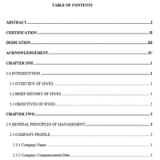
- Table of Contents
- List of Tables / Figures
Main Chapters
- Chapter One: Introduction
- Chapter Two: Organizational Profile
- Chapter Three: Training Activities and Practical Experience
- Chapter Four: Challenges and Observations
- Chapter Five: Summary, Conclusion and Recommendations
Final Sections
- References
- Appendices
How to Write Each Chapter (Accounting Student Guide)
CHAPTER ONE: Introduction
This chapter explains SIWES and its relevance to accounting.
1.1 Background of SIWES
Explain what SIWES is and why it was introduced.
Mention that it was established in 1973 by the Industrial Training Fund to expose students to industrial practice before graduation.
1.2 Objectives of SIWES
Include standard objectives such as:
- To expose students to real work environments
- To bridge the gap between classroom theory and practice
- To develop professional skills
- To prepare students for employment
1.3 Relevance of SIWES to Accounting
This is where you must be specific.
As an accounting student, SIWES helps you:
- Understand practical bookkeeping
- Learn real financial documentation
- Observe auditing procedures
- Handle tax computations
- Understand internal control systems
- Develop professional ethics
Examiners look closely at this section.
CHAPTER TWO: Organizational Profile
This chapter explains where you did your training.
If you trained at a bank like First Bank of Nigeria, describe:
- History of the organization
- Vision and mission
- Organizational structure
- Departments
- Services offered
If you trained at an audit firm registered under Institute of Chartered Accountants of Nigeria, explain:
- Nature of services
- Audit and assurance services
- Tax advisory services
- Consulting services
Include an organogram showing reporting structure.
💡 You May Also Read on:
- SIWES Report Format in Nigeria: Complete Guide, Samples, Structure, and A Plus Writing Tips
- How to Write SIWES Chapter One: Full Guide, Structure, Format and A Grade Example
CHAPTER THREE: Training Activities and Practical Experience (Most Important Chapter)
This chapter determines your grade.
Do not write vague statements like:
“I learnt many things in the bank.”
Instead, write specific accounting tasks.
Below are examples depending on where you trained.
If You Trained in a Bank
You may have:
- Assisted in account reconciliation
- Processed debit and credit transactions
- Verified customer documentation
- Handled cheque clearing processes
- Assisted with BVN updates
- Processed Remita Retrieval Reference transactions
- Observed internal control procedures
- Reviewed ledger postings
Explain each task clearly.
Example:
I assisted in daily reconciliation of customer accounts by comparing system balances with transaction records to identify discrepancies.
If You Trained in an Audit Firm
You may have:
- Prepared audit schedules
- Conducted vouching of transactions
- Tested internal controls
- Assisted in stock count
- Verified invoices and receipts
- Prepared working papers
- Computed capital allowances
- Assisted with PAYE tax computation
Example:
I participated in audit fieldwork where I performed vouching of revenue transactions by examining source documents such as invoices and receipts to confirm accuracy and authenticity.
If You Trained in a Corporate Finance Department
You may have:
- Assisted in payroll preparation
- Prepared bank reconciliation statements
- Recorded journal entries
- Prepared trial balance
- Assisted in financial statement preparation
- Reviewed expense documentation
Always connect your task to accounting theory.
CHAPTER FOUR: Challenges and Observations
Be honest but professional.
Common challenges for accounting students include:
- Limited access to confidential financial data
- Tight audit deadlines
- Complex tax regulations
- Short training duration
- Limited exposure to accounting software
Explain how you managed them.
Example:
Although access to certain financial records was restricted for confidentiality reasons, I gained knowledge by observing senior accountants and reviewing sample documentation.
CHAPTER FIVE: Summary, Conclusion and Recommendations
Summary
Briefly summarize your training period and skills acquired.
Conclusion
Explain how SIWES improved your professional readiness.
Recommendations
You can recommend:
To the organization:
- Increase accounting software training exposure
To the institution:
- Strengthen collaboration with reputable audit firms
To future students:
- Be proactive and ask questions
Formatting Requirements for Accounting SIWES Report
Follow these general rules:
- Font: Times New Roman
- Font size: 12
- Line spacing: Double
- Paper size: A4
- Alignment: Justified
- Length: 30 to 50 pages
Always confirm with your department.
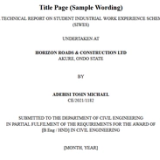
Sample Title Page for Accounting Student
A Technical Report on Student Industrial Work Experience Scheme (SIWES)
Carried out at:
First Bank of Nigeria, Lagos State
Submitted by:
Your Full Name
Matric Number
Department of Accounting
Faculty of Management Sciences
University Name
Duration: July 2025 – October 2025
Submission Date: January 2026
Common Mistakes Accounting Students Must Avoid
- Copying another student’s bank report
- Writing only general descriptions
- No references
- Weak abstract
- No accounting terminology
- Poor grammar
- Missing certification page
How to Make Your Accounting SIWES Report Stand Out
- Use real accounting terms
- Explain processes step by step
- Show understanding of internal control
- Include accounting software used
- Add relevant tables
- Reference textbooks or accounting standards
- Use professional tone
FAQs
How long should a SIWES report for accounting students be?
Most institutions require between 30 and 50 pages depending on department guidelines.
Can I use a bank SIWES report if I trained in an audit firm?
No. Your report must reflect your actual training environment.
Is referencing compulsory?
Yes. Even though it is a practical report, you should reference accounting textbooks, tax regulations, or professional standards where necessary.
What accounting software should I mention?
Mention only what you actually used such as QuickBooks, Sage, Excel, or ERP systems.
Does SIWES affect my final CGPA?
Yes. In many schools, SIWES contributes between 30 percent and 40 percent of your total industrial training score.
About the Author
Mohammad-Jamiu B. Balogun, GMNSE
AI Security Researcher · Founder, MonoEd Africa
Mohammad-Jamiu is a First-Class Telecommunications Engineer and Best Graduating Student (BUK), and an AI security researcher. He founded MonoEd Africa to give Nigerian students AI-powered academic tools — from SIWES logbooks to final year projects. His work has reached over 10,000 students across Nigeria.